Two weeks ago, following the conclusion of his unofficial Rape Gang Inquiry, Rupert Lowe launched Restore Britain as a ‘national political party’, repositioning the organisation from a non-partisan movement/think-tank into an electoral vehicle. Most readers who are familiar with right-wing online spaces will have seen an immediate rush of support for new party, with various nationalist influencers both here and in the United States encouraging their followers to get behind Lowe and hailing him as the ‘saviour’ of Britain and the only politician who will ‘deliver remigration’. Touting a poll which (ostensibly) put the new party on an astonishing 10% of the vote, Restore claimed within twenty-four hours to have reached 50,000 members. Ben Habib, leader of what was until the launch of Restore the most prominent anti-Reform right wing party (Advance UK) almost immediately declared his intention to merge with Restore under Lowe’s leadership. It seemed Lowe had some momentum.
The basic justification that Lowe’s online supporters offer for abandoning Reform at precisely the moment when they seem poised to destroy not one but both of the established political parties and usher in a government of a new party for the first time in a century is that the party as a whole, and Nigel Farage in particular, cannot be trusted to deliver on the priorities of the right, especially regarding immigration and demographics. They suggest that Farage’s personal views on immigration are too tame, citing his criticism of ‘mass deportations’ in late 2024; that he has invited the very same Conservatives that oversaw the Boriswave into his party; his expulsion of Rupert Lowe; and his embrace of ‘practising Muslims’ Zia Yusuf and Laila Cunningham within the party leadership.
As someone who has been involved in right-wing politics for more than a decade — perhaps not the longest time, but certainly longer than most who now see fit to suggest only they have the foresight to generate the winning strategy — I have seen a great number of attempts to create the ‘party without compromise’ come and go over the years. I have also borne witness to Nigel Farage and his efforts on behalf of our country under many different banners. I remain, in many ways, an admirer of Lowe personally for his willingness to push the boundaries and especially for his work on the rape gangs; the greatest tragedy this country has suffered in the last eighty years. I am not someone who believes that the Conservative Party were ‘basically fine’, or who wants to see a successor which is essentially the same but with a slightly harder line on future immigration. I understand why, at this time in our national history, many people feel so betrayed and distrustful, and why there is such unwillingness to grant benefit of the doubt. It is from this perspective that I wish to persuade you to hold fast in support of Reform, and to resist the temptation to throw away this historic opportunity.
This Substack is reader-supported. To receive new posts and support our work, consider becoming a free or paid subscriber.
What does Nigel Farage believe about immigration?
Let us first address, one by one, the criticisms levied at Reform in recent months. The first, and most general, is that Reform’s policy on immigration and deportations does not go far enough to address the challenges our country faces. I will not say that there is no truth in this — the scale of what is required is indeed remarkable. Yet nobody would suggest it is possible to go from zero to sixty in an instant; as such, the relevant question is how far we can go in what timeframe. On that note, I would invite you to compare the official stances of Reform and Restore, rather than taking the words of supporters of either party on X as policy commitments.
As Pimlico Journal noted in that week’s newsletter:
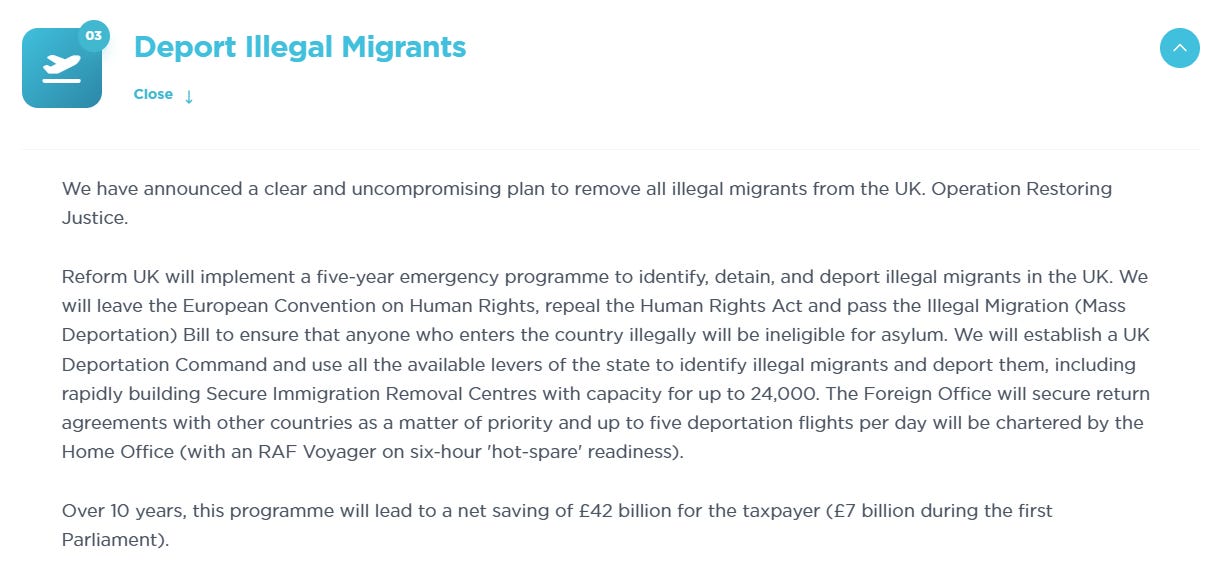
‘Restore have promised to deport every illegal migrant, abolish the existing asylum system, and thereby end the housing of illegal migrants at the taxpayer’s expense. This is precisely the same policy as Reform, down to the precise language of ‘detain and deport’ and ‘mass deportations’, as their website makes clear:
Restore will bring legal immigration ‘almost… to a complete halt’. Lowe calls ‘net-zero’ immigration too weak, and says that more people need to leave than arrive ‘for the foreseeable future’. He suggested that those who do not speak English, who claim benefits, live in social housing, or commit crime must be made to leave, and that this means ‘millions must go’. Restore published a paper in October 2025 detailing the legal changes that would need to be made to enable deportations. The paper is valuable, and does a good job of outlining roadblocks to deporting those without the right to stay in the country, but it does not make clear how those with existing visas will be dealt with, nor does it make any suggestions for dealing with foreign-born or descended citizens who fall into the categories Lowe described as worthy of deportation. A separate policy announcement in August 2025 proposed ‘overhauling’ ILR to stop the Boriswave, and committed to returning recent migrants.
After initially committing to ‘net-zero’ immigration, Reform have been consistently pushing the line towards net-negative numbers for the past year or more. Farage himself takes every opportunity to confirm this, and Zia Yusuf reiterated the point most recently on Question Time last week. The current plans that Reform have put forward would scrap ILR entirely, replacing current visas with a temporary renewable visa with higher salary thresholds and strict language and character requirements. The implication of this is that there would be no pathway to citizenship for migrants, perhaps outside of marriage.
Again, both sets of policies are substantially the same, with differences only in rhetorical emphasis.’
Whilst many members of Restore are supporters of policies more radical than this, there is little to suggest that this is true of their new leader. Speaking on the Winston Marshall Show, Lowe affirmed his commitment to a colour-blind conception of citizenship, saying:
‘I don't care about people’s religion or their colour or whatever. If they come here and they want to make a contribution, and they’re here on merit, then I like merit. Merit is the key.’
Speaking with Julia Hartley-Brewer, Lowe pushed back against Farage’s policy of abolishing Indefinite Leave to Remain (ILR), suggesting that even the most recent migrants cannot be required to leave so long as they are net fiscal contributors. Even in the Restore Britain launch video, Lowe suggested that Britain was just fine as far as immigration, and more or less anything else, were concerned, before Blair came into office in 1997 — a stance that few of the younger supporters of either Restore or Reform would accept. I have no interest in attacking Lowe’s positions for the sake of it, but the point is simply to highlight that he is a civic nationalist and a conservative who believes that immigration has been too high for a few decades now, and nothing more.
How does this compare to Farage’s own views on immigration? In 1994, having been involved in founding UKIP a year earlier, Nigel Farage requested the support of Enoch Powell and attempted to recruit the then 81-year-old as a candidate. To his disappointment, neither request was granted — although he was given the opportunity to develop a relationship with Powell having been tasked with chauffeuring the retired politician to meetings and talks hosted by the new party. Powell has always been the political figure to whom Farage has paid the most respect, tainted as his view of Margaret Thatcher — perhaps second in his list of favourite politicians — is on account of her inconsistency on the European question. On the morning of the day of Robert Jenrick’s defection, at a press conference in Scotland, Farage gave his most recent defence of Powell, stating that he was ‘right to talk about not having vast community change’.
This was not a new opinion. It cannot be said to have been introduced for cynical, tactical reasons. It is just the last in a series of such endorsements which stretches back more than three decades, and is a direct confirmation that Farage is aware of — and opposed to — not just large immigration flows or the importation of fiscally burdensome migrants, but demographic change itself. It is from Powell that Farage learnt of the dangers of demographic change. But perhaps the greater lesson that British politics’ longest standing party leader took from his hero is best described in this video, recorded over a decade ago at a small local event.
You should watch the video in full, in which Farage says the following:
‘The problem with the [Rivers of Blood] speech was this: that you need to be in politics — if you’re there not just for a career, but you’re there to change things, to move things on — you need to be ahead of public opinion to try to be a magnet, and to bring public opinion and bits of the media and change with you.
I’ve done that throughout the last twenty years. I’ve tried to keep putting the flag further and further out in the ground. But there’s a problem if you go too far ahead, and you go to a place that people aren’t simply ready to even conceive. And it led to the destruction of the career of without doubt the most talented post-war politician in Britain.
But it did something else. It also allowed that liberal media elite to make immigration a banned subject. And from 1968, until me in 2003-4, nobody with a sensible voice or view in British politics dared to touch the subject. So the irony was, that Powell was right in many ways, not in every way but right in many ways, the irony was he stopped it being a debate.’
As someone who was, in many ways, a veteran of Gamergate (and it is a sad sign of my advancing age that many readers will now be unfamiliar with that refrain), I will always have enduring respect for Sargon of Akkad, who was a formative influence for many at that time. Nevertheless, it is worth mentioning that his own political journey has occurred only very recently. As late as 2020, Sargon remained committed to a liberal, civic nationalist political vision. That in itself is no criticism. But the zeal of a convert is a cliché for a reason. It is easy to think, when you have just woken up to newly discovered truths, that they have just now become obvious, and that everyone else will surely realise them imminently as you have.
Having fought the same fight for more than thirty years, Nigel Farage is subject to no such delusions. He is, as is shown by his sheer longevity, a cautious, and shrewd political operator. If you lose not only the media, but the public by going too far too fast, then what’s the point? You can’t do anything without power, and obtaining power has always been his aim. He is the Good Cop. He’s Mr Nice Guy. The bloke who’s been fighting for you, the ordinary citizen, driven by love of country, unlike the ‘crazies’ and ‘extremists’, as represented (so he argues) by the succession of minor parties to his right. This is a political strategy built on a recognition that the British public do not want to vote for a party they perceive as extremist.
As a result, Farage has a long history of pushing the boundaries whilst also defining them to his right as he goes, enabling him to move the debate forwards without being tarred with that label, and thereby bringing the electorate along with him. He is indeed perfectly happy to suggest that ‘deporting millions of people’ is unworkable and undesirable when he feels the public would react poorly to that suggestion, yet at the same time he refuses to throw his team under the bus when they seek to push the line further. In a recent interview with Nick Robinson, Farage refused to countersignal Matt Goodwin, Reform’s candidate in the Gorton and Denton by-election, for suggesting that being born here does not necessarily make one British. Nor did he push back against defector Suella Braverman for suggesting that she is not English on account of her ethno-religious background. This, too, is part of his longstanding and intentional strategy, allowing others to serve as outriders whilst he maintains the confidence of a broader section of the electorate as a sensible and acceptably moderate leader.
This simple fact — that the public do not necessarily believe what you believe, and that it is therefore necessary to approach communication strategically, rather than naively declaring your views with a full chest — seems lost on many of Farage’s critics. Setting aside the specifics of the accusations levelled by Reform against Lowe, I believe this is the fundamental reason that Farage ousted him from the party to begin with. Farage said last Tuesday that:
‘When [Lowe] stood up and said that we have to consider the mass deportation of entire communities, including those born in the United Kingdom, that just moves way beyond a point of reasonableness… that was the moment I realised we had to get rid of him.’
This comment has to be understood in the context of the video above — not just as a naïve statement of Farage’s views on the subject itself, but as political strategy and the absolute necessity to be able to reign in surrogates when they misunderstand the extent of their latitude. In speaking as he did, Lowe was falling into the Rivers of Blood trap. If he couldn’t be trusted toe the party line (or at least stay as close to it as required) and to work as a team, instead of throwing out red meat for the chuds (myself included at the time), then he had to go. And it seems that’s what happened. Lowe has since said he tried for months to work internally to get the party to go harder, but was blocked from doing so. At which point, rather than deferring to Farage’s historically vindicated judgement, he started declaring that Farage was not the right leader for 2029, and that he would like to lead Reform some day — none of which could ever be accepted by a political party, especially one with so few elected representatives (giving each an outsized public platform).
For those of us on the right, Farage’s commitment to maintaining mainstream appeal can be uncomfortable. Wary of past betrayals, his statements can easily make us worry. Indeed, I myself felt that at the end of 2024 and the beginning of 2025 Farage was tacking unnecessarily close to the centre with his comments on immigration. The most often cited evidence of this is his interview with Steven Edgington in late 2024, where he said that:
‘Mass deportations, at the moment — it’s a political impossibility. I'm not going to get dragged down the route of mass deportations or anything like that. If I say I support mass deportations, that's all anybody will talk about for the next 20 years. So it's pointless even going there’
But during that period, he overtook the Conservatives and Labour to become the first third party on course for a general election victory in 100 years. There comes a point when one simply has to concede his strategic capability. And now, as the political landscape has shifted, Reform is officially committed to mass deportations and net negative immigration. Is this not a vindication of their strategic approach?
In the final analysis, this question comes down to trust, and to interpretations of statements from two men who often contradict themselves on this issue. What we should all be able to agree on is that Rupert Lowe should not be given more benefit of the doubt than Nigel Farage over any comments which we might take issue with. In fact, given that Farage has explicitly told us for decades that his approach is strategic, whereas Lowe’s primary selling point is simply saying what he believes without caveat, the reverse is more reasonable. One can never know another man’s soul — but the evidence does not vindicate accusations that Nigel Farage is a secret ‘race communist’, nor even that he is less radical than his newest competitor.
Is Reform too close to the Conservative establishment?
The second criticism levied at Reform is that they are not only ideologically close to the Conservative party, but have been literally filling their ranks with ‘failed Tories’ who are tainted by their complicity in the Boriswave in particular. There are two issues to deal with here. The first is a strategic question: should former Tories be allowed to defect, and does that give Reform an electoral advantage? The second is a political question: do the individuals who have been given a leadership position risk the success of Reform in government?
Crucial in answering the first question is stepping outside of our own preferences and understanding the actual concerns that the marginal Reform voter has with the party that will decide their vote in the coming years. Unsurprisingly, these voters are not primarily concerned that Reform is not radical enough on immigration. As Dominic Cummings and many others have pointed out, the primary concern of these voters is that Reform is a one-man-band, and that Farage is untested in government. We must keep in mind that these marginal Reform voters are not right-wing radicals. They are, by and large, people who have voted Conservative at every election in the twenty-first century, including 2024. It is to them that these defections must appeal, not to us. This explains the strategic appeal of individuals such as Danny Kruger and Robert Jenrick, who confer a sensibility and legitimacy that Farage has historically lacked with these voters.
The other group of voters Farage is seeking to attract are those who voted Labour until 2019, when they lent their support to Boris Johnson. It is not quite correct to describe these voters as ‘low information’ — many of them are bombarded with Facebook slop every hour of the day — but they are certainly ‘poor information’ voters, and as such, as crazy as it might sound to us, there is still some lingering affection for Boris Johnson among this crowd. This explains the strategic appeal of individuals such as Nadine Dorries (and please be assured, I was among the first to recognise how truly awful both Dorries and her flagship Online Safety Act were all the way back in 2021). None of this is to say that these decisions are beyond criticism: Farage is not infallible. Nevertheless, his record of success makes a degree of deferral entirely reasonable, and, as yet, they seem to have been successful in maintaining his momentum and his leadership in the polls.
To answer the second question, we must look at each figure individually. The two that I will go out and defend full-throatedly are the appointments of Braverman and Jenrick. Both of them are among the very few Conservative party politicians who, while in office, attempted to tackle mass migration, and found themselves time and time again thwarted by the Civil Service, and more importantly by the Prime Minister. Jenrick was initially a staunch ally of Rishi Sunak. He campaigned vigorously for him in the 2022 leadership election against Liz Truss, and along with Oliver Dowden, they endorsed Johnson in an article for the Telegraph in 2019, the first of the newer generation of MPs then considered on the right of the party to do so. Despite the closeness of their relationship, Jenrick decided that he couldn’t stand by while his friend and political ally was not doing what he promised to the British people, and publicly resigned saying so.
What is the alternative to recognising that the commitment of people like Jenrick is genuine, as is their change of mind to the extent that they were historically wrong? As I described earlier, many — especially around Restore — on the right have themselves followed a very similar trajectory over precisely the same timeframe. I have seen many people who only a few years ago would have drawn back from the positions they now espouse suggest that any history of poor ideological tendencies cannot be forgiven. I respect their passion for a cause we share — but that does not justify standards which, consistently applied, exclude most of those who try to enforce them.
Braverman did the same, finding herself bound as Home Secretary by Sunak’s refusal to leave the ECHR. As previously mentioned, she wrote in the Telegraph last year that she herself was not English, and that ‘…for Englishness to mean something substantial, it must be rooted in ancestry, heritage, and, yes, ethnicity.’ Is this not good enough, simply because she isn’t white? Straightforward and overt bigotry on this issue is neither justifiable nor politically helpful. The same defence can be given of Zia Yusuf, who many seem to attack regardless of the extent of his political soundness. As has been noted in Pimlico Journal before, it is reasonable to ask for stronger demonstrations of commitment from people who might have personal reasons to oppose your political project, but it is not reasonable to ignore the possibility that people can have different individual incentives or even straightforward convictions which allow them to align with your efforts. For decades, the most prominent and effective advocate of radical socialism in Britain was Tony Benn, a man who inherited a peerage. Would it have been beneficial for the left to reject his support out of refusal to recognise his commitment?
Again, Nigel Farage is not infallible, and not all defections are good defections. I cannot offer any good justification for the embrace of Nadhim Zahawi — although it is notable that he did not receive any position on Reform’s front bench, despite rumours to the contrary. But the principle that defections are acceptable, and in some cases necessary, is what matters. That principle is recognised not just by Farage, but also by Rupert Lowe himself. If Reform’s crime is that they are too close to the Conservatives, Lowe is perhaps even more guilty.
Recent sailors on the good ship Lowe may not remember that the origins of the bad blood between him and Farage go back to his standing down as a Brexit Party candidate in 2019, when he was allowed to contest Dudley North (one of the party’s strongest seats). He did so in order to endorse the Conservative candidate, saying the following:
‘I am putting country before party as it is now highly conceivable that my candidacy could split the vote… I believe that if the Labour Party were to be elected… [they] will devastate Britain and destroy all that decent people have achieved through their hard work and enterprise.’
This choice may have been entirely reasonable at the time, but it certainly shows that Lowe is not the committed anti-Tory that many of his supporters make him out to be. It is also very strange that Lowe was able to see this logic in 2019, but does not seem to see it in 2026 — when the stakes are far higher, and the reward much greater. Why did Lowe feel that Johnson’s Conservatives were worth endorsing, yet Farage’s Reform has to be resisted?
Of course, Lowe himself does not, in fact, claim to be a stalwart partisan against the Tories. He has worked closely with Conservatives in Parliament, and has been granted a seat on the Public Accounts Committee as a result — an honour no Reform MPs have been granted. He has consistently praised Kemi Badenoch, as well as seeking Robert Jenrick’s participation in his Rape Gang Inquiry. In fact, it is only once Jenrick defected to Reform that Lowe became more critical. Even in Restore’s launch video, Lowe confirmed that he had invited ‘patriots’ in parties including the Conservatives to join. He now suggests he refers only to members of the new intake, who are not tainted by participation in the last government — but this seems to contradict his praise for Badenoch, who was in government from 2019 and served in the cabinets of both Liz Truss and Rishi Sunak.
Most of Restore’s small group of councillors are also former Conservatives, including their first representative, Maria Bowtell (who defected to Reform before leaving due to her inability to handle running a local association without an already developed party infrastructure), and the group on Kent County Council who had been previously ousted from Reform over leaks last year. Braverman’s policy paper, co-written with Guy Dampier from the Prosperity Institute, on leaving the ECHR is quoted repeatedly in Restore’s Mass Deportations paper. Gavin Williamson and Susan Hall were both on the board of Restore before it launched as a party. Last but not least, whilst still a Reform MP, Lowe publicly repudiated the party’s policy against a pact with the Tories — which, for those who have short memories, was one of the reasons that he was kicked out of the party.
To be clear, I am not criticising Lowe for any of this. As much as the Tory party has cost this country dearly, practical alliances must be made to advance our cause. But yet again, when Lowe works with such people he is praised by his supporters for being shrewd and ‘statesman-like’, whilst Farage is accused of becoming the establishment for doing the same thing. There is nothing wrong with building coalitions and bringing in supporters who used to wear a different ribbon on their chest. For my sins, I myself was a Conservative member for many years whilst there was no viable national alternative vehicle for right-wing politics. The problem, as before, is the utter hypocrisy of these critiques as levelled at Reform.
How will Restore impact British politics?
So far, this article has focused on demonstrating the viability of Nigel Farage as a leader and Reform as a vehicle from a political perspective. If we accept that, then we must consider the impact of Restore’s existence on the next general election, and more broadly on the future of British politics.
A poll conducted late last year gave a hypothetical ‘Rupert Lowe Party’ 10% of the vote, but it is not at all clear that this is a reliable indicator of his actual support. The poll did not use standard methodology (inevitable when you’re including a hypothetical party) and had a sample size approximately half as big as the standard in British polling. Moreover, a recent survey by JLL Partners for GB News had Rupert Lowe only recognised by 8% of the public, down from 14% at the height of the controversy surrounding his exit from Reform last year. Another recent poll post the Restore launch had ‘other parties’ together at 5%, which would include supporters from every other minor party wrapped into them, bar those in Parliament currently.
Figures released on ‘party membership’ are also unclear. Taking Lowe’s announcements at face value, it appears there have been approximately 40,000-50,000 new members since launch, and it might be reasonable to conclude that these people support Restore as an electoral party. Their headline figures, however, include many who had previously signed up as ‘supporters’, who may well also be members of other parties. Additionally, Restore membership is open to foreigners as well as Brits, and Lowe’s strong following in the United States and the rest of the Anglosphere suggests he may have many members there too. It’s therefore hard to gauge currently what Restore’s electoral impact might be.
In terms of support for their agenda, Restore boast that ‘mass deportations’ has ‘overwhelming public support’:
‘Over half of voters (52.7%) say they would be more likely to back their MP if they supported mass deportations, compared to just 17.8% who would be less likely. Over half (54.8%) of non-voters in the 2024 general election would be more likely to vote for their MP if they backed the mass deportation of all illegal migrants. 41.8% of 2024 Liberal Democrat voters would also be more likely to back their MP if they supported mass deportations.’
The top line on this is accurate. But diving deeper into the statistics, the numbers are far less kind to the Restore — and even the Reform — agenda. First things first, of those who support mass deportations, 55% of them think that far more migrants are staying here illegally than legally, an inaccurate assumption, and the ire of the public is focused on illegal migrants:
‘Those who want to see mass deportations almost universally want to see removals of those who come to the UK to claim benefits (91%), small boat migrants (90%), and those coming without work visas to work in unskilled jobs (85%). However, these numbers fall dramatically when it comes to other groups. A much-reduced 39% of deportation supporters say they want to see large-scale removals of asylum seekers who came to the UK via the correct legal process; 26% want to see workers with work visas coming to work in industries with skills shortages removed en masse; and at its lowest level 19-20% want to see migrants coming on work visas to work as doctors or nurses to be asked to leave.’
Additionally, only 30% of deportation supporters want ‘elderly care workers’ to leave. As all informed readers will know, the disastrous ‘health and social care visa’ was one of the most exploited by the Boriswave arrivals. What we should take away from these results is not that people do or do not support mass deportations — it is that their understanding of the picture of historic and current immigration is largely distorted, and that their thinking on the issue is not particularly coherent. They do not have clear answers to these questions, much as they do not have clear answers on most political questions. Instead, they have vague desires to see undefined sensibilities reflected: yes, they want a lot of people removed; no, they can’t define precisely who that is; no, they are not comfortable with the prospect of indiscriminate deportations. This political landscape lends itself less towards a specific policy than towards a specific style of speaking on the issue, which reassures voters whilst being clear that their concerns will be addressed. Naively stating that millions of people who have citizenship, some of whom were born here, must be deported is not going to be the winning strategy even to achieve that very goal.
More importantly, the phrase ‘a week is a long time in politics’ does not apply to the process of building a machine capable of victory at a general election. Reform as an entity started up seven years ago in 2019 under its former Brexit Party moniker, and even they wouldn’t be ready if an election happened tomorrow. The amount of organisation it takes to not just stand in an election, but win it, is absolutely immense, and Reform and (especially) the mainstream parties are a million miles ahead. When you’re looking to build that team, who are you going to get behind you? There’s not going to be any MPs, or anybody with experience in public office, at the top of Restore. The team right now is well suited to running an online political offensive, but how are they going to fare when dealing with the civil service? How are they going to take down the House of Lords? Who’s going to be running the budget?
Lowe has advocated for getting ‘experts’ to back the party, but the response to this so far has just been to repeatedly call for Jeremy Clarkson (a well-known Remainer and friend of David Cameron) to stand. Anyone suggesting this is playing fantasy football. The lack of credible leaders so far is something that even supporters of Restore, such as Maven Politic (for whom I have much respect), have noted:
‘None of the management of Restore, aside from Lowe himself, fit the bill [of experts]. Take Maria Bowtell, who recently has become their first councillor. A quick look shows her private sector experience consists of minor admin and consultancy work. Yes, that makes her marginally better than a parasitic civil servant, but it falls vastly short of what Lowe promised. The rest of the team seems to consist of Zoomers who have no private sector experience or academic expertise at all, leaping straight from university into political campaigning, journalism, or policy work. The ideology and character of these men aside, this is more or less identical to what happens in the Tories or Lib Dems. If you want a party built on competence and merit, your team must reflect those virtues.’
The election ground game is also crucial when it comes to getting out the vote, and for that, you need to know who your supporters are. How do you get that data? The only way you can get anything more than party members or registered supporters is by going around and knocking on the doors in your constituency, or calling them up. It’s hard work, and it’s not pretty, but if you don’t do it, there goes your victory. It takes years of work from tens of thousands of people across the country. There are now only three years until the next election. It is simply not possible in that time to develop a party infrastructure which can direct such local efforts, and then recruit tens of thousands of campaigners, and then perform years of canvassing.
None of this matters, apparently, to some who have come out in support of Restore. There are far too many who care only about signalling their ‘based’ credentials online, rather than implementing change in the real world. This commitment to being the ‘beautiful loser’ is represented best by this tweet which flew around the Lotus Eater sphere after Restore’s launch:
This is an attitude which plagues the British Right. The perfect is the enemy of the good. Politics is not a game in which the loser receives a consolation prize and a pat on the back. The stakes now are too high. Either we take power, by whatever means, or we’re done for. A future where there is no right-wing government in 2029 looks incredibly bleak. I do not want to risk backing the weaker horse, especially when its policy is practically identical to that of Reform, just because some of its leaders say the words I want to hear more vehemently and care less about the political impact of doing so. I don’t think it’s a coincidence that this happened at the precise moment when the path became clear on both sides for Reform to win a victory at the next election. The desire to snatch defeat from the jaws of victory is palpable.
At the end of the day, our calculation is simple. If there is not a right-wing Prime Minister in 2029, the correct choice will be to head straight to SkyScanner and pick your destination. If there is a right-wing Prime Minister in 2029, it will be Nigel Farage. If I have not managed to persuade you that that is a desirable outcome, I hope you will recognise the cold, hard maths of electoral feasibility on the one hand and the ticking clock of replacement migration on the other. Even if Reform go no further than ‘net zero’ immigration, the additional time is necessary to allow new options to emerge.
But there is another reason to stick with Reform, which grows more important every day. In 2026, the party is a vehicle for Nigel Farage. But in 2036, Farage will almost certainly have retired and the party will be something different. What shapes a party, in the long run, are the networks of people involved in it. Many of the young men involved in Restore I consider friends. I do believe that while they are misguided in their strategy here, they are right about many of the problems in this country. Young supporters of both parties agree on this. I don’t doubt that they are doing what they think is right for Britain. We just disagree about the way to go about it. And I think that’s the greatest shame about this whole debacle. Infighting, instead of promoting a united front, is what gives the enemy an advantage.
What I fear is that with a radical face on it, bright young men who would become the future of Reform are going to throw their lot behind the wrong horse, thus abandoning the chance to influence what is set to be the next party of government. If Reform solidly wipes out what remains of the Tories in 2029, everyone who wants a ‘job in politics’ will flock to them. This was always the issue with the Conservative Party. As Rupert Matthews, Reform’s PCC for Leicestershire and a former Tory member told me earlier this year, around one third were wet Lib Dem types, one third decent people, but the most damaging third were those who really didn’t care about this country, and were more concerned with grifting and social climbing. I know many of the young people staffing Reform — fortunately, they have, thus far, resisted the advances of this class of people. But if those who should be taking these roles go elsewhere, where will Reform be forced to turn?
All our hard work will be undone if the future of Reform past its first parliament slips away from the messaging it has gained its vast support from, and genuinely does become the Tories 2.0. Do you want Reform to be staffed with East India Club Enjoyers and people who started reading the Financial Times at nineteen? Connor Tomlinson recently leaked messages from Matt Goodwin in which he encouraged Tomlinson to hold his tongue where necessary because he is a ‘smart young man’ who could be a future MP. That possibility has now expired. Whilst association with Lowe was already an albatross, there will now be a complete blacklist on anyone involved in a party explicitly opposing Reform, established after Reform topped the polls — and inevitably so. That is just how party politics works.
Restore, I think, would have had the most influence in the years to come, positioning themselves as the primary think-tank of the right, working with Reform and others to develop policy and push the discourse forwards. The ‘online right’ has not seen its power and influence increase over the last few years because of its posts, but because of who was able to wield them, and where. The social housing discourse, kicked off by the articles of Juice8882 in this very journal, was picked up and parroted on GB News, discussed by MPs, and made its way down the ‘posting-to-policy’ pipeline, precisely because the ‘Westminster bubble’ took notice. The people who are supposedly in the job of containment were perfectly happy to promote ideas and people to the forefront that would have been anathema only a few years ago. Just last week, David Shipley wrote in The Spectator that ‘…we must close our borders to Afghans, and that those who are here must be deported.’ The Spectator, edited by Michael Gove. Does this look like containment to you?
As a political party, it is not even clear that Restore will be able to drag other parties rightward (as Farage has historically done to the Tories). This strategy works when the problem is that people in the party have genuine beliefs which are to the left of the country, and need to be subjected to electoral pressure to meet voters where they are. But when a party already to the right of the marginal voter is subjected to competition on their right, the electorally advantageous response is often to tack to the centre, as Farage was forced to do in response to the BNP in the 2000s. Whilst Farage is having to distance himself against the right, he is unable to push the public conversation in the right direction — and the arguments of the left grow stronger.
If Restore has such little chance of winning the next election, and some chance of handing it to our enemies; if its political influence on Reform is at best a coin flip, and its impact on the future development of the party which is overwhelmingly likely to be the new party of the right is sure to be negative, then I struggle then to understand what the case for supporting it could be. The hour is late — now is no time for indulgence.
This article ended up being far longer than originally intended, but I felt it was necessary to give those who share our mission the respect of a comprehensive explanation of our disagreements on the method. For all the reasons above, I implore any person of merit who is thinking about jumping off the Farage train to keep your seatbelt on for the time being. I would like to think I have persuaded some of you that Reform deserves your support, or at least that the country requires it. I hope that in short enough time, the right wing will unite once again around the one man who gives us a chance to arrest Britain’s decline before it is too late.
Until then, I encourage everyone else to remember that we all want to save our country, and that disagreements on strategy are legitimate and inevitable. We’ll have to come back together at some point, and blood feuds are hard to undo. Let’s get back to work.
This article was written by Jack Hadfield, respected newsman and friend of Pimlico Journal. Have a pitch? Send it to submissions@pimlicojournal.co.uk.
Nope. Farage is clear he will neither deal with Islam, or deport the thousands of girl hungry savages we keep taking in. Unless that happens, we are done for. Get real. Islam is colonising Europe. Ms. Ayaan Ali Hirsi is quite clear on that, and she should know.
Quran/Sharia bound Islam, stuck in the 11th century is completely incompatible with secular Europe.
“We don’t want to alienate Islam”. Idiot, the Quran is clear that it is already alienated from Christianity and Judaism.
Restore Britain is just the “Your Party” of the Right, that’s obvious, but Farage could have worked harder to bring Lowe back into the fold. They clearly both have absolutely titanic personal egos.




Nope. Farage is clear he will neither deal with Islam, or deport the thousands of girl hungry savages we keep taking in. Unless that happens, we are done for. Get real. Islam is colonising Europe. Ms. Ayaan Ali Hirsi is quite clear on that, and she should know.
Quran/Sharia bound Islam, stuck in the 11th century is completely incompatible with secular Europe.
“We don’t want to alienate Islam”. Idiot, the Quran is clear that it is already alienated from Christianity and Judaism.
Restore Britain is just the “Your Party” of the Right, that’s obvious, but Farage could have worked harder to bring Lowe back into the fold. They clearly both have absolutely titanic personal egos.