
Good Morning,
Last week, we chose not to publish our usual newsletter, as events were dominated by the single story of Peter Mandelson, which ultimately led to the exit of Morgan McSweeney from Number 10. We felt this deserved treatment in a full article looking at the nature of McSweeney’s project and what his fall means for the Starmer government and for ‘Blue Labour’. You can find that article here:

This week, Keir Starmer survived the worst week of his premiership so far. This came after last week, in which Keir Starmer survived the worst week of his premiership so far. How much longer will the Labour party allow this streak to continue?
Plus, as rumours of shadow cabinet announcements continue, are Reform moving quickly enough to build the machine they will need to govern? What should we make of Rupert Lowe launching Restore Britain as a political party?
This newsletter’s agenda: Keir Starmer survives his worst week yet (free); Rupert Lowe launches Restore Britain (free); Reform to announce shadow cabinet, but HQ buildout remains slow (paid)
Keir Starmer survives his worst week yet
This week, the Labour Party finally admitted to itself that, whilst Keir Starmer might be the most unsuccessful Prime Minister in post-war British history (with the exception of the Fifty Days Queen), there is not a single person on their benches who could do a better job. On Sunday, a week of increasingly extreme pressure on Keir Starmer over the Peter Mandelson affair culminated in the resignation of Morgan McSweeney, with rumours abounding that Starmer himself might resign the following day. Monday began with a statement by Scottish Labour leader Anas Sarwar, calling on the Prime Minister to resign — and all eyes fell upon the cabinet to deliver the final blow to a Prime Minister whose authority had evaporated and whose continued occupation of the office had surely become untenable.
And then… nothing. At least, that is, until Deputy PM David Lammy came out issuing a statement in support of the Prime Minister. Over the following hour, as the day drew to a close, similar statements came from every member of the cabinet until, finally, Wes Streeting — suspected by No. 10 to have coordinated with Sarwar on his statement — finally lined up behind Starmer as well. The Prime Minister’s survival in the face of such massive pressure is essentially unprecedented, particularly given the intervention from Sarwar, which has still not been addressed by the government a week later.
Interviewed on Tuesday, Ed Milliband described the events of Monday as follows:
‘Yesterday was a moment of peril for the Prime Minister… but, as a collective body, the cabinet [and] the Labour Party looked at the alternative of going down this road of a chaotic leadership election and trying to depose a Prime Minister, and they said “no, that’s not for us”.
‘[MPs] looked over the precipice … and they didn't like what they saw.’
A remarkable admission from one of the main alternatives to Starmer as party leader — but not an incorrect one. Milliband might be popular within the Labour Party, but according to YouGov his support in the country (17% approval) is worse than Starmer’s (18% approval). Angela Rayner’s (26%) is higher, but her ongoing tax investigation makes it hard to imagine that she would deliver the government from scandal if became PM. If Wes Streeting could make it through the membership, he might have slightly broader appeal on day one — but what would really change other than slightly slicker communication?
For now, at least, the party has decided to stick with the devil it knows — and as crazy as it is, it is hard to argue confidently that that is the wrong decision. They will certainly lose hundreds of seats under Keir Starmer if he survives until the next election, but the chance that changing leader will make things worse, not better, is at least even. The hope among many MPs, particularly on the soft left, is that Starmer — freed of the malicious influence of Morgan McSweeney — might now embrace his ‘true self’ and move leftwards. It is not clear, however, how that might manifest. A change of heart in No. 10 does not add headroom to the budget, and the government has already reaffirmed its commitment to continuing with Shabana Mahmood’s immigration reforms.
This leaves Keir Starmer in a strangely strengthened, yet still fragile, position. If there is truly no alternative, Labour MPs have no choice but to get behind him — but with his authority shot, he no longer has the ability to force them into uncomfortable compromises. What we are likely to see, then, is a period in which backbenchers dominate on policy, with Keir Starmer in office but not meaningfully in power. This zombie government could well limp on until May, with the Gorton and Denton by-election already largely written off by the party — although the release of the Mandelson files still poses the greatest immediate threat to Starmer’s position. It is possible — although perhaps still less than likely — that the logic keeping Starmer in position holds even beyond then, especially if backbenchers start seeing policy commitments that assuage anger. Someone will need to take responsibility for the failures at that election — but with Ed Milliband seemingly more eager to wear a Starmer skin suit than to take the crown for himself, one can imagine that the soft left might use that opportunity to have him replace Reeves as Chancellor, rather than Starmer as Prime Minister.
As Starmer looks to build his new team following McSweeney’s departure, one somewhat unexpected casualty has already emerged: Chris Wormald, the Cabinet Secretary. The position is the most senior in the civil service, and has become an increasingly political appointment in recent years. Wormald himself is rumoured to have secured the position under Starmer by confirming his personal support for the Labour Party, but was always understood as an uninspiring and conservative choice. From 2016-24, he served as permanent secretary in the Department for Health and Social Care, where his handling of COVID was broadly seen to have been poor.
Antonia Romeo, the leading candidate to replace him, is on the other hand thought to be a more interesting choice who is more likely to deliver wider reforms — but she is not without controversy. Friends in the civil service report widespread dislike for her within the organisation, with a sense that Romeo is better at promoting herself than delivering in practice. She certainly seems to be effective at generating support from politicians, given her evident success with Starmer as well as her previously understood closeness with Liz Truss (at least whilst both were at the Department of International Trade). On the other hand, given that the most common allegations that follow her are of vague ‘bullying’, a common civil service term for attempts to get them to actually do their jobs, yet that politicians seem to like her, one wonders if she might actually be quite effective after all.
The other concern with Romeo surrounds her time as Consul General in New York, where she was investigated for financial improprieties. This led to an unprecedented public intervention by former permanent secretary of the Foreign Office Simon McDonald, who essentially suggested that Romeo was unfit for the role on Channel 4 News and that his attempt to advise the Prime Minister on the matter had been rebuffed. For a former perm sec to launch such outright criticism of a sitting one (Romeo is currently perm sec at the Home Office) is more than unusual.
Regardless, no amount of change in the team around Keir Starmer will address the fundamental problem that he himself is not capable of being an effective Prime Minister. Given this strange deadlock, it seems the Labour government will limp on, scandal by scandal, until Reform cruise to victory in 2029. It’s at least a good thing, then, that there is nothing on the horizon that could threaten their position in the polls…
Rupert Lowe launches Restore Britain
On Friday, Rupert Lowe announced the launch of Restore Britain as ‘a national political party’. Restore was originally established as a non-electoral vehicle for Lowe, positioned as something between a think-tank and a campaigning organisation. It will now seek to stand candidates across the country at the next general election. Such a move has been largely inevitable since Lowe was kicked out of Reform at the beginning of last year — his sense of his own position has always been inflated by the adulation of his online fanbase, and (to be fair to him) his commitment to the policies he advances means he was always unlikely to be satisfied with the lack of influence that comes with being a simple independent MP.
It is not clear what kind of impact Lowe could have on the electoral picture. His supporters have pointed to a poll conducted in November by FindOutNow (a pollster which typically produces the most optimistic results for Reform) which suggested the following voting intentions:
Reform: 25%
Green: 18%
Labour: 16%
Conservative: 13%
Liberal Democrats: 13%
“A party led by Rupert Lowe”: 10%
At the time, FindOutNow had Reform far ahead of any other party in standard polling at 31%. Whilst the two polls used different methodology, and therefore should not be understood as directly comparable, there is at least some suggestion here that Restore could have an impact on Reform’s polling position — although, interestingly, their support seems to be drawn equally from Reform and the Conservatives.
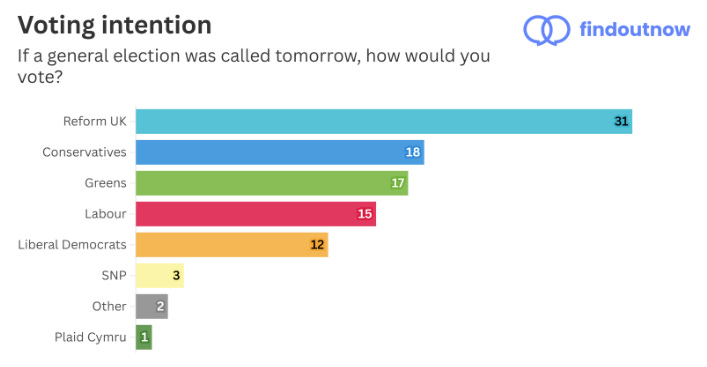
That said, we should take this poll with a tremendous grain of salt — not least because the sample size of 1000 is about half of the standard (making the poll substantially less reliable). At the height of the controversy surrounding Lowe’s exit from Reform, a survey by JLL Partners for GB News suggested that only 14% of voters (and only 29% of Reform voters) could identify Rupert Lowe when prompted with a picture of him. Lowe’s public profile is certainly not higher now than it was then, and it would be quite remarkable indeed if more than two thirds of those who can identify the man are willing to vote for a party led by him over any alternative.
A reasonable expectation, then, would be that Lowe would start out from a far lower position than his supporters expect — but even then, it might not necessarily be a big problem for Reform. Much as Tommy Robinson has long served as a useful foil for Farage, offering the public a bogeyman from which Farage can distance himself, the presence of a more radically-presenting party could well make Reform seem like the sensible choice by comparison. To be clear, this question of positioning is entirely separate from policy: Reform is and must continue to be radical in its intentions. But, as those around Lowe would do well to recognize, the aim of politics is not to say the right things in public — it is to win power, and use that power to do the right things in government. Being able to represent yourself as moderate without having to step back from policy commitments is therefore useful.
Nevertheless, when the next election is likely to be an extremely tight balance between five competitive parties (plus the separatists), it is certainly a risk to introduce the prospect of further vote splitting on the right. It’s therefore worth looking at Restore and comparing them to Reform as their supporters have done extensively, to see whether their critiques have merit.
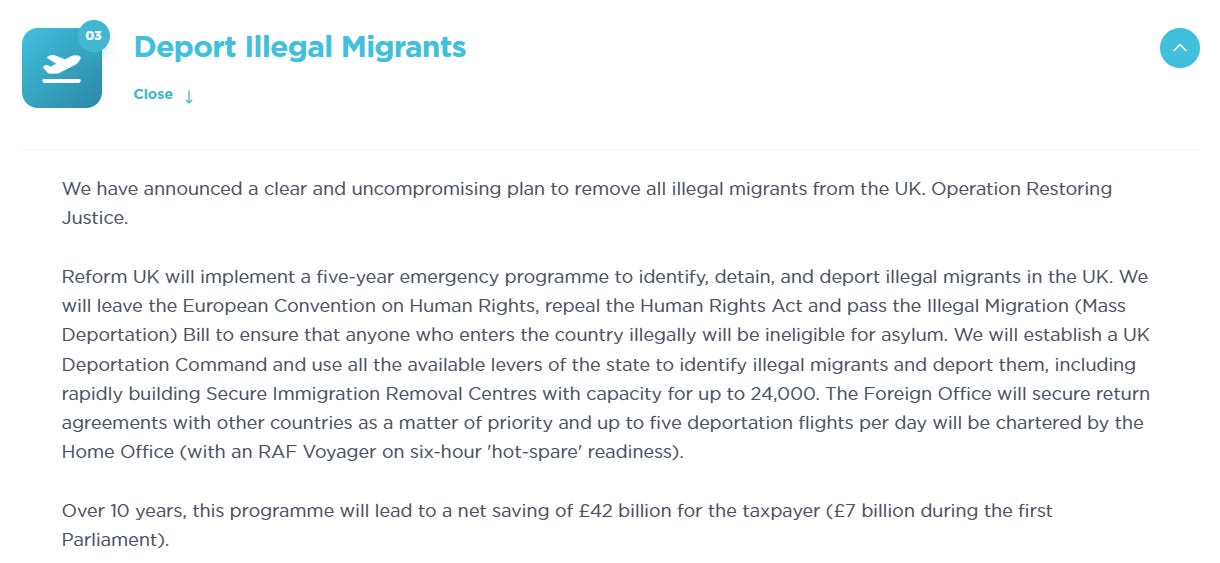
Restore have promised to deport every illegal migrant, abolish the existing asylum system, and thereby end the housing of illegal migrants at the taxpayer’s expense. This is precisely the same policy as Reform, down to the precise language of ‘detain and deport’ and ‘mass deportations’, as their website makes clear:


Restore will bring legal immigration ‘almost… to a complete halt’. Lowe calls ‘net-zero’ immigration too weak, and says that more people need to leave than arrive ‘for the foreseeable future’. He suggested that those who do not speak English, who claim benefits, live in social housing, or commit crime must be made to leave, and that this means ‘millions must go’. Restore published a paper in October 2025 detailing the legal changes that would need to be made to enable deportations. The paper is valuable, and does a good job of outlining roadblocks to deporting those without the right to stay in the country, but it does not make clear how those with existing visas will be dealt with, nor does it make any suggestions for dealing with foreign-born or descended citizens who fall into the categories Lowe described as worthy of deportation. A separate policy announcement in August 2025 proposed ‘overhauling’ ILR to stop the Boriswave, and committed to returning recent migrants.
After initially committing to ‘net-zero’ immigration, Reform have been consistently pushing the line towards net-negative numbers for the past year or more. Farage himself takes every opportunity to confirm this, and Zia Yusuf reiterated the point most recently on Question Time last week. The current plans that Reform have put forward would scrap ILR entirely, replacing current visas with a temporary renewable visa with higher salary thresholds and strict language and character requirements. The implication of this is that there would be no pathway to citizenship for migrants, perhaps outside of marriage.
Again, both sets of policies are substantially the same, with differences only in rhetorical emphasis. It is worth repeating that you should not place any value in therapeutic repetition of your favourite phrases by politicians — you should want them to say what is necessary to secure the support of a large enough fraction of the population to win a majority in Parliament and implement your agenda. If anything, the current Reform policy is stricter on ILR (although one expects that Restore would likely pursue the same ends). Both parties have implicitly suggested that non-citizens who are not economically self-sufficient would find themselves without permission to remain, and therefore would end up being sent home. Neither have put forward any suggestions which would deal with those who do not claim benefits (although under the plans of both those whose earning fall below as-yet unconfirmed thresholds would likely be denied visa renewal), let alone addressing the thornier issue of how to deal with undesirable immigrants and their descendants who already have citizenship.
It would be wrong not to address perhaps the most common source of criticism against Reform and Farage in particular on immigration, which is his comments towards the end of 2024 on mass deportations:
‘For us, at the moment, it's a political impossibility. I'm not going to get dragged down the route of mass deportations or anything like that. If I say I support mass deportations, that's all anybody will talk about for the next 20 years. So it's pointless even going there.’
This came during a period in which the party as a whole softened its stance on immigration, with a number of other worrying comments made. Indeed, Pimlico Journal was critical of Reform on this issue at the time. However, the myopic focus on a few comments made over a few months seems strange in the face of the fact that Reform now list publicly as one of their top priorities the passage of the ‘Illegal Migration (Mass Deportations) Bill’. They have adopted not just the policy but the exact language requested of them.
This gets down, ultimately, to an issue of trust. If you don’t believe that Nigel Farage wants to address the issue of mass migration, I’m not sure there’s much that can be done to persuade you otherwise. This is a man whose first political hero was Enoch Powell — who he knew personally towards the end of his life, and whose support he always desired. It is a man who, as a boy, delighted in the double entendre of his initials, and as a young man left a lucrative career to dedicate decades to the political cause we now inherit. If you interpret his refusal to deliver catharsis at the expense of votes as a sign or untrustworthiness, there is perhaps nothing he can do to convince you either.
This brings us to the last issue worth covering, which is a set of general questions about personnel. In particular, many have attacked Reform for taking on former Conservatives, and have suggested that this legitimates suspicion of their motivations. Again, we have also criticised Reform for some of these announcements — Nadhim Zahawi, Nadine Dorries, and Jake Berry have no business being involved in any political movement of the right — whilst defending others. This criticism, however, rings entirely hollow given that, in the very video in which he announced Restore’s launch as a party, Lowe stated explicitly that he had invited ‘patriots’ from the Conservatives to join him. He is, of course, vanishingly unlikely to be taken up on that invitation, but there is clearly no difference of principle here.
The other side of this coin is the suggestion that Reform has too many ethnic minorities in positions of influence — with a particular focus on Zia Yusuf (unsurprisingly, given his history with Lowe). We have covered this issue before, but it’s worth reiterating some key points here as well. Firstly, anyone who actually bothers to listen to what people say will know that Yusuf is among the most politically sound voices within Reform, constantly pushing beyond the rest of the party (especially on immigration). More generally, whilst it is reasonable to expect higher standards of commitment from those who might have personal reasons to oppose the political project of reversing demographic change, it is not reasonable to dismiss the possibility that individuals can have those commitments regardless of their personal heritage.
As we have stated before, Suella Braverman (who has consistently maintained that she, as an Indian, cannot be English) is far to the right of Tommy Robinson (who supports increased migration of Sikhs and Hindus to counter ‘Islamic influence’) on issues of immigration, race, and culture. What, therefore, are we to make of Reform’s embrace of the former and rejection of the latter? Lowe, for his part, has never made any statement suggesting he would reject party members or candidates from a non-British background, and has historically been close with fellow Reform reject Ben Habib — he has, however, confirmed his intent to exclude Tommy Robinson from any association with Restore (according to those inside the organisation).
Given all of this, there are only three things that Restore offers which Reform does not: an opportunity to reject responsibility for cultivating broad support in favour of the catharsis of hearing your views reflected by a politician, a leadership position for Rupert Lowe, and jobs for those associated with him. In fact, with Lowe’s private wealth and the support of Elon Musk, it seems there will be jobs aplenty. Despite this, it is ultimately unlikely that Restore breaks the pattern of minor right-wing parties historically to secure more than a percentage point in the polls. In the past 80 years, no right wing party not led by Nigel Farage has ever won even 2% at a general election. Perhaps that fact is worth keeping front of mind in the months to come.
