

Recently, there has been a lot of interest in the Fabian Society on Britain’s Online Right. Sparked by the discovery that Lord Justice David Bean — the man responsible for the decision to overturn the closure of Epping’s migrant hotel last August — had formerly served as the Society’s chair, the For You Page Right has since engaged in something of a witch hunt, revealing ‘secret’ foes from Sunder Katwala to Sadiq Khan as vessels of this most sinister of socialist plots. The Lotus Eaters in particular (for American readers, think of a cross between Matt Walsh and Darryl Cooper, then clone this person ten times over) appear to have set themselves at the vanguard of this inquisition and, as such, will form the main foil of this piece. Rupert Lowe, who is currently locked in their basement, has also taken the opportunity in one of the few public appearances he has been permitted after the launch of his new party, Restore, to attack the Fabians — outwardly, a rather strange use of his time, but it gives us some sense of just how seriously these people are now taking this threat.
Such furore raises a number of questions: Why do these people perceive the Fabian Society as uniquely frightening? Why do they consider membership to be an aggravating factor, even for well-established political enemies? Countless reasons have been given, but can be roughly distilled into the following:
They are ‘communists’, bearers of a tradition which runs from Jacobinism through to Bolshevism, but compelled by Britain’s particular circumstances to adopt an incrementalist approach.
It is an ‘elite’ organisation, counting Prime Ministers among its movers and shakers (Keir Starmer and Tony Blair, for example), and is lodged within effectively every institution of import, whether that be the City of London Corporation or the United Nations. Subsequently, it exerts significant influence over events and bears a large degree of responsibility for phenomena such as replacement migration.
They are... secret Muslims? George Bernard Shaw, a leading early Fabian, had high praise for the religion of Islam, with a character in one of his plays even remarking, ‘I believe the whole British Empire will adopt a reformed Mohammedanism before the end of the century.’ Therefore, it is argued, the Fabian Society was engaged in a conspiracy to Islamise Britain, and a sharp, straight line can be drawn from Shaw’s remarks to post-1945 Muslim immigration and, of course, Khan. See here noted intellectuals Lewis Brackpool and Jay Dyer discussing this evil plot.
Finally, towering above all else in significance: they have a scary logo. Yes, you see, the Fabian Society’s logo is (or rather, used to be) ‘literally a wolf in sheep’s clothing’, which ‘tells you all you need to know’. I would estimate that this piece of trivia alone accounts for approximately 90% of online commentary on the Fabians
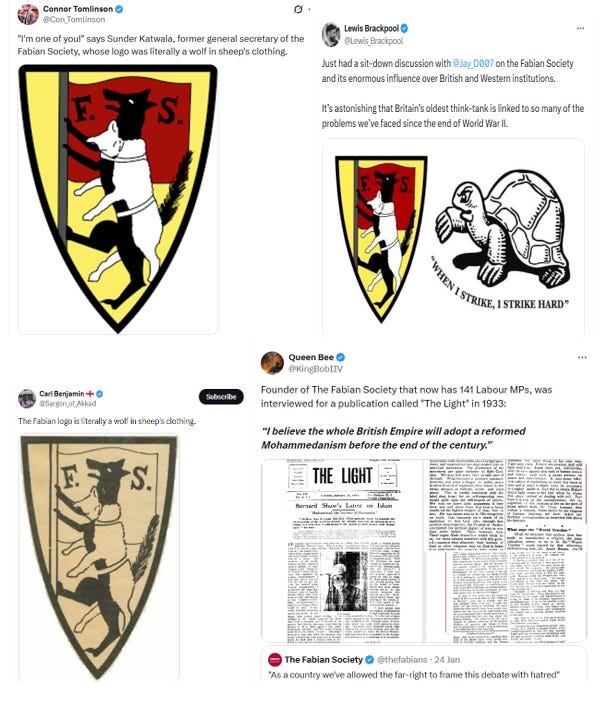
Exhibits A to D.
This article will attempt to correct these discourses. It seeks to represent the real — and, in some respects, even admirable — character of the early Fabianism to which Lotus Eater Thought continually refers. In doing so, I also hope to demonstrate the poverty of the ‘Fabian Society conspiracy’ as a mode of understanding the events of the twentieth century and beyond.
The Fabian Society has its origins in a small meeting group named the ‘Fellowship of New Life’. Established in 1883, the group was Ruskinite in character, composed of intellectuals dissatisfied with the inequality and industrial misery of Victorian life. Divisions, however, would immediately emerge as the anarchists and Arts-and-Crafts-style communitarians pushed to ground the Society in the pursuit of spiritual ends: the eradication of selfishness and the introduction of the ‘New Life’. For such romantic idealism had passed its high-water mark in Britain, and most members were instead defined by their restless desire to act: to take on industrial society and reconstruct it, rather than retreat into ‘Wholesome Chungus’ cultural activity.
An offshoot of this initial group, the Fabian Society was founded the following year on the rout of the spiritually-inclined, establishing as its purpose the preparation and discussion of research papers with actionable policy prescriptions. I will spare the reader the minutiae of these early days — from this basis, the Society was in the ascendant, owing largely to the industry of its core leadership, the economists Sidney and Beatrice Webb and the playwright George Bernard Shaw. This group, ‘the old gang’, was solidly middle-class in background and would dominate the Society for the next three to four decades.
It is here that we begin to chafe against the hysterics of the Lotus Eaters by simply asking the question: What did ‘Socialism’ mean to the early Fabians? To answer this question we are forced to generalise, but Fabian Socialism can nonetheless be distinguished by its desire to solve problems through the application of state power guided by ‘scientific’ expertise. Although the term would come later, ‘technocracy’ serves as a useful descriptor of this vision. The ends that this mode of government would serve were the welfare of the whole community, often understood through utilitarian conceptions of wellbeing (indeed, the Webbs considered themselves the heirs to Bentham), though modified by a rejection of individualist tendencies and a recognition of the inherent value of serving the community. Perhaps this explanation raises more questions than it provides answers, so we will turn to an exploration of how early Fabianism set itself apart from competing socialist movements.
In the Fabian Society’s formative period, from its founding in 1884 to the outbreak of the First World War in 1914, Fabianism was largely unconcerned with suffrage. While supportive of efforts to extend the franchise, with most believing that voting played an important role in securing the feeling of consent, stirring up the masses did not feature in the Fabian strategy. For even in Britain, progressives had grown disdainful of notions of ‘popular control’. The Fabians no less so: the Society had proven highly receptive to the arguments advanced in works such as Moisey Ostrogorsky’s Democracy and the Organisation of Political Parties (1902), which claimed to show, ‘empirically’, the despotic nature of party machines — or, in other words, the Iron Law of Oligarchy (1911) of proto-fascist Robert Michels.
Consequently, the Society sought to appeal directly to the extant political elite: in the Cowlingite turn of phrase, the ‘fifty or sixty politicians’ upon whose behaviour British politics was thought to turn. The Fabians were convinced that if the elite, reared behind the high garden walls of the public schools and the ancient universities, could attain a true understanding of industrial conditions — as presented (for instance) in Beatrice Webb’s Minority Report (1909) on the Poor Law — they would be compelled by the irresistible logic of Socialism, and would therefore heed the expert advice of Fabian advisors. One is reminded of Cummings’ shock at not being handed the reins of power simply for having ‘good ideas’. Not all were so cynically complacent, however: Shaw believed that suffrage in the hands of the ‘riff-raff’ was leading Britain to ‘national suicide’; democracy, in his view, would have to wait for the fruits of a comprehensive eugenics programme.
The masses would be rescued from the malaise of modernity primarily through scientifically-minded social reform: unemployment insurance, sanitary improvements, wider access to education and healthcare, and a ‘national minimum’ of health below which no citizen would be allowed to fall. Nonetheless, the Fabians expressed some desire to address more existential concerns. Yet this was motivated not so much by idealism as by necessity: the recognition of the need for some kind of ‘myth’ that would facilitate social cohesion. This most often took the form of a positive engagement with Christianity, and, in particular, the Church of England (already a corporatised aspect of the state, with a great deal of control over schooling), which was hailed for maintaining a system of ethics that encouraged a healthy, efficient lifestyle and, therefore, national prosperity. Many Fabians were even willing to subsidise the Churches, despite their metaphysical disagreements.
Shockingly, we find that no Lotus Eater has picked up on this line of argument. Perhaps it will be a cause of relief for them: the Fabian Society represents a longstanding conspiracy to re-Christianise Britain? It is through this pragmatist lens that Shaw’s praise for Islam should be understood. Islam was praised explicitly for its ‘utility’ in solving problems. Whether one agrees with the argument or not, Shaw’s point was that, far from representing a means of eradicating European peoples, the religion of Islam, with its supposedly less ‘life-denying’ approach to natural instincts like violence, might serve to revitalise a Europe that had grown soft and decadent. This appraisal had nothing to do with the mass importation of Muslim bodies. The notion that Shaw — the most fiercely pro-eugenicist of any Fabian — would have supported the immigration of Pakistani peasants today is ridiculous, and anyone who peddles this take should also be treated as such.

But what of the Fabian approach to race and nationality more broadly? Surely here we will encounter a bastion of ‘Woke’ racial politics? The dull, half-answer to this point is that racial questions simply weren’t that important to the early Fabians. Most members were wholly concerned with social reform, and it took the Society fifteen years to come out with their first statement on colonial policy. Nonetheless, it remains true that they were race-blind globalists who looked forward to the advent of a one-world socialist state. One could cite countless statements from either Shaw or H.G. Wells (who was something of a sensation within the Society from 1903 to 1908) concerning the falseness of race and the primitivism of the nation-state. However, on closer examination, we quickly see that these desires were animated by a rather different spirit from those that drive left-wing racial politics today.
The Fabian position was what we might describe as ‘racial millenarianism’ — science, technology, and political action would annihilate the differences between peoples with the same rapidity as they had reduced travel and communication times between countries. Utopia was just round the corner. This was an unrefined universalism, and therefore fiercely assimilationist, envisaging a future with one language, culture, and politics — although also inherently British in character, given that the Fabians regarded Britain as the world’s most politically advanced state. Foreign peoples would not so much be ‘included’ as dissolved, with their cultures and traditions (for which Fabians often reserved a great deal of scorn, prompting all manner of Soyjaking from modern biographers) falling by the wayside. I encourage the reader to read this piece from J’accuse, which provides an excellent outline of this brand of thinking as it manifested in later decades. Unlike the ‘High Egalitarianism’ of the post-1945 period, however, Fabian universalism grew out of a Britain that was receptive to eugenic ideas and remained a first-rate imperial power, and therefore did not need to compromise to the same degree, if at all. One can subsequently identify the tightly managed character of this universalism and its prioritisation of utopian outcomes — a far cry from the racial grievance politics of our day, with its spiteful demands for ‘justice’ no matter the cost.
The writings of Wells are illustrative of what I am trying to portray. While many readers will no doubt recall GCSE English’s attempt to argue that Wells was an anti-imperialist visionary (‘The War of the Worlds talks about Tasmanians!’) — and it is true that he often argued that there were no ‘fundamental incompatibilities’ between peoples — Wells’ dreams of interracial harmony were far more complex. When reflecting in Anticipations of the Reaction of Mechanical and Scientific Progress upon Human Life and Thought (1901) on what it would mean for the ‘New Republic’ of the future to treat people not as races, but individuals, Wells concluded the following, which is worth quoting at length:
[The New Republic] will aim to establish, and it will at last, though probably only after a second century has passed, establish a world-state with a common language and a common rule... It will, I have said, make the multiplication of those who fall behind a certain standard of social efficiency unpleasant and difficult, and it will have cast aside by coddling laws to save adult men from themselves. It will tolerate no dark corners where the people of the abyss may fester, no vast diffused slums of peasant proprietors, no stagnant plague-preservers. Whatever men may come into its efficient citizenship, it will let come — white, black, red, or brown; the efficiency will be the test.
Wells conceded that his race-blind universalism might nonetheless produce a racialised future, while acknowledging that the present state of knowledge did not allow for any firm assumptions. He predicted that a majority of Europeans and East Asians would be able to serve as full citizens, whereas only a minority among the ‘coloured’ races would make it through.
Returning to the Society more broadly, Wells’ views serve as a useful means of introducing another core element in Fabian thought: duty. Under a Fabian framework, it is not only the individual who has rights (to healthcare, to education, etc.) but also the community as a whole. As such, individuals qualify for their rights via the performance of citizenship duties. Wells’ ‘efficiency’ proviso (typically understood as an individual’s health and economic productivity) is one example of such an obligation and was arrived at similarly by the Webbs. Interestingly, it would be on this issue that the young Winston Churchill broke off his friendship with Beatrice Webb, remarking on her welfare proposals: ‘I do not like mixing up moralities and mathematics.’
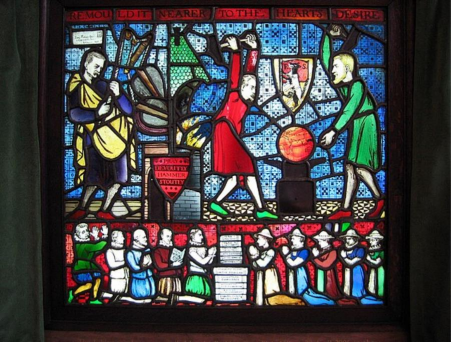
It is easy to see how these views allowed for a positive engagement with empire, as exemplified by the Society’s stance on the Second Boer War. While Britain’s Left was largely united in denouncing the war as an expression of unchecked capitalism and militarism, the Fabian Society came out in support of both British actions and a victory with annexations, losing fewer than two dozen of its roughly 800 members in the process (Ramsay MacDonald and Emmeline Pankhurst among them). A tract entitled Fabianism and the Empire (1900), intended to be an authoritative statement of the Society’s views, clarified the reasoning as follows: Imperialism was inevitable in an age of great power competition. As such, it is desirable that Britain, the civilisation most likely to adopt Fabianism’s brand of global socialism, should control vital resources and see off rival powers (the Boers, meanwhile, were seen as deserving of nothing but scorn for clinging on to archaic political ideals). Nonetheless, the Society’s active support for imperialist actions was conditional upon, in this instance, the nationalisation of the Rand Gold Mines and the investment of their profits in social reform — for the ‘nation’s blood’ had been spent and thus the nation must benefit.
Where does this leave us with regard to the humble Eater of Lotuses? By now, it should be obvious enough that, regardless of the many objections to Fabian ideology that could be raised, the early Fabians have effectively nothing in common with the Left today concerning the nature of the body politic, not least when it comes to questions of nationality and race. Yes, they were ‘globalists’ who dreamed of a multiracial future, but this ideal was modified by commitments to universalism and citizenship that were designed to ensure that this future would be defined by political and material progress. It is subsequently impossible to imagine them looking upon Britain’s present-day approach to these matters with approval. Far more difficult still would be to imagine what the Fabian spirit might prescribe as remedy — but one can assume with some confidence that it would be far more daring than anything your rank-and-file ‘Reactionary Catholic Zoomer’ is likely to suggest.
I hope that this account has served to refute points one and three from the introductory section: namely, the idea that Fabianism can be understood merely as a variant of communism, or that it seeks to replace the British or European peoples with Muslims. Nonetheless, I suppose that point two, the charge of elitism remains somewhat unaddressed, and one can certainly imagine why the lofty, Apollonian ideals treated thus far might frighten a troupe of comic book collectors (reader, I am far more interested in appealing directly to you). And so it is to the feasibility of Fabianism as an elite conspiracy that we now turn.
It was owing to these characteristics — in particular, support for imperialism and the desire to work directly with the elite — that the Fabians found themselves at the centre of Britain’s ‘National Efficiency’ movement in the years immediately following the Boer War. This movement was somewhat eclectic, comprising not only Fabians but also Liberal-Imperialists such as the Earl of Rosebery and even Unionists open to social reform. It was defined by a rejection of laissez-faire liberalism, a desire to revitalise the empire, and an effort to improve the living conditions of Britain’s industrial citizens (in part motivated by a fear that slum life was biologically deleterious). These were thought of as mutually reinforcing objectives that would help Britain better face down a rising Germany. It was during this period that the Fabian Society’s prospects were at their height, with ‘the old gang’ having established close personal relations and authentic ideological affinity with some of the most prominent figures in both major parties. The Webbs even set up a dining club, the Coefficients, wherein the leading advocates of ‘efficiency’ began to try to act as a corporate entity.
However, this happy state of affairs was not to last. Like the snake into Eden, Joseph Chamberlain’s landmark speech of May 1903 in favour of tariff reform — a theme which would dominate British politics for years to come — would soon split the National Efficiency movement irreconcilably. In the feuding between Rosebery and Chamberlain that followed, the Webbs, Shaw, and several other leading Fabians would eventually throw in their lot with Chamberlain, feeling pushed to jump by Rosebery’s ever-increasing unwillingness to talk down laissez-faire.
This decision would prove to be disastrous, catastrophically undermining Fabian political influence. For one, Chamberlain and his acolytes tended to regard tariff reform as something of a panacea: the solution to unemployment, low wages, funding for social reform, the German menace, and more. As such, there was little willingness to engage with the more sophisticated policy work of the Fabians. More significant, however, was the landslide Liberal victory in the 1906 election, which produced an administration that would eventually succeed in pushing through landmark social reform, most notably in the form of health and unemployment insurance. Like a spiteful ex-lover, the Liberals delighted in having cut the ground from under treacherous Fabian feet. If these reforms did not go far enough, the political moment had nonetheless been lost, leaving the Fabians largely reduced to unsuccessful petitioning (notably to Churchill) during the next ten or so years of Liberal dominance.
There would be some small reversals in fortune in the following years: Sidney Webb would have a substantial role in drafting the Labour Party’s 1918 constitution (most notably Clause IV), and Beatrice Webb would serve on the merry-go-round of DOGE-style committees, similarly inept, spun up by Lloyd George during the First World War. But from this point onwards, it was clear that the Fabians would never receive the blank cheque to reconstruct society from first principles that they had once dreamed of. Disillusioned, they turned their attention abroad: the Webbs travelled to the Soviet Union, hailing it as an ideal playground for technocrats; Shaw went to Italy, endorsing Mussolini as ‘the right kind of tyrant’ who could get things done. The Fabian Society itself was effectively moribund for most of the 1930s.
The Fabian Society would make a surprising comeback with the outbreak of the Second World War. G.D.H. Cole, a socialist academic, revived the Society in 1938 by merging it with his own New Fabian Research Bureau (a separate organisation) and gave it a new constitution in 1939, building close connections with Labour Ministers, first during wartime and then after Attlee’s landslide in 1945.
However, as the Society adapted to the realities of democratic politics, it became clear that this was same institution only by name and not by nature. The early Fabians benefitted from a situation in which the policymaking apparatus outside of Whitehall was still extremely primitive; even by the 1950s, however, both the Labour Party itself and the Trades Union Congress had powerful research departments of their own. It was increasingly just one research institution among many.
Perhaps even more importantly, it is obvious that we no longer really live in the elite-dominated society — something that was already slipping away in the Webbs’ own day — that made early Fabianism conceivable in the first place. Even the 1950s were a very different to the world in which Shaw and the Webbs operated, but the 1960s and 1970s would force a more fundamental reassessment. For better or worse, society and culture were democratised; technocratic post-war economic ‘planning’ and ‘fine-tuning’ was discredited; and the challenge of rank-and-file trade unionist radicalism, whether it was seen as an opportunity or threat, was not something which early Fabianism could provide answers to. This is not to say that ‘the old gang’ were without legacy; certainly, they introduced a technocratic strain into the Labour Party that would echo, for instance, in Blairite policies like PFIs or Bank of England independence. Earlier, the term ‘Fabianism’ itself found use as a shorthand for a certain brand of technocratic productivism within the Labour Party, particularly prominent in the 1960s, which was thought to ultimately derive from the early Fabians. But the Fabian Society we have spent the first half of this essay describing was effectively dead.

This latter-day Fabian Society, while still influential as (effectively) a proto-think-tank crossed with a general venue for left-wing political debate and discussion, was not in any way akin to the incrementalist, elite-directed utopianism of the early Fabians that seems to so terrify the Lotus Eaters and friends. Yet in terms of the fame and direct political influence of its leadership, the Fabians had a genuinely remarkable run in the first three decades after the end of the Second World War. The Society’s Chairs in this period included future Prime Minister Harold Wilson, future Chancellor of the Exchequer Roy Jenkins, senior Cabinet Minister and major ‘revisionist’ Labour Party intellectual Anthony Crosland, senior Cabinet Minister and converted radical-left firebrand Tony Benn, future Cabinet Minister and ‘gang of four’ member Bill Rodgers, heterodox left-wing nationalist and opponent of European integration Peter Shore, and Harold Wilson’s main economic advisor (also a left-wing nationalist and opponent of European integration) Thomas Balogh. This is before even considering the many influential Labour MPs who were active members or served on the executive committee but never served as Chair. Are the Lotus Eaters vindicated?
The truth is that other than the fact that these men were all important in their own right, not much unites them beyond their shared involvement in the Labour Party. For a brief time in the early 1950s, the Fabian Society was effectively a pressure group for the Right of the Labour Party, but from at least the late 1950s onwards, it is difficult to detect any coherent and consistent strain of thought from the Society and its publications, even if it is true that the ‘revisionists’ still held the upper hand. Some of the aforementioned Chairs were clearly on the Right of the Labour Party: Jenkins and Crosland. Others were clearly on the Left: Benn and Balogh. Even on the Left, there were divisions: Benn was a close friend of the trade unions, while Balogh was far less enthusiastic. Some were cosmopolitans — perhaps even ‘globalists’. Others were left-wing nationalists and staunch anti-Europeans. Almost all were probably social liberals, broadly speaking, but the importance placed on this fact varied greatly from person to person. The 1939 Fabian constitution even forbade expressions of a collective Fabian viewpoint, meaning it was effectively incapable of acting as an organised faction. The Society’s publications frequently (and openly) prescribed contradictory policy platforms.
Given this very obvious ideological (and tactical) disunity, it is rather hard to read any kind of grand conspiracy of a secret elite into the latter-day Society’s activities. It had now become an appendage of the Labour Party within which the various factions of the Party competed for influence, just as they did within the Constituency Associations and the like. Logically, the lack of a consistent agenda — a clear difference from ‘the old gang’ — meant that the Society typically reflected rather than created shifts in Labour Party policy. Like clockwork, the Society was rocked by factional disputes in the 1970s and 1980s, just as the Labour Party itself was; and, like clockwork, it went along with the Labour Party’s neoliberal turn in the 1990s, publishing the original paper that recommended the removal of Clause IV.
Since the middle of the 1970s, the Fabian Society has quite clearly fallen into serious decline, even as a think-tank. The Society seems to have been damaged by the defection of their incumbent Chair, ‘gang of four’ member Shirley Williams, to the SDP in 1981, though the Society was reportedly struggling for much of the previous decade as well. Of course, many Labour MPs were still members of the Fabian Society: the Fabians even boast on their website that after the 1997 landslide, ‘over 200’ Fabians sat in the Commons. But this did not mean that the Fabian Society was especially influential in the Blair years. With the creation of new think-tanks and the increasing use of Spads, there was now more competition for policy influence within the Labour Party than ever before. And, even aside from the increased competition, it is telling that virtually none of the Chairs from around the early 1980s to the present day — with only a few exceptions (Robin Cook, Ed Balls, Sadiq Khan) — were close to being as important as the men listed above. For the most part, we have a collection of backbench MPs, minor Lords, mid-ranking academics and policy wonks, and (at best) some relatively junior and unimportant Ministers and Shadow Ministers. Some former Chairs have been so irrelevant that they do not even have Wikipedia pages. Maybe a low point was reached when two future convicted criminals, Denis MacShane and Eric Joyce, served as Chairs of the Society within just four years of each other: Joyce was convicted of drink driving in 2010, assault in 2012 and 2014, breach of the peace in 2014, and finally child sex offences in 2020; MacShane was one of the few MPs (and the only former Minister) sent to prison for fiddling his expenses.
There seems to have been a tentative revival of interest in the Society in more recent years, with Starmer, Streeting, and Reeves all previously or currently being members of the Fabian Society’s executive committee, and Miliband and Rayner both being active members — but again, given what we have said about the Society’s role today, this does not necessarily translate into genuine influence over the Labour Party, with the Society seeming to serve more as a forum for discussion than a place in which policy is formulated or important decisions are made. Again, it reflects changes within the Labour Party. In fact, it explicitly advertised itself as a pluralistic forum during the factionalism of the Corbyn years. There is no doubt that the Society, while not completely irrelevant, remains a shadow of its former self, whether that be the Society of the early post-war years or of the early twentieth century. For those wanting to work out why and how things happen in left-wing politics today, the twenty-first century Fabian Society is not the first place you should start looking.
This, I suppose, leaves us only with point four: that the Fabian Society used to have a ‘scary’ logo. This cannot be denied. But this logo, symbolising the Fabian strategy of elite permeation, was only in use for around fifteen years. Sometime around the turn of the twentieth century it was abandoned in favour of a rather-less-scary tortoise, symbolising the Society’s commitment to patient, gradualist, but decisive change, with the motto ‘When I strike, I strike hard.’ The tortoise remains in place as the Society’s logo to this day (though nowadays, a simple red square with the words ‘Fabian Society’ in white seems to see more use, which is rather boring of them). Perhaps the mere image of an angry tortoise threatening to ‘strike hard’ is enough to terrify some people, though I doubt it terrifies our readership. If the fact that the Fabian Society briefly had a ‘scary’ logo in the century before last genuinely still sends shivers down your spine, then perhaps political commentary is not for you.
It is interesting to speculate whether things could have worked out differently. Certainly, there is some merit to a ‘high political’ approach which asks what might have happened if the Fabians had stuck with the Liberals — their original target for permeation — during the era of National Efficiency. Hypotheticals are always intrinsically misleading, but it is at least possible to imagine Britain’s initial rounds of social reform being pioneered with significant direct influence from the Webbs. Perhaps our welfare state could have been established on rather different principles, involving greater obligations on behalf of the recipient, whether that be through insurance schemes (like many European countries) or provisos designed to guarantee ‘efficient’ outcomes — but, again, these things are impossible to predict.
With this in mind, one might reasonably claim that Fabianism’s greatest weakness was its uncompromisingly elitist character, and therefore its natural dependence on external politicians. We are reminded once again of Cummings: no doubt he and the Vote Leave team had better, even necessary, ideas relative to Johnson and the wider Tory party — but why listen to him? Why, when you can make what appears to be the safe and easy choice, should you transfer power to a policy nerd who upsets your parliamentary allies and can be fired without immediate political damage?
Returning to our subject matter, it is in this sense that we might take seriously the charge levied by contemporaries in British literary modernism: that the Fabians were essentially ‘banal’, best embodied by the figure of the soulless, grey bureaucrat. Pound, for example, denigrated Fabianism as ‘unhumanising’ while Woolf saw it as an ‘anti-imaginative’ force that threatened the very basis of culture. Wells, it turns out, came to agree, dedicating large swathes of his autobiographical novel, The New Machiavelli (1911), to attacking the Webbs as people who, if things went their way, would ‘…take down all the trees and put up stamped tin green shades and sunlight accumulators.’ Certainly, these portrayals often devolved into little more than caricature, driven either to a failure to grasp the scope of their targets’ ambitions or even by a sense of intra-modernist competition. Where they retain merit, however, is in highlighting the difficulty of reconciling Fabian ideals with democratic conditions – a daunting task that lies far beyond the scope of this discussion. Later, the Fabians became not just banal as individuals but banal as a society as well.
Such questions are deserving of attention; it is a shame that so many on the right are content to end their analyses at the discovery of a scary logo. Perhaps Scott Greer’s theory vis-à-vis Candace Owens — that right-wing commentators peddle conspiracy theories primarily because they are in the business of entertainment — is the most straightforward explanation. Equally convincing is that, for all the clamour around the need for a ‘right-wing intellectual vanguard’, people like the Lotus Eaters are fundamentally uninterested in (and probably intellectually incapable of) doing history. They thus have no plausible explanations for historical change and are comfortable resorting to the sort of superstitious peasant conspiratorialism we saw at the beginning of this piece. Perhaps the most credible judgement, however, proceeds from an understanding that the Lotus Eaters are fundamentally democratic people: there is no doubt in their minds, for instance, that the average Briton is wholly opposed to the vast majority of immigration post-1945 (hence their endorsement of Restore); as such, the only explanation for our present conundrum must be the presence of a grand, malign conspiracy.
Understanding the mind of The Man Who Has Eaten A Lotus is a Sisyphean task. What can be said for certain, however, is that their thinking obscures so many dreams — arguably naïve, but far from the products of resentment or evil — in the process. As we conclude, readers may wonder whether I have intended for this piece to constitute a full-throated defence of early Fabian ideology. This is not necessarily so; indeed, it is my personal view that the outright endorsement or condemnation of historical actors is an inherently misguided endeavour. Nonetheless, perhaps it is through engagement with figures such as these that the Right, more broadly, might begin to come to terms with the universalist spirit that is so inescapably part of the British character.
This article was written by John Thermidor, a Pimlico Journal contributor. Have a pitch? Send it to submissions@pimlicojournal.co.uk.
If you enjoyed this article, please consider subscribing. If you are already subscribed, why not upgrade to a paid subscription?
They were the Extropians of the late XiX century!
Interesting and amusing. You don't mention the eugenics item that was important to the early Fabians. I recall that Tory Sir Keith Joseph as the only modern British politician who advocated it. Naturally, today it would arouse screams of Nazi Germany and the like but it seems to me a policy backed by a certain rationality...