
Severity at the first is mercy in the end
A lesson from the 1857 Indian Mutiny for the modern British state
Last Thursday was the 169th anniversary of the liberation of Cawnpore. It’s not an anniversary many Britons mark, or even recall these days. But we should. During the Indian Mutiny, previously loyal sepoy regiments broke their oaths and turned on East Indian Company soldiers and civilians alike. My family lived in India at the time and all of the men and boys were killed by mutineers. Around 15% of all the British living in India at the time were killed. British forces prevailed in 1858. Following the conflict the last Mughal Emperor was exiled, and the East India Company ceased to control India, with the establishment of the ‘Raj’ — direct rule from London’s India Department.
During the early stages of the Mutiny, in the summer of 1857, two hundred British women and children were taken hostage at Cawnpore by the mutineers. When the British relief force arrived on the 16th July 1857, they found every hostage murdered. The troops found horrors: a hook which had been used to hang a child from the wall; bloodstained shoes and dresses. A room where so many had been killed that the floor was flooded with blood ankle-deep. In the courtyard, a tree, smeared with the brains of children and infants who had been smashed against the trunk and then thrown down the nearby well.1 That well itself, full of corpses. Some had been thrown down alive. A Highlander vomited at the sight.2
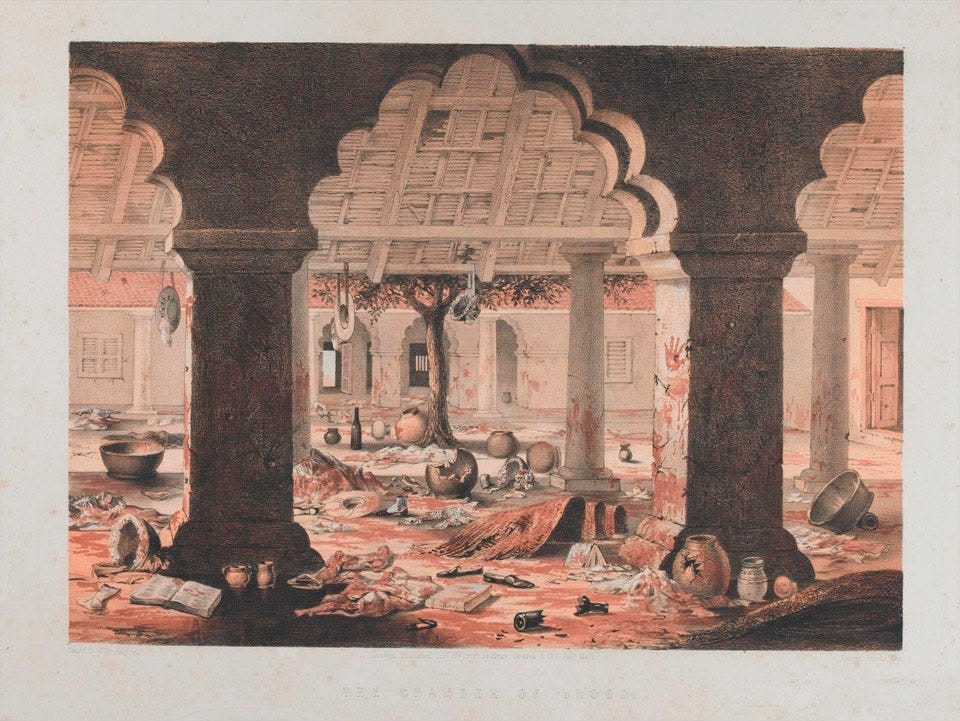
That morning discipline broke down. The troops became depressed and started drinking heavily. They began looting. Brigadier General James Neill, in command, restored discipline by buying up all the alcohol in the town and making it clear that any man who looted would be hanged.3 Once order was restored, the British went mad with vengeance. The reprisals were terribly severe, Neill made sure of it.
‘Whenever a rebel is caught he is immediately tried, and unless he can prove a defence, he is sentenced to be hanged at once: but the chief rebels or ringleaders I make first to clean up a certain portion of the pool of blood’.
Other captured sepoys were executed by being strapped across cannons which were fired. Remember Cawnpore became a battle cry for the British troops. Reparations became ever more brutal. The Highlanders set fire to one village and killed every single person trying to escape. All of this is, to the modern eye, utterly barbaric. We would use terms like ‘war crimes’ to describe actions like these. Yet there is something entirely explicable in it. When men find their women and children violated and slaughtered, a deep and terrible rage rises up.
As Neill wrote, ‘One cannot control one’s feelings. Who could be merciful to one concerned? Severity at the first is mercy in the end’.
There was great wisdom in this observation. Neill was evidently a severe man— he restored order to his own troops by threatening to hang them, and he pacified the region with exemplary and brutal violence. What he understood is that we often do great harm when we are too concerned with being merciful, or kind in the first instance, rather than doing what must be done. In many ways, this tendency, this preference for being ‘kind’, ‘decent’, ‘fair’, this refusal to say ‘no’, is the universal failing of the British state.
The most obvious example of this is the justice system, where, contrary to popular belief, we jail far fewer people than we did even 15 years ago. Quarterly ‘first receptions’ — the first arrival of an inmate within the prison system — were 18,379 in Oct - Dec 2025. In Oct - Dec 2010, there were 30,242 first receptions — despite significant population growth since 2010. Part of the reason for this is, no doubt, that the police’s ability to solve crimes has collapsed. In 2013, the earliest year for which figures are available, almost 22% of crimes resulted in a charge or a caution, or in other words, 78% of crimes went unpunished. That was bad enough, but according to last year’s crime outcomes data, now a mere 6.3% of crimes with a victim result in someone being charged. Today’s bleak statistic, however, is an improvement on the even darker days of 2022, when just 4.6% of such crimes resulted in someone being charged. This all means that the average criminal has only about a 1-in-20 chance of being charged when they commit a crime. The decline in proactive policing is no doubt part of this, and something James Neill would decry.
Of course, even if they are charged and convicted, most criminals will not be jailed. Partly this is because of a culture which endeavours to avoid prison for all but the most serious crimes, and partly it’s because we simply haven’t built enough prisons. Sentencing policy, as a result, is driven not by goals such as punishment, public protection or rehabilitation of offenders, but simply by the constraints of capacity, which exists because the state is unwilling to override planning law by enacting primary legislation ordering that prisons are built. For any normal state this would be a matter of emergency, but our politicians’ refusal to be ‘severe’ has resulted in a system that is no longer concerned with justice. The new Sentencing Act accelerates this process. Under it, prison sentences of under a year will be suspended in almost every case. Even sentences of up to three years can be suspended. Prison, for many, has been replaced by what the government likes to call ‘tough sentences in the community’, which will almost always require the person to wear one kind of electronic monitoring device (‘tag’) or another.
Unfortunately — but unsurprisingly — that system is not functioning properly. According to a National Audit Office (NAO) report published this month, the Prison and Probation Service does not ‘have an accurate understanding of the number of individuals that should be monitored and are not’, nor does it know how many breaches of tag conditions result in ‘enforcement action’, but the NAO does tell us that those breaches they observed were not taken seriously — ‘where outcomes are recorded nearly half result in no further action’ and ‘both serious and minor breaches’ are ‘treated in the same way regardless of severity’. All of this chaos is exacerbated by the apparent incompetence of the Prison, Probation, Police and the outsourced tagging company, Serco.
This report comes almost two years after I discovered that Serco were failing to tag many released prisoners. I understand that this was news to ministers and senior civil servants, and resulted in many angry calls. And yet, two years later the system is still, according to the NAO, ‘creating public protection risks’.
A Neillian state would have sacked the company which was so manifestly failing in its contracted duty, and had even failed to communicate this failure to the government. Such merciful tolerance for manifest failure does great harm. Severity would force improvement.
This softness is even written into our Sentencing Guidelines. They define ‘aggravating’ and ‘mitigating’ circumstances. Many of the mitigating circumstances are ones which objectively mean the criminal poses a higher risk. An offender with low IQ, an inability to understand that what they did was wrong, so impulsive as to have committed the crime without planning, and who is easily led, will serve a significantly shorter sentence. This is despite every single one of those traits indicating their greater risk to the public and increased likelihood of committing more serious crimes.
The result of all this is that we do our very best not to jail dangerous men, and when we do have to, it is for as little time as possible. Even within our prisons, rules essentially do not exist — obvious drug-taking is ignored, as are breaches of dozens of smaller rules. I also often discern, within the Ministry of Justice’s higher echelons, a discomfort with the very idea of jailing people, as though it’s somehow all a bit brutal and distasteful. So instead, we have chaos.
A severe state that recognised its duty is to deliver order and protect the law-abiding majority would take a very different approach. The death penalty would be used broadly and appropriately, and jail sentences would be determined on the basis of public protection, not out of a misguided desire to be merciful to young men.
Similar unwillingness to be severe is found across the Yookay state. Mental health detention is often adjacent to justice. There, we are committed to reducing the rate at which we section black men — NHS psychiatrists are ‘under pressure not to section psychotic Black patients to avoid appearing racist’. None of this is secret: it is made explicit in the NHS’s own policy documents, such as the ‘Patient and carer race equality framework’ (PCREF). The whole document is full of concern for those people who are sectioned, but has not a word for the terrible harm which can and has been done by psychotic people such as Valdo Calocane, Zephaniah McLeod, Joshua Jacques, and, it seems, Wayne Broadhurst’s killer, Dawood Safi, whose plea of diminished responsibility due to psychosis was accepted last week. Again, an unwillingness to be severe is causing great harm, and indeed, the murder of innocent British people.
Similarly, our migration policy is functionally a rape- and violence-maximising policy because we are unwilling to intern all illegal migrants on arrival and deport them. Asylum decision makers (ADMs) are told they can’t reject applications if they notice obvious lies and deceptions in claimants’ stories, and even when they are reciting almost word-for-word a story which the ADM has heard many times before (which I have confirmed with ADM sources). The current debate about whether the Boriswave should be allowed to settle is between those who recognise they would financially ruin the country, and those who seem to think that it would somehow be rude or unkind to cancel visas and send people home. Similarly our refusal to deport foreign criminals is a manifest rejection of severity, and makes us all less safe. We don’t even screen new arrivals for diseases, and as a result we have seen a significant increase in cases of TB, and are now close to losing our ‘low incidence status’.
A Neillian migration system would be ruthlessly self-interested, offering work permits only, with no path to settlement or citizenship. Only those who are all but certain to be an asset to the country would be allowed to come here, and there would certainly not be any asylum system.
The squeamishness has even infested the Ministry of Defence. Amongst senior civil servants there is a clear distaste for the idea that the department exists to kill people. Instead, terms like ‘keeping the peace’ are preferred. This culture, I think, is also part of the reason we’re now three and a half years into the interminable Haddon-Cave inquiry. Haddon-Cave is pursuing current and former British special forces soldiers for potentially violating the ECHR Article 2 rights of the terrorists they were lawfully ordered to kill in Helmand between 2010 and 2013. This is, quite naturally, destroying morale in the SAS, causing soldiers to quit, and damaging the operational effectiveness of our forces — men are much less willing to pull the trigger if they’re worried about being pursued by MOD lawyers for the rest of their days.
Neill himself died during the Mutiny. He fell on the 25th of September 1857, while leading his men to break the siege of the British Residency at Lucknow. After his death it was announced that he would have been made a Knight of the Bath, and this honour was bestowed upon his widow Isabella, along with a generous pension. Memorials to Neill were erected in India and his native Scotland.
Today we live in a country which has forgotten the value of severity; we would prosecute and shame a man like James George Smith Neill. As we imagine what a new British state might look like, we must remember his wisdom — that severity at the first is mercy in the end.
This article was written by David Shipley, a Pimlico Journal contributor. Have a pitch? Send it to submissions@pimlicojournal.co.uk.
If you wish to support what we do, please consider subscribing. If you are already subscribed, why not upgrade to a paid subscription?
Hibbert Great Mutiny
Trevelyan, Cawnpore; Kaye History of the Sepoy War
Forbes, A. - Havelock 1890 edition, p.145
JG Farrell's The Siege of Krishnapur is a wonderful, wonderful novel (as is all of his work) that I cannot recommend more highly. https://en.wikipedia.org/wiki/The_Siege_of_Krishnapur
My goodness, what a fine essay. You should be as proud as we are thankful.