
On Sunday morning, Morgan McSweeney resigned as Chief of Staff to Keir Starmer. His resignation was offered to quench the fury of Labour Backbenchers over revelations that Peter Mandelson — whose appointment as US Ambassador was pushed heavily by McSweeney — not only had a closer personal relationship to Jeffrey Epstein than previously understood, but had potentially broken the law by leaking politically and financially sensitive information to the financier when he was working under Gordon Brown.
Labour MPs, on average far to the left of the Government and of McSweeney in particular, have long sought an opportunity to oust the man who, more than anyone else, has driven Keir Starmer’s political agenda (and who is primarily responsible for his ascent to the leadership in the first place). The media have been eager to take up this project, especially since McSweeney fits their much-loved archetype of ‘slightly dark’ éminence grise, much like his predecessor Dominic Cummings. With the Mandelson Affair, they have finally got their scalp — and perhaps knocked down the first domino of the Starmer Government as a whole.
For all its faults, and there are many, it cannot be said that there was absolutely no vision underlying the Government to date. That Keir Starmer was unable to articulate that vision does not mean it wasn’t there — if not in the heart of the Prime Minister, then at least in the mind of his Chief of Staff. But what was it that Morgan McSweeney wanted to achieve? What will the Starmer Government look like without him? And what do the Prime Minister’s political prospects look like now that he has been deprived of his most important advisor?
Morgan McSweeney was born in County Cork, at the southern tip of the Irish Republic. Unlike most of the Labour Party’s ‘Fenian Mafia’, he does not come from a socialist or republican background — in fact, his family are keen supporters of Fine Gael (the slightly more right-wing of Ireland’s two historically dominant centrist parties, which has its origins in the pro-treaty side of the Irish Civil War). His grandfather fought with the original IRA, and his father, an accountant, was caught up in a string of fraud cases around the time he left Ireland.
He moved to London in 1994, and joined Labour in 1997, convinced by Tony Blair’s support for the Good Friday Agreement. He was hired at Labour HQ to do data entry by the campaign team, which was then led by Peter Mandelson. McSweeney worked his way up the party’s professional structure as a campaigner, and built up a great deal of recognition based on his ability to win tough campaigns where Labour’s credibility was on the line. The most notable of these were Lambeth in 2006, where he successfully took control from the hard left with the help of Steve Reed (a Lambeth council member who subsequently became the council leader and now serves in the cabinet as Housing Secretary) and in Barking and Dagenham in 2010 against the ascendant BNP.
McSweeney’s victories in the latter campaign were credited to two things: his political positioning and his talent for strategy. His focus on ‘traditional working class concerns’, such as crime and immigration (from a restrictionist perspective), gave the party credibility in an election at which the party lost almost every other council which was up for election. Investigating the tactics of his opponents, McSweeney found that the BNP was particularly focused on swaying the views of hairdressers, pub owners, and taxi drivers — local figures who spoke to more people than any other profession — on the assumption that these types of people would then be able to act as effective surrogates with broad reach. With much greater resources at his disposal, McSweeney simply copied this strategy to much greater effect. (Of course, the extent to which McSweeney was genuinely successful at changing minds in Barking and Dagenham has been questioned, but the myth, and the fact that he himself seems to believe it, is what is important for our purposes.)
His adoption of these concerns, however, was not simply a tactical measure when faced with a nationalist opponent. At the 2024 Labour Party Conference, McSweeney made a rare public appearance and clarified the philosophy that drove his fight against the BNP — a philosophy he sought to redeploy against Reform. At the core of his philosophy is the idea that institutions like the welfare state are set up to ‘serve’ ordinary people; that they are not shibboleths to be defended in their own right, and that elections are lost when this stops working. His approach was apparently informed by Cass Sunstein’s On Rumours: How falsehoods spread, Why we believe them, What can be done (2009) — although he stopped short of trying to refute voters’ beliefs with facts and figures. The emphasis was on delivering, then talking about how much you’ve delivered through people who actually have the legitimacy to talk about the issue (such as explicitly local candidates). He cited the example of Barking and Dagenham’s bin collections: the BNP blamed rubbish on immigrants, but McSweeney was able to mount an effective response by placing blame on the council’s waste disposal strategy and producing a programme to clean up the streets. In this focus on state dysfunction, it is easy to see parallels with the 2024 electoral strategy and with the Starmer Government’s (albeit feeble) attempts to counter Reform since then.
That sense that Labour should be a party which represents the actual concerns of a specific voter base, rather than a party which advances the various causes célèbres of left-wing political activists, is perhaps the fundamental principle which unites the otherwise quite disparate views of the political actors commonly associated with ‘Blue Labour’. The other half of McSweeney’s agenda reflects his early experience of New Labour. His desire for modernisation of the state — and a lack of reverence for existing operating procedures — enables genuine reform to be contemplated and reflects precisely the same instincts as Tony Blair (and has much resonance with the project of Dominic Cummings, albeit less radical).
Journalists were fascinated during the early stages of his tenure by his interest in Palantir CEO Alex Karp. McSweeney even reportedly kept a copy of Karp’s The Technological Republic on his bedside table. He was sympathetic to the project of turning No. 10 into an operational ‘hub’ modelled on Silicon Valley firms, and, like Cummings, understood the work of his agenda in government in primarily operational terms — restructuring the state and its institutions to deliver a properly functioning government — rather than as evangelising the ideological pretences of the Oxford PPE bluffer. This instinct makes as much sense from a left-wing perspective as it does on the right, even if the stronger ideological commitment on the left renders it ultimately impossible to deliver.
After Labour’s defeat in 2010, McSweeney took up leadership of Labour’s Local Government Association group before being appointed leader of Liz Kendall’s 2015 leadership campaign. The victory of Jeremy Corbyn in that election represented perhaps the low point of McSweeney’s career, and he spent the next five years plotting the comeback of the Labour Right. To that end, he founded Labour Together, a think tank which served as a major organizing force for opposition to Corbyn’s leadership. Over several years of expensive polling, McSweeney determined that the younger ‘idealists’ of the soft left could be peeled away from Corbyn and any successor — and that Keir Starmer, with his record of opposition to Brexit and perceived soft-left political affiliations, would be the ideal candidate to do so. His subsequent appointment as campaign manager for Starmer’s leadership bid was crucial to the eventual success of that operation.
It would be incorrect, however, to describe Starmer entirely as a golem of McSweeney, or to suggest that Starmer has no views of his own. Coming, broadly speaking, from the party’s nebulous soft left, Starmer’s ideological foundations are a strange kind of ‘anti-politics’. He seemingly believes that ‘The Law’, properly defined and applied, can be used as a tool to mediate all disputes and abolish political conflict itself. His commitment to this view shines through only in the relatively few areas of policy which he has directly influenced — most notably the surrender of the Chagos Islands.
That said, trying to understand ‘Starmerism’ from the starting point of the man’s own views misses the point of what is unique about his leadership, and can potentially lead to exaggerating of the importance of ideas per se to his failure as Prime Minister. What fundamentally defines Starmer’s leadership and gives character to his government is not his politics, but his approach to the job he has been given. He does not function as an executive, setting direction and making decisions; instead, he operates as a manager, fielding opinions from his team and delegating responsibility for broad areas of his leadership to the relevant aides. In many ways, albeit for very different reasons, his government functions very similarly to that of Boris Johnson. Where Johnson delegated out of incompetence and disinterest, Starmer simply misunderstands the nature of the job. It is little surprise, then, that we see such a similar story unfolding following 2024 to that which followed 2019.
For Starmer, this approach to government is not a political decision — it is simply good, sensible management (something he apparently learned from his time as Director of Public Prosecutions). His project, more than achieving any specific goal, is to bring that sensible management to government itself. As such, the political agenda can (and should) be outsourced to a competent politician with a clear understanding of voters and a program to address their concerns. It is in the light of this understanding of the role of Prime Minister that Morgan McSweeney was able to fuse Starmer’s project with his own.
When Starmer was first elected, however, McSweeney’s domain was rather more limited due to the presence of another delegate — Sue Gray, Keir Starmer’s first Chief of Staff. It is easy to see how the combination of the two makes sense under Starmer’s approach to governance: McSweeney is a political creature, who can craft the messaging and the policy to back it up, whilst Gray’s civil service background makes her an obvious choice to lead reforms to the state (at least in the mind of Keir Starmer). This arrangement, of course, did not work for McSweeney. Gray’s politics are in many ways the opposite of his, with the constitutional reforms proposed by her and Gordon Brown focused not on increasing responsiveness to voters but on further depoliticisation and the entrenchment of the permanent bureaucracy.
Pursuit of her agenda would surely derail his — and, besides, he had his own goals for reforming government. So he saw to it that she was removed within months of her appointment, and added her duties to his own, and the structure of Starmerism became the skin-suit for the McSweeney agenda.
Backbench MPs, reactionary and stupid as they tend to be, are always keen to bring down powerful advisors of this type, just as much in the Labour Party as in the Conservative Party. It really cannot be overstated how disastrous this tendency is to our politics. Such people are incapable of developing an agenda of their own and are incredibly sensitive to the disruptions and controversies produced by the pursuit of an agenda by others within their party’s leadership. The existence of advisors like McSweeney and Cummings is therefore required for government to function at all. Crucially, the inflated sense of self-importance of MPs combined with their ignorance inevitably causes conflict with advisors who, whatever their failings, typically have twenty or more IQ points on them and therefore rightly come to regard them as burdensome roadblocks to the pursuit of their agenda. As with Dominic Cummings, MPs quickly set out to remove McSweeney from his post — and, naturally, the media was happy to pick up their well-trodden scripts and play along with this game.
Of course, McSweeney’s agenda was in many ways objectionable from our perspective; however, from the perspective of the Labour Party, it represented perhaps the final opportunity to remain a truly national force (as opposed to a purely sectional group, working on behalf of immigrants, benefits claimants, and public sector employees). It was also the last opportunity for Labour to reclaim the mantle of the working classes, and to be a vehicle for their interests and desires (as indeed it was founded to be). But despite the fundamental validity of McSweeney’s analysis and his much-vaunted political skill, that project failed — and not just because of resistance from MPs.
Two things would have been crucial to McSweeney’s success. The first was a reorienting of Labour’s representational priorities, both in reality and in the minds of voters. His aim, reflective of the aims of Blue Labour as a whole, at least in its more moderate Parliamentary form, was to establish a kind of ‘pro-white multiracialism’ — i.e., a society marked by relatively low (though non-zero) rates of immigration and a retreat from the anti-white excesses of the previous decades, while simultaneously accepting the basic premise that the British national community is a multiracial one — to settle debates on immigration and culture and enable the focus of politics to return to the economic issues on which Labour could attract the support of its traditional base once again. Establishing this kind of settlement would have been incredibly difficult — perhaps even impossible — but if it had been successful, the key would have been a correct sequencing of message and delivery. An initial period of pandering to the anxieties of white voters was required, with strong messaging on assimilation and crime combined with substantial reductions in net migration. Only once this had bought sufficient credibility could the government then turn towards reintegration of ethnic minorities into a shared civic identity.
Fate had other plans for Morgan McSweeney. In Summer 2024, only weeks after Keir Starmer was elected, perhaps the most significant race riots in British history swept the nation, as decades of anger over immigrant crime boiled over following the stabbing of eleven girls (some as young as six) and two adults in Southport by a second-generation Rwandan immigrant. The importance of these riots has been somewhat understated subsequently as the general incompetence of Keir Starmer’s premiership has been gradually revealed. Unrest over immigration is by no means unprecedented, and has continued since. And yet we have never seen events such as those that occurred that summer: rioters set hotels alight with illegal immigrants inside, established racial road-blocks at major junctions, and fought with police across the country. The tone of the conversation on immigration shifted radically overnight.
It was only after the riots that Starmer fully recognised McSweeney’s moderately reformist approach would be required to regain any semblance of his government being anything other than an occupational force. Sue Gray was clearly ill-equipped to deal with the situation (indeed, seemingly lacking any plans for Government at all beyond a ‘return to decency’, perhaps because she had spent her career as a shady ‘ethics advisor’ rather than in a policy delivery role). She was off the scene by October, thus allowing for McSweeney’s total domination of No. 10.
But Starmer’s change of course was already too late. His response to the riots was a political disaster, and it would not be an exaggeration to say that this was the moment that his Premiership’s failure was made inevitable, even if it took eighteen months for this to become clear. His hard line against the rioters, refusal to seriously engage with the questions raised by the murders, and persecution of even those who had not engaged in violent behaviour, including for mere social media posts, pitted him squarely against the very voters that McSweeney’s project was designed to win back. That all of this occurred in the context of prison overcrowding that necessitated the early release of thousands of prisoners, including violent offenders, only made the reaction worse. ‘Two-Tier Keir’ was now firmly established in the public mind, even among those who condemned the riots themselves. Shabana Mahmood — the minister who actually oversaw the prison releases — actually managed the situation quite deftly, floating the ‘chemical castration’ of child sex offenders at the same time, which meant that it was Starmer himself who would receive the all the backlash.
The crucial message sequencing for the McSweeney agenda to have succeeded was therefore completely disrupted. As soon as voters’ suspicions that Labour was not on their side were confirmed, it was impossible to regain that trust. Keir Starmer has been overseen the biggest decline in net migration in British history (even if it is largely the result of changes enacted in the final years of Tory government), and has announced further tightening of immigration rules that go beyond anything the Conservatives would ever have implemented. Despite this, he has absolutely zero credibility on the issue with voters. Whilst we may recognise that his approach is insufficient, the fact that most voters share this perspective is primarily explicable in reference to the events of that summer.
With his authority already damaged, Starmer fell back on the second aspect of the McSweeney plan: redirecting spending away from welfare to stimulate economic growth. Fate may not have intervened here, but the Labour backbenches certainly did. Sensing Starmer’s weakness and the dissatisfaction of what are Labour’s real core voters — rather than McSweeney’s desired ones — plans to tighten unemployment benefits and reduce the number of disability claimants were largely dropped. With both planks of the plan stymied and the economic picture worsening, what followed was a listless lurching from one disaster budget to another, reactively dealing with scandal after scandal in between.
When the plans of ministers or advisors fail, a Prime Minister usually reverts to their own agenda and replaces the individual with reference to a broader agenda. Starmer’s approach to the Premiership rendered this impossible. The political content of his government was entirely delegated to McSweeney, much as the financial management of his government was entirely delegated to Rachel Reeves. There was therefore nothing to fall back on — not because Starmer has no views of his own, but because he does not believe it is his job to direct the agenda. He found himself locked in a doom-spiral with a failed team, an increasingly hostile backbench party, no way to convincingly pivot to a new path, and no clue what that path could be if he could.
The failure of Morgan McSweeney leaves Blue Labour with no prospects as a continued tendency within the Labour Party. The newest and smallest Labour faction, their support was always limited within the party, despite Blue Labour’s apparent influence on the Prime Minister’s most important advisor. It is worth noting that there is a substantial distance between supposedly aligned political figures — including McSweeney and, even more so, Shabana Mahmood — and the intellectual crowd which surrounds Blue Labour godfather Maurice Glasman. Pimlico Journal has criticised the latter — mostly Conservative-aligned — ‘post-liberalism’, represented by figures such as Miriam Cates, as a shallow and largely counter-productive response to the challenges of the age, but the latter circle is of a genuinely radical disposition more reminiscent of the early ‘post-liberalism’ outlined by Patrick Deneen and others. Far from being a rear-guard action in defence of liberal democracy and moderate social conservatism, this tendency was willing to question fundamental liberal commitments including the sanctity of democracy and even the basic model of the autonomous individual. Whilst we may still find this objectionable for all manner of reasons, it is at least an interesting grouping.
By contrast, the Parliamentary Blue Labour faction, and its supporters within the party apparatus, is far less radical. A key distinction is on questions of immigration and identity: the Parliamentary faction is broadly aligned with McSweeney’s ‘pro-white multiracialism’, while the tendency outside of Parliament is more explicitly nationalist. I have spoken extensively to those around Glasman and the extent of the gulf is clear. Whilst class is indeed an important factor for both sides, for McSweeney this is a more traditional intra-national distinction (under a civic definition of the nation which recognises a ‘multiracial working class’ integral to its identity), whereas for those on the edges class is laundered through national concerns, with ‘class enemies’ being perceived as essentially non-national. This understanding of class is somewhat similar to the cultural politics around Labour in the immediate post-war period, which asserted that working-class culture was the authentic national culture over one that was upper-class, imperial, and global. This is made more coherent following a second globalist transformation of the upper classes. For many, this nation-first disposition towards class is rooted in a political background more interested in the third way than the left, and some have even cited Oswald Mosley to me as an important influence. What unites the two — and distinguishes both from the Labour Old Right — is an orientation towards these questions that is highly intellectualised, unmistakably modern, and could only come about in a world that has already experienced mass migration and social progressivism.
This distinction is important for assessing how the tendency will react, because it is what creates a difference of opinion within Blue Labour on the prospect of a Reform Government. For many on the more moderate end, this would be a disaster — as previously mentioned, Morgan McSweeney cut his teeth fighting the BNP and has always touted his achievements countering the ‘far-right’ (as, ironically, has Nigel Farage). Partly on those grounds, and partly as a result of their more traditional understanding of class politics (and therefore their lingering anti-Thatcherism), such people could never countenance Reform as a political vehicle.
The broader tendency, however, takes a far more relaxed attitude towards Reform, and as their foothold in the Labour Party slips away, it would not be surprising to see many of these figures attempt to involve themselves with Farage. Pimlico Journal remains, ultimately, of the belief that a more radical embrace of capitalism is required — but there are undoubtedly a number of issues (from economic diversification, to reindustrialisation, to management of labour demand, especially given the prospects for AI) where libertarianism may well be insufficient. It may therefore be a boon for Reform to engage with what is ultimately a highly intelligent faction which has thought deeply about some of these issues — if only at arm’s length.
Even outside of the acute crisis facing Keir Starmer as a result of the Mandelson affair, his Premiership is now effectively over. It is an entertaining irony that Starmer, in many ways the antithesis of Boris Johnson, has ended up falling into so many of the same traps. Indeed, the story of both Premierships is very similar: a Prime Minister unfit for the job, elected by his party with radical expectations but moderating in government; successive failures on policy combined with endless scandal and sleaze; a political agenda defined by a much maligned Chief of Staff who is eventually forced out, ultimately leading to the fall of the Prime Minister himself.
Despite the rallying of the Cabinet behind Starmer in the past twenty-four hours, the possibility that Starmer survives the year is now small. It is surely not possible to survive this level of public exhaustion. Nor is it plausible that a Prime Minister under these conditions can survive calls from senior party figures, including Scottish Labour leader Anas Sarwar, to resign. Starmer will not be able to do a public interview without being asked explicitly why he is still in post. At every PMQs, he will be hit with the same questions, backed up by the statements of his own MPs. His authority with the party is now zero. That situation cannot continue indefinitely.
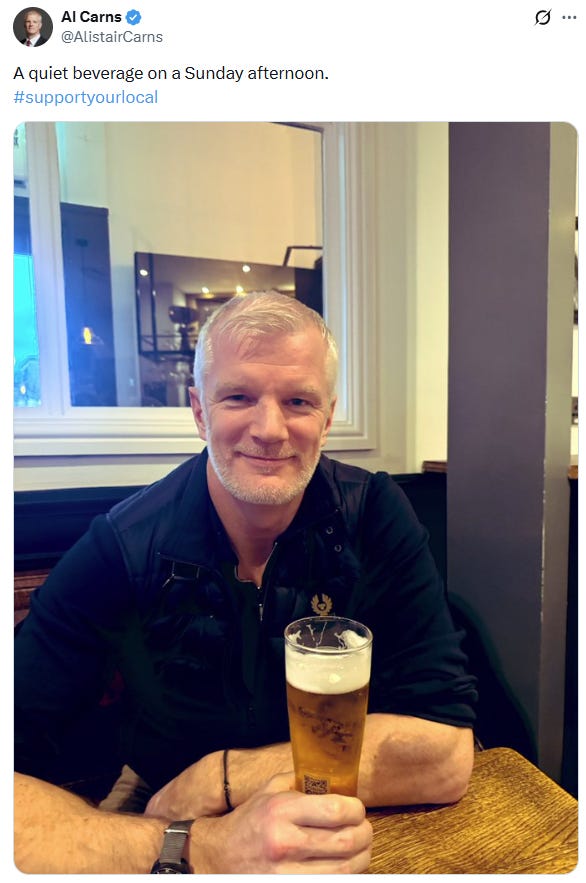
What comes next is less Boris Johnson and more Liz Truss. Just as she was forced to replace her Chancellor and effectively neutered in the process, if Starmer is to survive the next few weeks he will be required to replace his staff and his agenda with that of the majority within the party (the soft left). This charade is particularly embarrassing given that it represents a tacit admission by the entire Labour Cabinet (as well as backbench MPs) that Starmer has failed as Prime Minister, but that there is not a single MP that could plausibly replace him. Desperation has now reached such a fever pitch that Al Carns, an MP first elected only eighteen months ago, is being floated as a potential alternative simply because he served in the military, is a normal-looking white man, and hasn’t yet messed up his brief publicly. Approximately nobody has ever heard his name, and it would be unsurprising to learn that he is not, in fact, a real MP, but part of Albanian PM Edi Rama’s plan to create a new generation of politicians and political advisors using artificial intelligence.
What’s more, attempting this will be actively harmful to the prospects of a Labour revival, however dim they already are. Labour’s only hope now is to tack leftward, solidify 30% of the vote by taking from the Greens and Liberal Democrats, and cross their fingers that Parliamentary arithmetic makes a rainbow coalition possible. That is only possible if the leftwards move can be presented as a true reset, but by attempting it under Keir Starmer they will subject the rest of the party to his reverse Midas touch. Labour’s popularity will not rebound, and Starmer will have to be removed nonetheless after May (if he survives that long) — but the new Prime Minister will not be able to announce major policy changes to create a sense of differentiation.
Of course, if they were to pursue this strategy and replace Keir Starmer tomorrow, they would immediately run up against the bond markets and the serious potential for a genuine fiscal crisis. It’s understandable that many now seek the catharsis of seeing Keir Starmer deliver his resignation speech, but the damage that could be done by Angela Rayner or Ed Miliband, whilst beneficial for the right in purely electoral terms, would be tremendous. Reform’s task in 2029 is already the most difficult ever faced by a British government since at least 1945. Making it substantially harder is something we should dread.
Either way, what has seemed to be the case for the past year has now been all but confirmed: this Labour Government will ultimately be remembered as a brief period of suffering, its most substantial legacy being the paving of the way for Nigel Farage to enter 10 Downing Street.
There’s another way of looking at the McSweeney-Starmer project, which was perhaps not intended or understood by them in these terms, but this was the intimated direction after McSweeney wrestled the course from Sue Gray. Britain is a country facing tremendous political challenges and extreme misgovernment. Many of these problems are not particularly operationally difficult to solve. They just require a willingness to cut through the political Gordian Knot, disregarding the shibboleths of the previous age. It is not a country that has deep internal divisions (at least setting aside immigration) — few in Britain see their problems as the result of some other faction within the nation, but rather as misgovernment of the nation as a whole.
This kind of situation raises the prospect not of factional populism, but a certain kind of ‘national government’ of ‘men of push-and-go’ — technocratically presenting, not particularly aligned with any political ideology per se but committed to pragmatic, ‘common sense’ solutions to obvious problems in the interest of the nation as a whole. Similar kinds of political movement have been attempted before, especially in the earlier part of the twentieth century — most notably with David Lloyd George’s failed attempt to fuse his Liberal and Unionist coalition into a new, united party, and the later creation of a ‘National Government’. Keir Starmer is many things, but he is no ‘man of push-and-go’. It’s unsurprising that he ultimately failed to play this role. But that model remains the most convincing approach to winning the next election and to solving many of Britain’s problems. The country is not crying out for class-warriors like Margaret Thatcher or Jeremy Corbyn, people with a deeply ideological vision for our future — it is crying out for someone who will recognise the basic and clear ways in which the state is not functioning, and fix them.
This description may not immediately resonate with your image of Reform, which is often lazily described as a ‘populist’ party. But behind the admittedly gaudy fireworks and daytime TV branding, listen to the way in which Farage actually pitches Reform to the voters: the description of Reform as a party not of left or right, but of solutions; the constant reference to experts from outside politics who will be brought into the cabinet; the straightforward and non-ideological terms in which he discusses the problems of the day. Farage does not speak of ‘freedom’ or ‘progress’. He does not cite Burke or Mill. His excitement over a potential Labour defection could barely be contained. He speaks of ‘country’ and ‘common sense’ — of the real issues which confront voters in their daily lives.
Indeed, ‘national government’ is precisely the pitch that Farage is delivering — and whilst one might have reservations about the man, he is certainly one of ‘push-and-go’. With both of his major opponents destroyed by their experience of government, the path is open for Reform to claim the mantle not just of the ‘forgotten voters’, but of the nation as a whole. Time will tell if they will succeed.
This article was written by George Spencer, Managing Editor, and Francis Gaultier, Commissioning Editor. Have a pitch? Send it to submissions@pimlicojournal.co.uk.
If you enjoyed this article, please consider subscribing. If you are already subscribed, why not upgrade to a paid subscription?
McSweeney ran Liz Kendall’s 2015 Leadership Campaign and not Lisa Nandy’s
George Spencer articles are always a delight to read