
This article was pitched to Pimlico Journal before the announcement of Reform’s intention to abolish Commonwealth voting. It is nevertheless necessary to make the case for this policy, and to demonstrate how far this problem goes today.
It may come as a surprise, but you don’t need to be a British citizen to vote in UK elections, including general elections and referendums. Britain is relatively unique in the world in offering non-citizens the vote. While some countries allow long-term residents who aren’t citizens the ability to vote in certain local or municipal elections, the overwhelming majority make voting in general or presidential elections exclusive to those with citizenship.
In Britain, we are extremely lax. Any citizen of a Commonwealth country who finds themselves in Britain — a potential pool of some 2.7 billion people — can register to vote. This significantly devalues British citizenship and effectively makes it an optional extra for many migrants. In my estimate, there could be some 2.5 million Commonwealth citizens in the UK who are eligible to vote.
In most countries, one key difference between permanent residency (known as settlement, the equivalent being Indefinite Leave to Remain (ILR) in the UK) and citizenship is that the latter confers the right to vote. In the UK, however, this is not the case. A migrant from America, France, Germany, Japan, South Korea, or indeed any non-Commonwealth country would have to acquire British citizenship before their eligibility to vote. However, migrants from India, Pakistan, Bangladesh or any other Commonwealth country can vote, regardless of citizenship status. More than in any other part of our politics, this inconsistency is a real example of ‘imperial nostalgia’, for which no one can make a good case. The sole exception that could conceivably be legitimate is Irish settled migrants who are enfranchised on altogether different, national grounds, as covered in Pimlico Journal in 2024.
A history of British nationality
To understand this anomaly, you have to go back to the days of the British Empire, when there was no such thing as a ‘British citizen’ — that concept was not established in law until the British Nationality Act 1981. Before this, anyone from a country or territory that was ruled by Britain or in the British Dominions was considered to be a ‘British subject’. This is to say that, in law, there was no distinction between someone born in Britain, with ancestry going back centuries, and someone born in a British dominion.
This was noted by Enoch Powell in a television interview with Dick Cavett broadcast on 14 May 1971. I recommend watching the full clip. Below, I have shortened and condensed his monologue to get across the core of his argument, which is that all British subjects were considered the same:
We never had a definition of ourselves, there was never such a thing as a United Kingdom citizen, unlike the United States, which has its own citizenship, France, Germany. We never had that. We were British subjects, we were subjects of the King or Queen, as the case might be. Consequently, as the British dominions expanded, automatically everybody was born in or belonged to any part of a British dominion, hundreds of millions of human beings, were all British subjects.
In the law of this country, there was never any distinction between one British subject and another. There was no way of labelling the British subject, who if I may use the word, belonged to this country. This had many advantages when Britain was the centre of an empire and if the numbers from the rest of the empire who availed themselves of this identification remained small, then no problem arose. But the rest of the empire had its own citizenships, an Englishman wasn’t allowed to go and settle in India or Jamaica — on the contrary, they had their own very strict demarcations and definitions.
After the Second World War, there was a big technical revolution that took place, that was air travel, which made the movement of masses of people from one continent to another possible on a scale which had never been contemplated before. As a result of that, there moved into the United Kingdom growing numbers of British subjects from the rest of the world, by now the Commonwealth, it had ceased to be the Empire, who had no other connection than that with this country, with the United Kingdom.
It wasn’t that this was asked for, it wasn’t that these people were brought in as labour, like the movement of labour on the continent. It happened because without a major change in our law, it couldn’t be prevented, indeed it couldn’t be seen. You see we actually don’t know how many came in because if we’re all British subjects, you only counted, well you didn’t count British subjects. A Hong Kong Chinese or a Bataan from the North-west Frontier or myself coming back from a weekend in Paris, we were all the same going through the port of entry or Heathrow airport.
The Representation of the People Act 1918 stipulated that only British subjects could register to vote and that they must reside in the constituency in which they are voting. The British Nationality and Status of Aliens Act 1914 had already established that ‘any person born within His Majesty’s dominions and allegiance… shall be deemed to be natural-born British subjects.’
Under such a definition, a British subject born in India had the same rights as a British subject born in England if they were able to transport themselves to the United Kingdom. In the early twentieth century, an era of high shipping costs and no cheap transcontinental flights, the number of people doing this would have been very small. The British Nationality Act 1948 was later passed in response to the Canadian Citizenship Act, 1946; per the Canadian Museum of Immigration:
The Canadian Citizenship Act of 1946 created the category of Canadian citizenship and allowed residents of Canada to obtain citizenship regardless of their country of origin. Prior to 1947, individuals born in Canada and naturalized immigrants were classified as British subjects rather than Canadian citizens. The new act established the criteria for obtaining citizenship and outlined the circumstances under which citizenship could be lost or revoked.
The British Nationality Act 1948 established that if someone acquired Canadian citizenship (Citizen of the United Kingdom and Colonies), or obtained citizenship from any other Commonwealth country, they would automatically be considered a British Subject, as by this point, the British Government understood that other countries would follow Canada and define their own citizenship and nationality laws. How did the citizenship and immigration status of the Windrush generation change over time? As written in an article by Free Movement:
His Majesty’s dominions and allegiance was the entire empire, later known as the Commonwealth. There were also some additional rules on inheriting British subject status from one’s parents or grandparents if born outside the crown’s dominions and allegiance.
The British Nationality Act 1948 fundamentally changed how British subject status was conferred. Instead of it being derived from a person’s place of birth and a direct relationship of allegiance to the crown, it was to be derived from the citizenship laws of the individual countries of the Commonwealth.
This was a massive constitutional shift. It would no longer be the British Parliament determining directly who was or was not a British subject. Now who was or was not a British subject would effectively be decided by the legislatures of independent Commonwealth countries. The role of the British Parliament would merely be to recognise those laws and confer British subject status on the citizens of those countries.
Section 1 of the British Nationality Act 1948 states that:
Every person who under this Act is a citizen of the United Kingdom and Colonies or who under any enactment for the time being in force in any country mentioned in subsection (3) of this section is a citizen of that country shall by virtue of that citizenship have the status of a British subject.
Section 2 of the British Nationality Act 1948 states that:
Any person having the status aforesaid may be known either as a British subject or as a Commonwealth citizen; and accordingly in this Act and in any other enactment or instrument whatever, whether passed, or made before or after the commencement of this Act, the expression “British subject” and the expression “Commonwealth citizen” shall have the same meaning.
The Representation of the People Act 1948 maintained the requirement that only British subjects could vote, and did not change the expansive definition of that term. Following the Second World War, the dominions began to gain full independence, severing their constitutional links with Britain. This effectively brought an end to the British Empire as historically conceived.
The London Declaration of 1949 created the modern Commonwealth, whereby India became a republic but was allowed to remain a member of the ex-imperial association. The modern Commonwealth initially consisted of Australia, Canada, India, New Zealand, Pakistan, South Africa, Sri Lanka, and the United Kingdom. The London Declaration stated that:
The Governments of the United Kingdom, Canada, Australia, New Zealand, South Africa, India, Pakistan and Ceylon, whose countries are united as Members of the British Commonwealth of Nations and owe a common allegiance to the Crown, which is also the symbol of their free association, have considered the impending constitutional changes in India.
The Government of India have informed the other Governments of the Commonwealth of the intention of the Indian people that under the new constitution which is about to be adopted India shall become a sovereign independent Republic. The Government of India have, however, declared and affirmed India’s desire to continue her full membership of the Commonwealth of Nations and her acceptance of The King as the symbol of the free association of its independent member nations and as such the Head of the Commonwealth.
The Governments of the other countries of the Commonwealth the basis of whose membership of the Commonwealth is not hereby changed, accept and recognise India’s continuing membership in accordance with the terms of this declaration.
Accordingly the United Kingdom, Canada, Australia, New Zealand, South Africa, India, Pakistan and Ceylon hereby declare that they remain united as free and equal members of the Commonwealth of Nations, freely co-operating in the pursuit of peace, liberty and progress.
This, and the entire project of ‘Commonwealth’, was little more than a way for the Crown and British Government to save face. India retained all of the advantages of Commonwealth for merely symbolic concessions whilst also becoming independent and sovereign in all meaningful ways, as well as maintaining equal footing between their citizens and natural-born British subjects under British law. As David Coleman explained in ‘Demographic and Socioeconomic Consequences in the United Kingdom and Europe’:
…all citizens of the dominions and former colonies retained this citizenship after independence, as long as their countries remained within the Commonwealth.
Over the following decades, many countries would join the Commonwealth, often but not always countries that were former British dominions. Today the Commonwealth consists of 56 countries, including the United Kingdom, and encompasses a total of 2.7 billion people, some one third of the earth’s population. Notably, Mozambique, Rwanda, Gabon, and Togo all have membership without ever having been in the imperial fold.
Prior to the Commonwealth Immigrants Act 1962, immigration from Commonwealth countries was not restricted. Anyone from a Commonwealth country with the resources and will could relocate to Britain. Nothing prevented them from bringing their families, working in local businesses, or otherwise distinguished them from natives in law. The 1962 Act was superseded by the Commonwealth Immigrants Act 1968 and the Immigration Act 1971, all three acts recognising the deepening need to ‘stop empire coming home’. These acts imposed restrictions on entry, but did not ultimately change the legal status of Commonwealth citizens in Britain.
The British Nationality Act 1981, which is still in force today, finally introduced the notion of British citizenship, as separate from Commonwealth citizenship, with Commonwealth migrants no longer automatically becoming British subjects (or citizens). The status of ‘British subject’ was now restricted to certain highly specific situations covering statistically insignificant numbers of people. Yet this did not end voting for Commonwealth citizens, even though it would have been the perfect time to do so. The Representation of the People Act 1983, which is also still in force today, continued to include Commonwealth citizens in the franchise.
The next part is a direct excerpt from a House of Commons Library paper on who can vote in UK elections:
In his book, The Electoral System in Britain, Robert Blackburn comments that the British Nationality and Status of Aliens Act 1914 was refined by the British Nationality Act 1948 “to replace the notion of common nationality with a system of reciprocal Commonwealth citizenship”.
It also provided a system where countries such as India and the African republics were still to be regarded, for nationality purposes and the right to vote, as ‘British subjects’ even though they no longer owed allegiance to the Crown. They retained their position within the Commonwealth with the British monarch being recognised as Head of the Commonwealth.
The British Nationality Act 1981 updated the legislation around British citizenship, and the term ‘British subject’ now applies only in very specific circumstances.
The Representation of the People Act 1983 refers to the franchise as encompassing Commonwealth citizenship, using the term in the broad sense envisaged by the British Nationality Act 1948. The government gave assurances during the passage of the British Nationality Act 1981 that the new definition of British subject would not alter the possession of civic rights and privileges such as the right to vote.
I will note the use of the word reciprocal. Successive British Governments appeared to take the view that if Britain gave voting rights to Commonwealth citizens, partner nations would reciprocate this right for British citizens who lived there. This thinking, if naïve, made some sense at the time, given the high historical levels of emigration from Britain to the former ‘white dominions’.
In a House of Lords debate in October 1969, some twenty-one years after the British Nationality Act 1948 and some fourteen years prior to the British Nationality Act 1981, it was noted by Lord Colyton that many territories did not reciprocate this gesture.
Lord Colyton: To ask Her Majesty's Government what residential or other qualifications are required to enable citizens of Commonwealth countries and the Irish Republic to vote in British national or local elections, and which Commonwealth countries or the Republic of Ireland grant reciprocal facilities to citizens of the United Kingdom.
Baroness Serota: My Lords, Commonwealth citizens are British subjects and no qualifications are required of them additional to those required of citizens of the United Kingdom and Colonies. Nor are any additional qualifications required of citizens of the Irish Republic. As regards the second part of the Question, British subjects resident in the Irish Republic can vote at local elections. In Commonwealth countries the electoral position of non-citizens (including citizens of the United Kingdom and Colonies) varies and is often governed by complex legislation. Detailed information is not immediately available but I will send it to the noble Lord as soon as possible.
Lord Colyton: My Lords, I thank the noble Baroness for her reply. Is it not a fact that in many—I do not say in most, but in many— Commonwealth countries, United Kingdom citizens either cannot vote or can vote only if they have been resident for a very long time? While I think no one would have any objection, or has an objection, to Commonwealth and Irish citizens voting in this country, is there not a very strong case for Her Majesty's Government to approach all Commonwealth Governments and the Government of Ireland with a view to establishing full reciprocity in these matters?
To this date, few Commonwealth countries reciprocate this right to the extent that is conferred by Britain. The Home Affairs Select Committee reviewed the voting rights of Commonwealth and Irish citizens in 1982 and recommended no change, stating:
Though the historical background is different, the evidence put forward on behalf of Commonwealth and Irish citizens has many common elements. Both groups are arguing for the maintenance of their existing civic rights, rather than seeking new ones; and both feel threatened by the expression of opinions in certain quarters that these rights should be diminished or removed. In neither case did such a proposal find a voice in evidence to ourselves, and it would seem therefore that there is no widespread public demand for the removal of the voting rights of either Commonwealth or Irish citizens.
Given the relatively low levels of Commonwealth immigration up to this point, at least by today’s standards, there was no major domestic uproar about Commonwealth citizens being able to vote. The issue never achieved much political salience — even at the high points of pre-1997 anti-migration sentiment.
Post-1997 under New Labour, immigration into Britain increased substantially, from both EU and non-EU countries, much of which was from Commonwealth countries. Gordon Brown commissioned Lord Goldsmith to conduct a review into British citizenship laws in 2007; the report can be found here. In the report, Lord Goldsmith recommended the right to vote in Westminster elections should be exclusive to those with British citizenship.
I do propose that government gives consideration to making a clear connection between citizenship and the right to vote by limiting in principle the right to vote in Westminster elections to UK citizens. This would recognise that the right to vote is one of the hallmarks of the political status of citizens; it is not a means of expressing closeness between countries. Ultimately, it is right in principle not to give the right to vote to citizens of other countries living in the UK until they become UK citizens.
Lord Goldsmith noted that the concept of common Commonwealth citizenship, whereby each country that was a member of the Commonwealth would reciprocate the generosity afforded by Britain, never really materialised and that while they had a right to immigrate to Britain (at least until the Commonwealth Immigration Act 1962), this was also not always reciprocated.
So, as Lord Lester of Herne Hill has pointed out, this new concept did not translate the vision of a common Commonwealth citizenship into a harmonious system of citizenship laws.
Some of the Dominions had immigration practices which meant that British subjects did not have an equal right to settle in any part of the British Empire.
The Government never responded to Lord Goldsmith’s report. In 2010, the Conservatives were elected and pledged to bring net migration down to the tens of thousands; this would never materialise, despite appearing in three consecutive Conservative manifestos. The high levels of immigration would continue under successive Conservative governments, though some steps were taken to reduce non-EU immigration before 2021. As it stands in 2026, qualifying Commonwealth citizens are entitled to register to vote and stand as parliamentary candidates.
But what exactly counts as ‘qualifying’? According to the Electoral Commission:
A person is a qualifying Commonwealth citizen if they do not require permission to enter or stay in the UK, Channel Islands or Isle of Man or they do require permission to enter or stay in the UK but have been granted such permission, or are treated as having been granted such permission.
Any type of permission to enter or stay is acceptable, whether indefinite, time limited or conditional.
In short, anyone from a Commonwealth country who has a visa or some other right of entry or remain, such as Indefinite Leave to Enter (ILE), Indefinite Leave to Remain (ILR) or Right of Abode, can register to vote or stand UK elections.
I asked the Electoral Commission directly whether a Commonwealth national on a work or study visa would fit these criteria; their response confirmed that it would:

Hypothetically, this could even include those on visit visas. A visit visa is permission to enter the UK on a time-limited basis, which would meet this definition. I have spoken to someone who enquired with the Electoral Commission regarding this matter — while there are residency requirements, they rely on the Electoral Registration Officer conducting sufficient background checks against the applicant’s immigration status, which they are not mandated to do.
Home Office visit visas range from 6 months to 10 years. It’s therefore perfectly plausible that someone from a Commonwealth country could enter the UK on a visit visa, rent somewhere and register to vote. We certainly have confirmed cases of people on student visas voting in UK elections, and if living in student accommodation meets said residency requirements, there’s no reason to doubt that someone on a visit visa couldn’t meet it either, provided they were living at a residential address rather than a hotel.
Furthermore, there is no minimum time someone must have lived at an address to register to vote. This makes sense for British citizens; after all, people move. But it’s quite mad that someone from a Commonwealth country could come to Britain on a study, work or visit visa, rent a property, register to vote, and influence political outcomes in this country, despite not being a British citizen.
According to the House of Commons research briefing, Electoral Registration Officers are not mandated to verify the immigration status of foreign nationals registering to vote, and have not performed routine exit checks since 2021. It is also worth mentioning that, even if a country is suspended or withdraws from the Commonwealth, those nationals retain their voting rights in the UK. It should be said that this is primarily down to the laziness of successive UK Governments and Parliament for not updating the necessary legislation.
Zimbabwe was suspended from the Commonwealth for one year in 2002, and this suspension was later made indefinite. In protest, Zimbabwe withdrew from the Commonwealth in 2003. Despite Zimbabwe not having been a Commonwealth member for more than twenty years, its nationals can still register to vote, per the Electoral Commission:
Mr Boswell: To ask the Secretary of State for Foreign and Commonwealth Affairs if he will make a statement on the administrative consequences for nationals of (a) the UK and (b) Zimbabwe consequent on that country's Government's announced withdrawal from the Commonwealth.
Mr Mullin: The immediate impact on UK nationals of Zimbabwe's withdrawal from the Commonwealth is negligible. Our High Commission in Harare, which becomes an Embassy, will continue to provide consular and other services normally afforded to British citizens. No policy or legislative changes in response to Zimbabwe’s withdrawal will be made after detailed consideration of the impact such changes might have on ordinary Zimbabweans. We also intend to remain in step with our key Commonwealth partners and coordinate closely with the Commonwealth Secretariat in London. Under UK legislation, Zimbabwean citizens have the status of "Commonwealth citizens" because Zimbabwe is designated as a Commonwealth State in Schedule 3 of the 1981 British Nationality Act. This entitles them to certain rights and privileges as Commonwealth citizens, such as the right to vote in national, local and European elections held in the UK. Zimbabweans currently benefit from the provisions of the immigration rules relating to Commonwealth citizens. They are eligible for entry to the UK under the UK Ancestry entry clearance and the Working Holidaymaker provisions of the Immigration Rules. Zimbabweans who have one British parent and are Commonwealth citizens, have right of abode in the UK. Also affected is the right of Zimbabwean nationals to consular protection in third countries where Zimbabwe has no diplomatic representation. Zimbabwe's withdrawal affects the eligibility of its nationals to serve in our armed forces and civil service. There are implications for the UK's extradition arrangements with Zimbabwe, now that it has ceased to be a member of the Commonwealth.
How big is the problem?
What is the number of eligible Commonwealth citizen voters in the UK? Well, for a start, it’s pointless asking the Electoral Commission, as they hold no central record. As Rupert Lowe discovered when he put in a written question to the Ministry of Housing, Communities & Local Government on 11 December 2025:
Rupert Lowe: To ask the Secretary of State for Housing, Communities and Local Government, whether his Department holds aggregated data on the number of foreign nationals registered to vote in UK local elections, broken down by EU citizens, Irish citizens, and qualifying Commonwealth citizens.
Samantha Dixon: The Department does not hold data on the number of foreign nationals registered to vote in UK local elections. Electoral registers are managed at a local level by Electoral Registration Officers. The Electoral Commission already has access to information about nationality that is held on electoral registers and have published this data in the past, including most recently in 2023. The government has no plans to make any changes to these matters.
If there isn’t a central record of how many are registered to vote, are there any estimates for how many eligible, qualifying Commonwealth citizens there might be? Yes. In 2013, Migration Watch UK conducted research and used a commissioned table based on the 2011 census (DC2110EWR), which classified residents in England and Wales by sex and age by passport held. They estimated the number of Commonwealth citizens in the UK who would be eligible to register to vote at just under one million — 960,263 to be precise.
To be clear, this only counts residents of England and Wales (not Scotland or Northern Ireland), at the time of the 2011 census, who held a foreign passport but who didn’t have a British passport (so as not to count dual-nationals, as some people may be British citizens and hold passports for other Commonwealth countries):
The ONS have confirmed to us that this means that those who were counted as having foreign passports in this table only had foreign passports and were not British citizens.
The 2011 census, as we all know, is completely out of date. Thankfully, table CT21 0325 from the 2021 census, shows all usual residents aged 18 or over by bespoke passport held (UK, Ireland, Commonwealth Group 1 and 2, Other Passport Held, No Passport Held) and breaks this down by post-2019 Westminster Parliamentary Constituencies. Crucially, as with DC2110EWR, this does not count those with multiple passports twice, per the note in the table:
Where a person recorded having more than one passport, they were counted only once, categorised in the following priority order: 1. UK passport, 2. Irish passport, 3. Other passport.
So, if someone has a British (UK) passport and an Australian passport, they are only counted once, and in the priority order specified, so in this case, they would be counted as a UK passport holder. Tallying up Commonwealth Group 1 and Group 2 for all constituencies, you get a total of 993,426, meaning that at the time of the 2021 census, there were just shy of one million Commonwealth citizens who could have registered to vote. This is quite a small difference from the figure of 960,263 from the 2011 Census. There are likely a few reasons why:
A Commonwealth passport holder at the time of the 2011 Census may have acquired British citizenship by the time of the 2021 Census, by which point they would not be counted in this table as with the above priority order, they would be counted as a UK (British) passport holder.
They may have left the UK, and before Brexit, non-EU migration was much more limited and stable. This could explain the rather minimal discrepancy between the 2011 and 2021 census figures.
Due to the COVID-19 pandemic, many Commonwealth nationals in the UK on visas may have returned home to be with their families, at least temporarily.
However, even a table based on the 2021 census is unsatisfactory. The UK has experienced significant levels of immigration post-Brexit, i.e., the ‘Boriswave’, and most of this was non-EU migration that really started to kick off just after the 2021 census. The current ONS estimates show a net migration peak of 944,000 in the year ending March 2023, assuming no further ONS revisions.
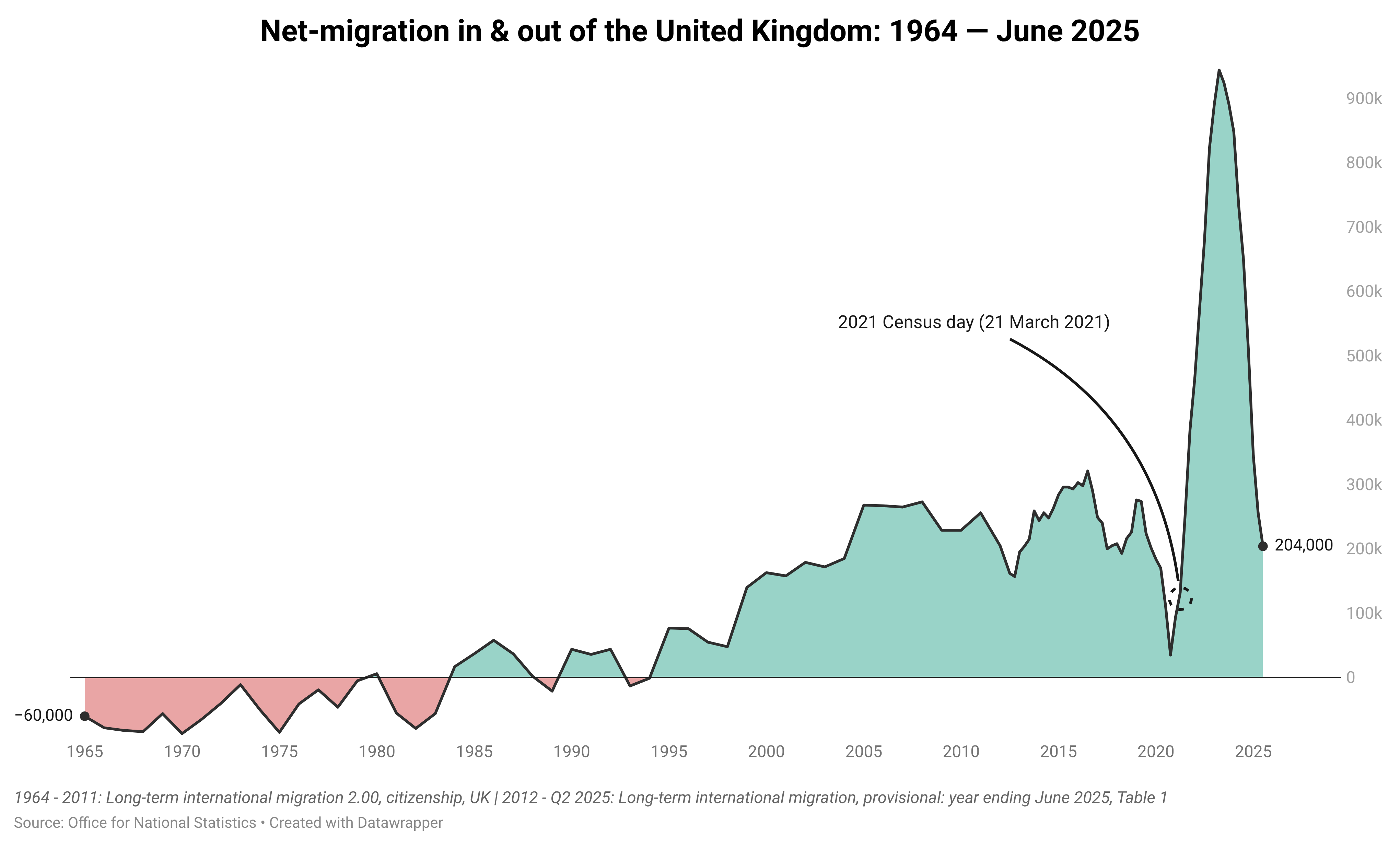
Fortunately, there are ways we can gauge a rough idea of how many eligible Commonwealth nationals are in the UK post-Boriswave. Table 3f and 3e from the ‘ONS long-term international migration, provisional: year ending June 2025 release’ allows us to see immigration and emigration estimates for the top ten non-EU countries, six of which are Commonwealth. These include:
India
Pakistan
Nigeria
Bangladesh
Australia
Ghana
I stress these estimates do not encompass all Commonwealth countries, only estimates from the top ten non-EU nationalities. From these estimates, we can derive a net figure. Once tallied, it looks like this:
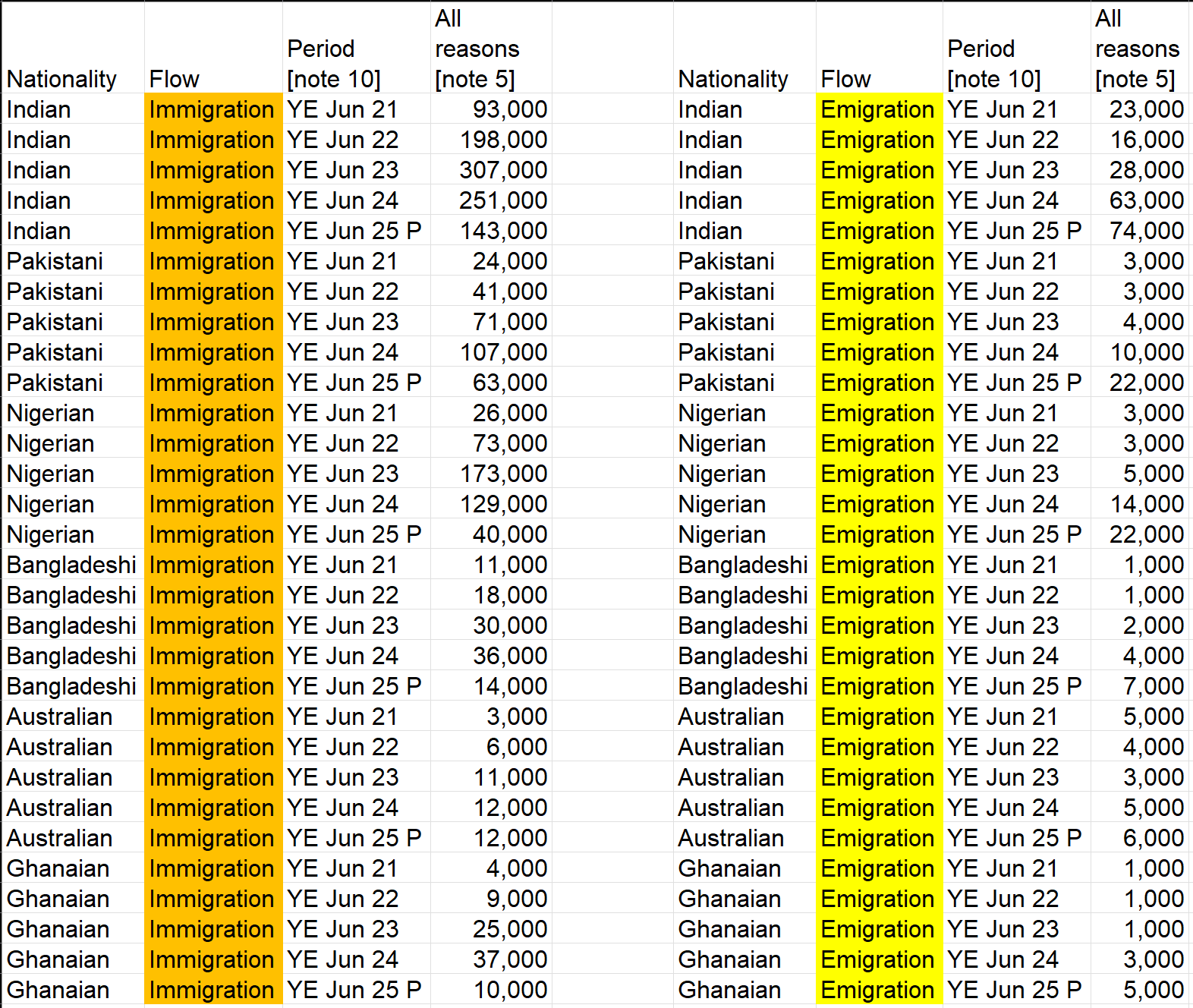
Total immigration: 1,977,00.
Total emigration: 342,000.
Net-figure: 1,635,000.
There are some caveats with this approach:
Given the coverage period is Year End (YE) June 2021 to YE June 2025, there will be some overlap with those captured in CT21_0325, as some may have arrived in the year ending June 2021 and would have been captured in the 2021 census and who held a Commonwealth passport on Census Day (21 March 2021). This number will be small, given that the Boriswave truly took off in 2022 and 2023, and throughout much of 2020 and 2021, we had COVID-19-related travel restrictions.
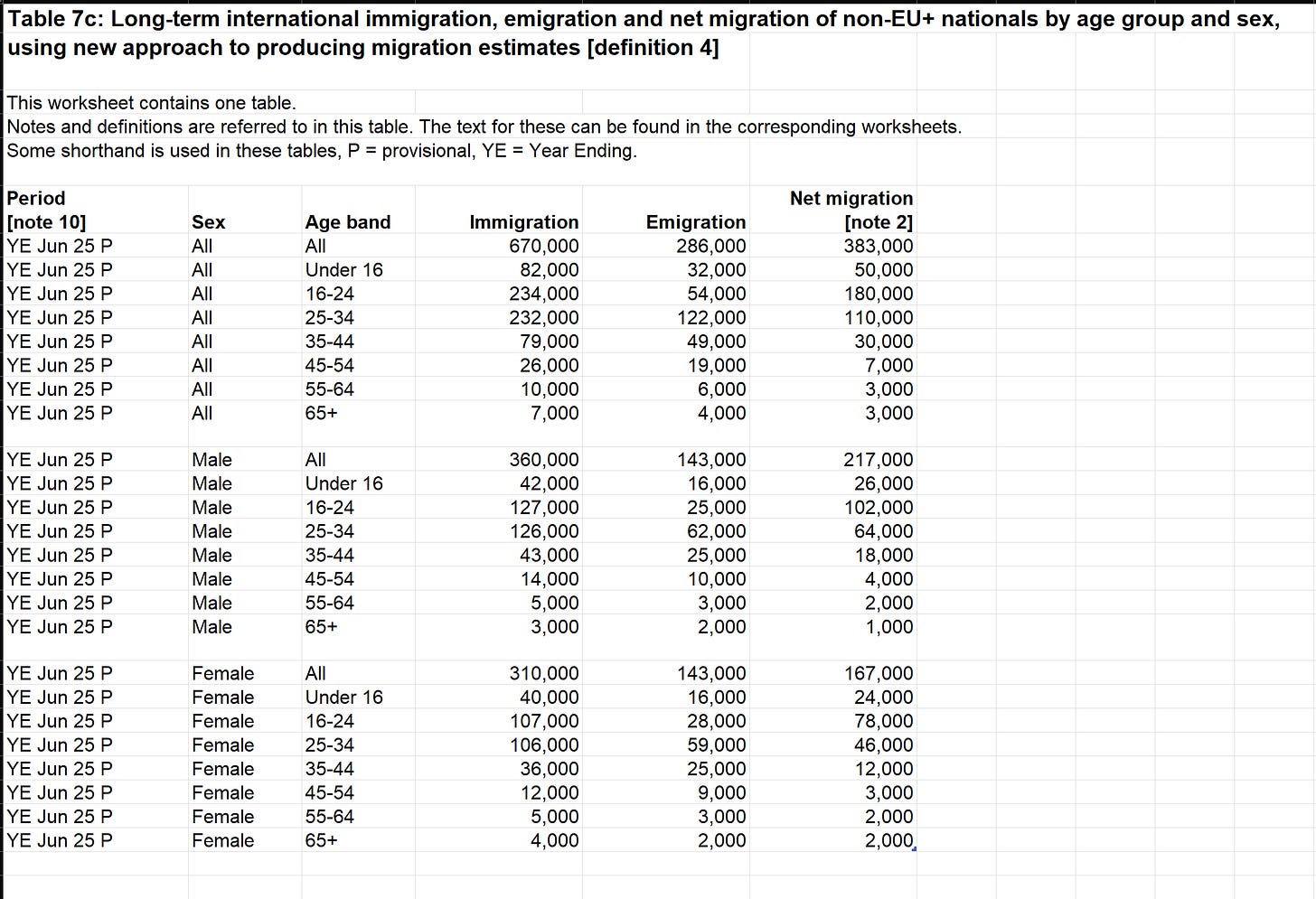
Some of these nationals will have been under the age of 18 when they arrived, so wouldn’t have been able to register to vote, at least on arrival. Neither the Home Office or ONS disaggregates by age for visa issuance or immigration and emigration estimates (at least not in publicly available datasets) when it comes to nationality. This is less of an issue, however, given that: (a) Labour is lowering the voting age to 16, and (b) by the time of the next General Election (which could be as late as August 2029), even someone who arrived under the age of 16 in, say, 2022 or 2023, could be of voting age by August 2029.
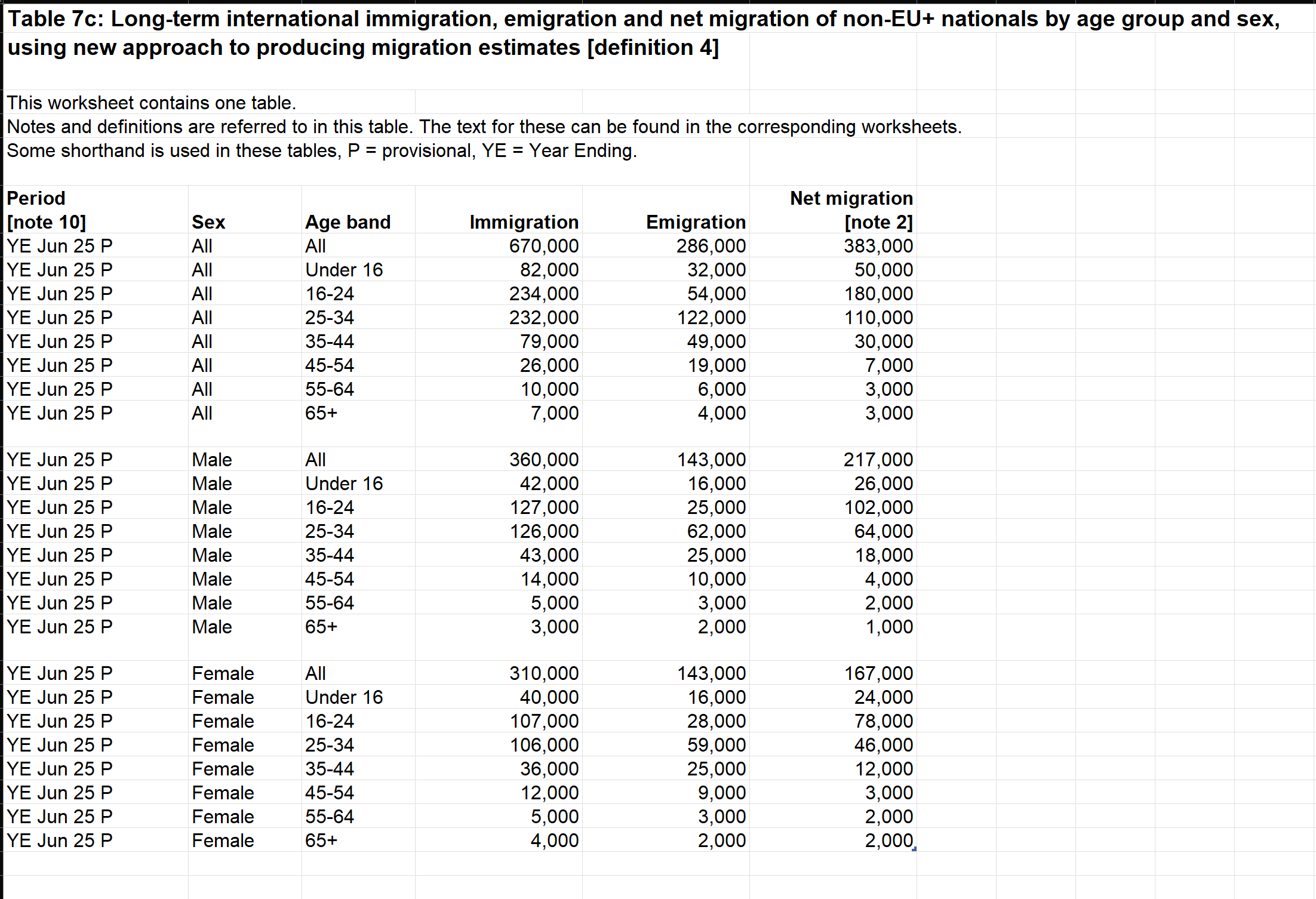
If you look at Table 7c, which only covers the year ending June 2025, most non-EU immigrants are aged 16 or older.
These estimates only cover six countries that are in the Commonwealth and included in the ONS estimates, out of 55 total Commonwealth countries (not including the United Kingdom). If we had immigration and emigration estimates for all Commonwealth countries, the figure would no doubt be higher.
If you tally 993,426 (from CT21_0325) and 1,635,000 together, you get 2,628,426. Even after accounting for some overlap and those immigrating from Commonwealth countries who are below the age to register to vote (currently 18, set to be reduced to 16 before the next election), this is a massive figure. Even if you are conservative in your assessment of these figures, it’s probably a safe assumption there are around ≈2.5 million Commonwealth citizens in the UK who could register to vote.
However, being able to register to vote doesn’t necessarily mean you will. How many Commonwealth citizens do actually register to vote?
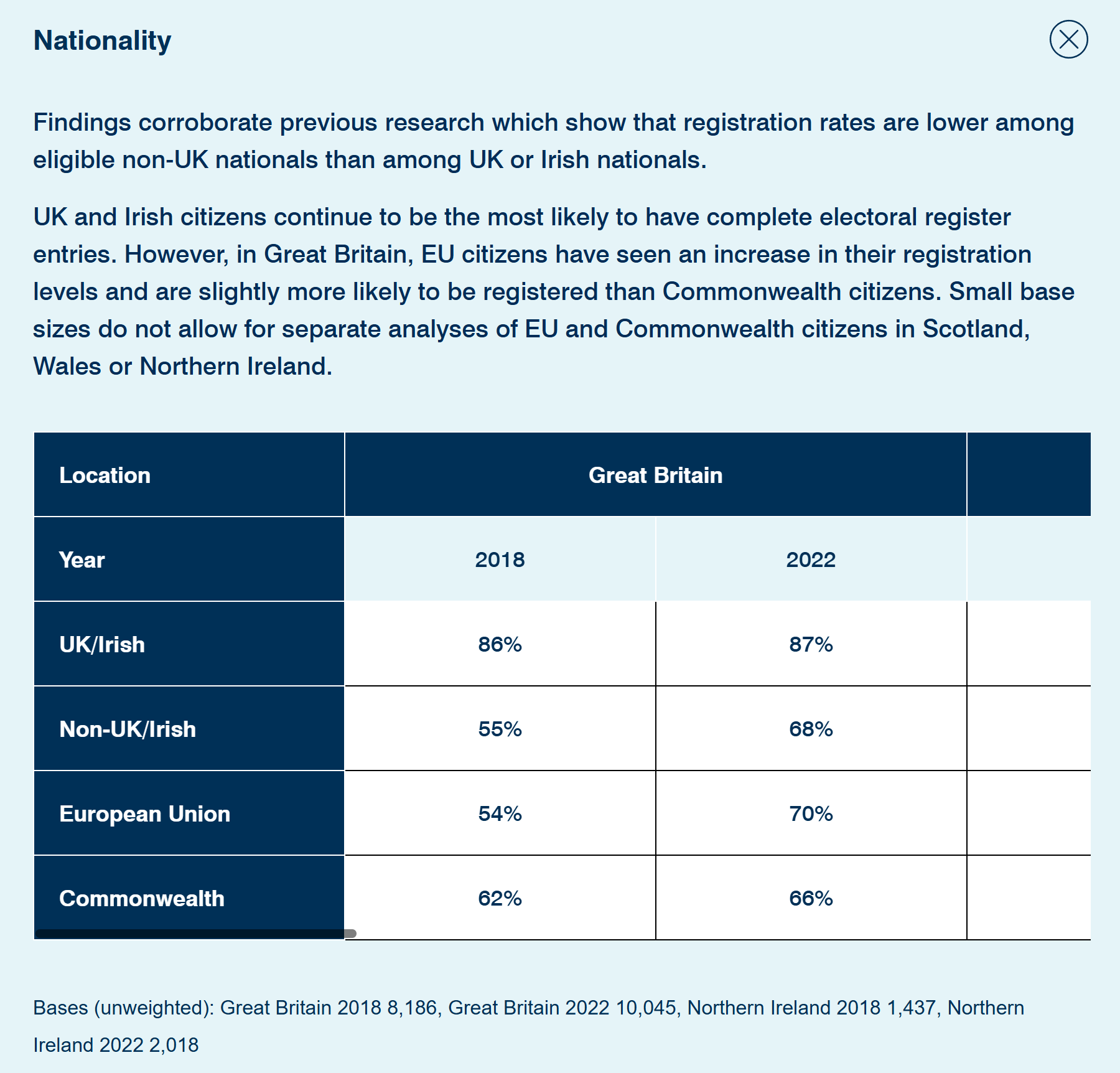
Instinctively, I would have said not many. If I had to guess, I would have assumed around 5-10%. A lot of British citizens don’t even know Commonwealth citizens can vote, and I’ve had a few immigrants in my replies whenever I mention Commonwealth voting who are surprised to learn they can register to vote. But in 2023, the Electoral Commission released a report titled: ‘2023 report: Electoral registers in the UK’. In the report, under ‘Nationality’, they list the percentage of Commonwealth citizens in 2022 who were registered to vote at 66%, up from 62% in 2018.
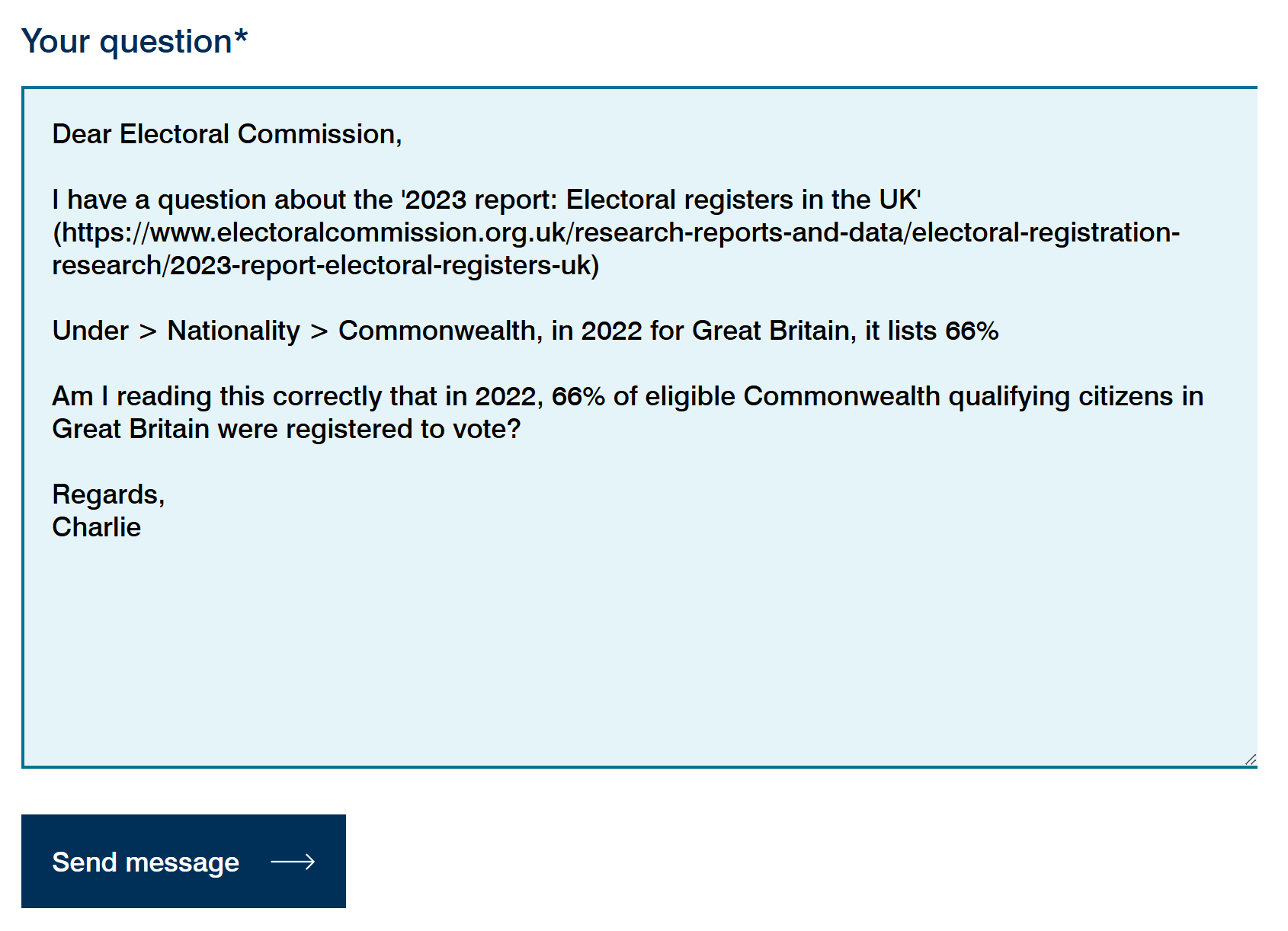
To ensure I was not misreading this, I contacted the Electoral Commission and asked:
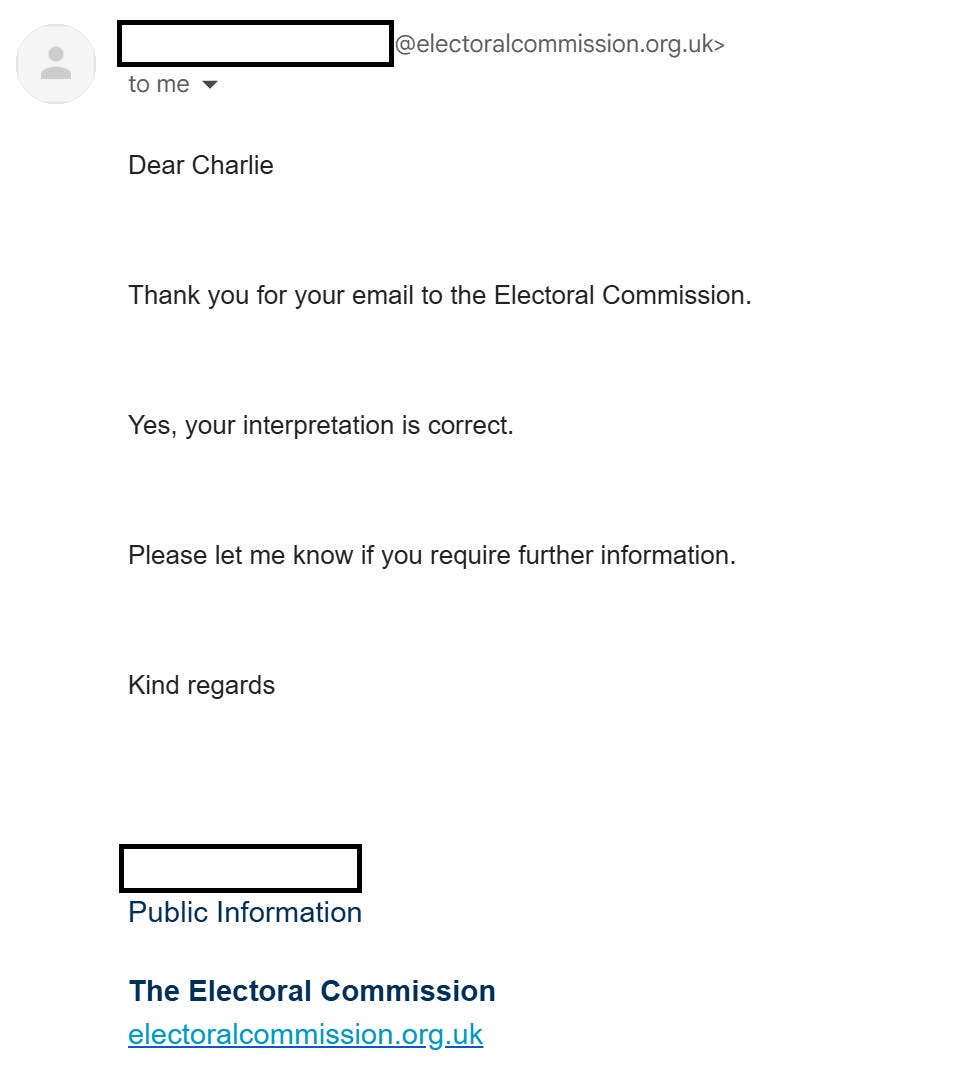
They responded and confirmed that my interpretation was correct.
I then asked what dataset the Electoral Commission was using to determine what percentage of Commonwealth citizens were registered to vote. I won’t include these responses, as they aren’t relevant to the premise of the article, but, in short, the Electoral Commission conducts surveys every couple years with massive sample sizes to represent the population, and of the Commonwealth citizens interviewed for the survey, 66% in 2022 were registered to vote.
These figures are substantially higher than I expected. If these Electoral Commission surveys are accurate and representative of Commonwealth citizens at large, then of the 2.5 million estimate earlier, over 1.6 million Commonwealth citizens could be registered to vote in UK elections. In addition to lowering the voting age to 16, Labour is also set to introduce automatic voter registration (AVR).
In a recent article in The Spectator, David Shipley spoke with the Ministry of Housing, Communities and Local Government, who confirmed to him that automatic voter registration will include Commonwealth citizens.
The Representation of the People Bill aims for a gradual shift towards a more automated registration system to simplify the process for voters, such as reducing the need for them to repeatedly fill out their details across various government services. That includes Commonwealth citizens, and it is right and fair that we make it easier for anyone eligible to register so we can boost engagement in our democracy.
It isn’t exactly clear quite how this will work. But regardless, by the time of the next general election, it’s plausible the UK will be automatically registering hundreds of thousands of Commonwealth citizens on temporary visas to vote in UK elections despite not being British citizens.
Given how ethnic-minority voters tend to lean left, this is likely to benefit left-leaning parties like Labour and the Greens. According to YouGov, at the 2024 general election, 53% of ethnic-minority voters planned on voting Labour, with 14% voting Conservative, 14% Green, 7% Reform UK, 6% Liberal Democrat, and 5% to other parties.
As highlighted in an article in Reuters from July 2024, some migrants even boasted about voting for parties at the 2024 General Election who promised to make it easier for more migrants to settle in Britain:
Paulraj, 27, who came to Britain in February last year, said he was excited to cast his vote after missing the election in his native India.
Teh Wen Sun, a 33-year-old Malaysian student from Salford said she did not see much difference between the two main parties, but she was keen to vote for a party that is more receptive to immigrants.
Oyinkansola Dirisu, 31, a support worker from Manchester who came to Britain in 2022, said she was looking forward to voting for Labour, and said she wanted whoever won power to make it easier for people like her to move to Britain.
One migrant was even surprised to learn they can vote despite not being British citizens and remarked how their country doesn’t allow people from other countries to vote:
In my country, they don't allow people from other countries to vote... I came here on a student visa, but they are giving us an opportunity, like British citizens," said Panjak who works part-time as an ambassador at his university in Manchester, northwest England
For all the talk of foreign interference in British politics, it’s a travesty that Commonwealth voting has persisted for this long. Setting aside raging debates about national belonging, citizenship (regardless of to whom it is given) must be meaningfully separated from non-citizenship as a representation of shared political participation. The anachronism of Commonwealth voting makes a mockery of that notion. It has only persisted for so long because successive British Governments have been too lazy, too timid, and lacked the foresight to envisage what such a provision in law would allow if immigration from the Commonwealth remained high or was to grow further — as it ultimately has.
Given the surge of immigration into the UK since 2021, much of which has been from Commonwealth countries and given the growing influence of ethnic voting blocs we are seeing emerge, it’s time to end Commonwealth voting and to assert that only British citizens should be able to vote in UK elections.
This article was written by Charlie Cole, a Pimlico Journal contributor. Have a pitch? Send it to submissions@pimlicojournal.co.uk.
If you enjoyed this article, please consider subscribing. If you are already subscribed, why not upgrade to a paid subscription?
Great piece. Is the commonwealth voter data available by constituency. It would be interesting to see how many MPs are reliant vulnerable to commonwealth voting blocks. As we saw in Gorton where many seem to have flipped en masse to the Green (as in the flag) party
Great article. Do we have any suggestions on how best to change this? Are we seeing any political desire to change it?
I feel that Reform will be slightly reluctant to touch it just yet as it might be seen as targeting the “strivers” who come from commonwealth countries, with even the notion of the commonwealth being fairly nostalgic and therefore having some intangible value for a lot of Reform’s older base.