
‘British Values’ are many things. Tool, weapon and lie, increasingly deployed in a sinister fashion to label political figures on the right as ‘un-British’. They are also, as is often the way in the Yookay, ineffective, not least because of their peculiar history, which goes all the way back to 1988 and Thatcher.
These days, British Values are often appealed to by our politicians, despite, or perhaps because of, their vapidity and universality. For there is nothing uniquely British about these values, and yet they have become an object of a shallow attempt to foster a secular religion. They are part of the National Curriculum, and are taught in schools across the land, often illustrated using the ‘British Values Hand’. What makes this all particularly odd is that ‘British Values’ are an entirely modern invention, albeit one with a rather unusual history. Indeed, their vapidity and universality may rather be the point. They are so inoffensive as to be acceptable to many people in multicultural Britain, while also being sufficiently protean that they can be changed to suit prevailing political goals.
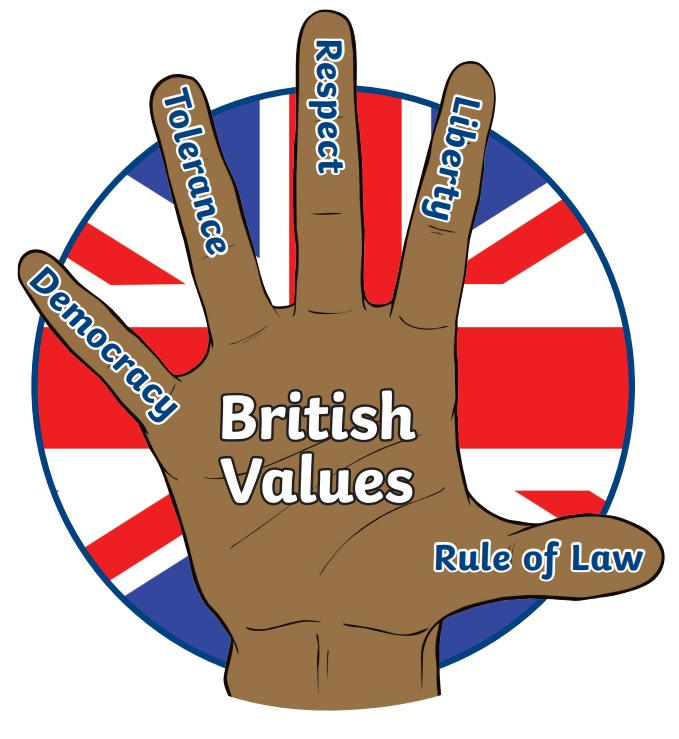
British Values were officially defined in the 2011 Prevent strategy as ‘democracy, equality of opportunity, freedom of speech, and the rights of all men and women to live free from persecution of any kind’. But when Keir Starmer spoke in Hastings recently, he defined these values as ‘rules that protect those in need’, ‘the freedom to live and let live’, ‘decency and tolerance’, ‘respect for difference under the same flag’ and the ‘common good’. The disappearance of ‘democracy’, and its replacement with ‘decency and tolerance’, is particularly sinister, given the regime’s increasing tendency to label those who challenge multiculturalism as lacking in ‘decency’, and the manner in which ‘tolerance’ has come to mean ‘accepting multiculturalism’, not tolerance for different political opinions.
In any event though, these values, according to Starmer, ‘make us strong’, and he even went as far as to say that he owes ‘everything’ to British Values, a peculiarly ahistorical claim for a man born in 1962. The Prime Minister also had a warning for some of us. According to Starmer, those who notice that integration has failed in many parts of our country are manufacturing ‘grievance’ and undermining those sacred British values he holds so dear. Although his particular form of British values is new, in fact, the Prime Minister is just the latest politician to claim that ‘values’ will save a country which is visibly fracturing under the pressures of multiculturalism.
This utopian belief in the power of an artificial set of national values was visible in 2011, in the government’s Prevent report, which warned that the Home Office had been funding ‘a small number of Muslim organisations’ which ‘had expressed (or employed people who had expressed) extremist views’ (that is to say, views incompatible with British values). The view at the time seems to have been that extremism, particularly the Islamic form, would be defeated by encouraging all British citizens and residents to accept these values as their own. This belief seems to have developed after the London bombings in 2005. Grappling with the reality that four British-born, notionally ‘integrated’ muslims had conducted suicide bombings on London’s tube and bus network, Labour ministers started to speak openly about the failures of multiculturalism. Margaret Hodge, at the time the Work and Pensions minister, apparently ‘blamed a surge in white, working class racism on its black victims’ failure to ‘integrate’, while Ambalavaner Sivanandan, Director of the Institute of Race Relations, wrote that ‘no country in Europe could be prouder of its multicultural experiment than Britain. But in the wake of the bombings of 7 July, multiculturalism has become the whipping boy.’
By the following year, Bill Rammell, then Labour Minister for Higher Education, was arguing for ‘compulsory lessons’ about ‘core values’. In Rammell’s utopian view, schools would be ‘the engine for creating a more united and cohesive society’. Needless to say, despite British Values being embedded across the education system, this country is less united and cohesive than it was twenty years ago, with explicitly sectarian MPs, and the Green party winning a by-election having campaigned in Urdu, and emphasised Starmer’s closeness to Modi in an advert for Muslim voters.
Rammell’s idea wasn’t new. In fact, the whole concept of values which would bind British society together was developed last century, in the very different world which existed after the Wall fell and before the Towers did. It was also a concept originally developed for schoolchildren, again, animated by a utopian belief that our schools could knit society together. However, the origin of this approach was neither the Blair, nor even Major governments. Instead, it was under Margaret Thatcher that the 1988 Education Reform Act introduced the National Curriculum, which amongst many other requirements, mandated that schools be responsible for the ‘spiritual, moral, social and cultural’ development of pupils. The beginning of this innovation in the British state’s self-conception had, in fact, coincided with a wider intellectual milieu of ‘constructivist’ theories of nation (springing from Benedict Anderson’s Imagined Communities and Ernest Gellner’s Notes on Nationalism, both published in 1983) and a new communitarianism. At the time, this seems to have been intended to prevent hard-left local authorities from pushing their own extremist ideologies.
However, this effort was soon co-opted by those on the left with their own agenda. By the mid-90s, the Schools Curriculum and Assessment Authority (SCAA) had become animated with a new purpose, publishing pamphlets and hosting conferences on ‘Education for Adult life: the spiritual and moral development of young people’. This was explicitly seen as a reaction against Thatcherism, in which teaching ‘fundamental values’ would ‘shore up an increasingly fragmented social order’. At the ‘Education for Adult Life’ conference, Ron Dearing, former businessman, University of Nottingham Chancellor, and future author of 1997’s National Committee of Inquiry into Higher Education gave a speech which articulated the decline of ‘invisible bonds’ in society:
The invisible bonds to which I refer are the bonds that came naturally in a much more stable society than we have today. They came from families of grandparents, parents, uncles and aunts, who often lived their lives in one town; from neighbours who lived in the same street for long years; from the doctor, the parson, headteacher and teacher, the postman, the policeman, and, yes, the milkman too, for being long part of one community and being known, liked and respected, and by their lives, setting standards, in particular, for young people. By contrast today, we are a highly mobile society. Those tent-pegs of my childhood have largely gone, especially in our cities. At the same time, the gradual erosion of the Christian religion, the decline of Sunday School as part of a child’s Sunday, and the values they stood for, have further loosened the code that our society is based upon.
The SCAA’s post-conference report went further, describing the ‘possible causes’ of this moral collapse as ‘dominant intellectual currents’, ‘loss of moral discernment’, ‘loss of respect for national leaders, both temporal and spiritual’, ‘materialism and greed’, the ‘fragmentation of the family and the collapse of historic communities’, ascribed to ‘marriage breakdown, social and geographic mobility, unemployment and poverty…the influence of international mass media’, ‘technological developments’ and ‘lack of a common language’ (by which they seem to have meant the lack of agreed meanings of moral words, rather than a population which did not all speak English).
The SCAA had commissioned polling company MORI to conduct research, and seems to have used that evidence shamelessly to advance its goals. In early 1996 the SCAA cited a 1994 MORI poll, which seemed to ‘question the very existence of a consensus on core moral values’, finding that ‘48% of 15-35 year olds did not believe that there were definite rights and wrongs in life, while 41 % felt that morality always (not just sometimes) depended on the circumstances’. The organisation used this poll to claim that there was a ‘problem of moral relativism’ in British society, and yet within the same year, it cited a 1996 MORI poll, intended to ‘discover the degree of agreement on the values statements’. The SCAA claimed that this showed ‘there is in fact a very strong agreement across all ages and social classes’, although the study was challenged for asking no children for their opinions, and over the fact that 82% of responses from schools were personally returned by head teachers, who were presumed to speak on behalf of the entire school.
At the SCAA’s ‘National Forum for Values in Education and the Community’, in 1996, the organisation aimed to ‘establish a consensus on values for schools’. It apparently ‘identified core values focused on the self, relationships, society and the environment, aiming to support students’ spiritual, moral, social and cultural development’. By 1997, in the early months of New Labour, this new narrative seemed embedded in academia, with the ‘very prominence of current concerns about values education’ being explicitly framed as a response to ‘the development of individualism, consumerism and value-added thinking’.
By 1999, the National Curriculum Handbook for junior schools contained a detailed list of ‘fundamental values’ for the ‘self’, ‘relationships’, ‘society’ and ‘the environment’.
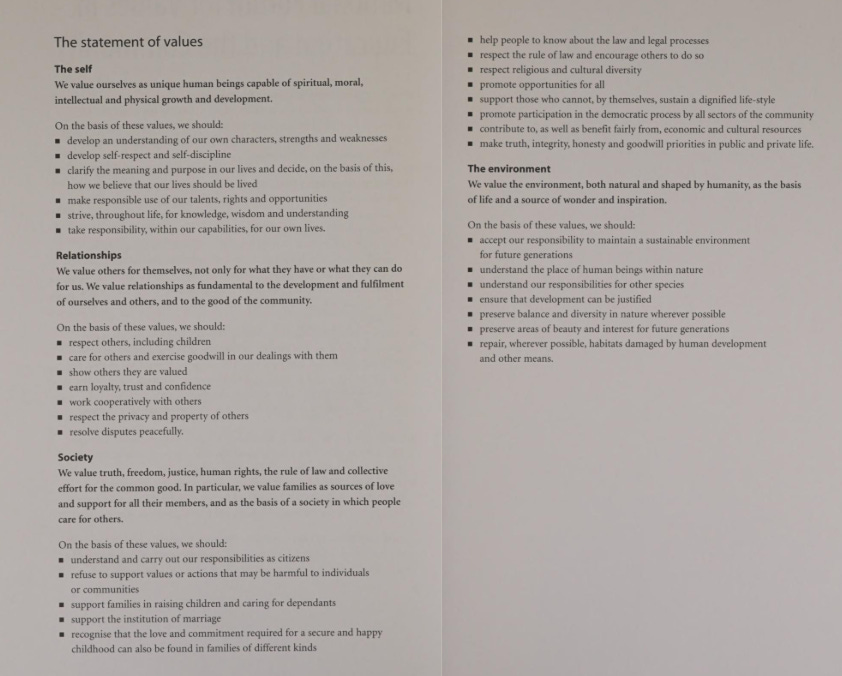
Many of them are very similar to today’s British Values - in particular the ‘Society’ section which states we ‘value truth, freedom, justice, human rights, the rule of law and collective effort for the common good’, in a clear antecedent of both the 2011 ‘democracy, equality of opportunity, freedom of speech, and the rights of all men and women to live free from persecution of any kind’ and Starmer’s ‘rules that protect those in need’, ‘the freedom to live and let live’, ‘decency and tolerance’, ‘respect for difference under the same flag’ and the ‘common good’.
There are differences, too. Respect for ‘the institution of marriage’ has disappeared from the 21st Century Values, although even in 1999 it was oddly juxtaposed with the instruction to ‘recognise that the love and commitment required for a secure and happy childhood can also be found in families of different kinds’. Perhaps this represents a moment of balance between old-fashioned respect for institutions which worked and the modern preference for never shaming people’s lifestyles. It is also interesting to note the blending of universal moral principles, such as ‘respect others’ and ‘develop self-respect’, with more political demands to ‘respect religious and cultural diversity’ and an explicitly environmentalist section.
These values, already embedded in the education system and supported by academics and experts who promised they would knit Britain back together, must have seemed a godsend to New Labour. After 9/11 and after the London bombings, the government didn’t invent a new strategy to handle the disaster that multiculturalism had become. Instead, it took an idea from the dying years of the Major government and expanded it from the education system to the whole of British society. Trying to teach a unified set of values to 1990s British schoolchildren, and thereby healing British society, was in all likelihood already impossible. Attempting it with adults in the post-9/11 world was doomed to failure, as we have seen over the past two decades. That politicians in 2026, thirty years after the SCAA conference, are still desperately asserting the importance of British Values, and hoping that they will fix Britain, merely reveals quite how tired and unimaginative our governing class are. For in the Yookay, even our utopians have given up on Utopia.
This article was written by David Shipley, a Pimlico Journal contributor. You can find more of his work at The Spectator, The Critic and on his website. Have a pitch? Send it to submissions@pimlicojournal.co.uk.
If you enjoyed this article, please consider subscribing. If you are already subscribed, why not upgrade to a paid subscription?
Starmer and Bliar have no British values as recognised by decent, sentient, indigenous or properly integrated Britons.
1000 years of nationhood, built by we, the people.