
The political and diplomatic row over the Chagos Islands has reached a salience usually reserved for the price of poppers and Johnson’s Baby Oil for the Chemsex Right — that is to say, the faction that dominates the Conservative and Unionist Party. Conversely, for the sensible centrist balancers who make up the readership of the Pimlico Journal, the issue has been of very little interest. Unfortunately, the matter of the Chagos Islands shows little sign of being ready to quit the stage. As such, this article will set out doctrine in relation to the Chagos Islands which must be adopted wholesale and uncritically by all readers of the Pimlico Journal. This is less an editorial line, and more a dogma. Dissent from it will not be tolerated, and those who demur from it will be subject to ostracism. Only by taking this inflexible line may we ensure that this tedious topic is banished from discussion forever.
The purpose of this article is to debunk the existence of the so-called ‘Chagossian People’. However, before we arrive at this ontological holocaust there are a few preliminary matters which must be addressed.
The History and Geography of the Chagos
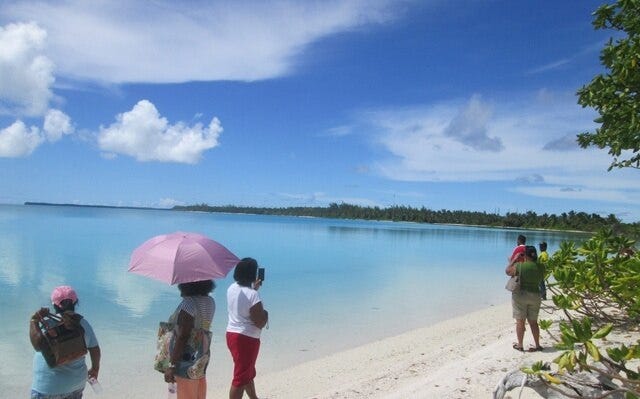
The Chagos Islands are a remote archipelago of small rock and coral atolls in the Indian Ocean. They are about 1,000 miles south of India, and about 2,000 miles east of Africa. The nearest place to the Chagos that anyone in his right mind has heard of is the Maldives, which are about 300 miles to the north. The nearest outlying island of Mauritius lies about 1,000 miles to the southwest, with Mauritius proper being a further 300 or so miles away. The largest island in the Chagos is Diego Garcia, the atoll upon which the ‘joint’ military base is now located.
No island in the Chagos has a source of fresh water other than rainwater (and for pendants, rainwater lenses). For pre-modern man the Chagos were about as accessible as the moon. Until Portuguese naval architects invented the caravel, no human civilisation was capable of reaching the Chagos, and indeed it was the Portuguese who were the first to encounter the Chagos and to supply names to its principal atolls.
Readers who know their history will be aware that the French Indian Ocean colonies of Isle de France and La Réunion were captured by Britain in a brilliant campaign led by Cdre J. Aubrey in 1810, with the latter being returned to France (who still control it to this day) and the former ceded to Britain as ‘Mauritius’ in the 1814 Treaty of Paris. Under this treaty, France ceded not just Mauritius, but all its dependent territories. The Chagos, although discovered by the Portuguese in the sixteenth century, had been a dependency of Isle de France since 1715. Thus, the Chagos became lesser dependencies of the Crown Colony of Mauritius.
We will pause here to settle some pedantry. Occasionally sensible voices of the Online Right, such as Madeline Grant and Lord Moylan, have objected to the BBC making reference to the British Government’s plans to ‘give back’ the Chagos to Mauritius. However, the BBC is in fact perfectly correct: the Chagos were dependencies of the Crown Colony of Mauritius, and the Mauritian Republic of Corrupt Lower-Caste Indians (or whatever the post-independence nation is officially called) is the legal successor of the Crown Colony of Mauritius. That the Chagos Islands are far closer to the Maldives than Mauritius and that the Colonial Government in Mauritius never had much to do with the Islands is irrelevant. As such, if we were to cede sovereignty to Mauritius we would indeed be ‘giving back’ the Chagos as a matter of natural English usage. This does, of course, provide us with no actual reason to do so — but more on that later.
The French had established copra (coconut oil) plantations on some of the larger islands of the Chagos in the eighteenth century and likely employed slave labour in those plantations. Those plantations continued to operate after Mauritius was ceded to Britain. Manumission of all slaves in the British Empire occurred in 1834.
The inhabited islands of the Chagos were all owned by the copra plantations, except for some small parcels of land in Diego Garcia that were owned by the Mauritian Colonial Government. The copra plantations employed contract workers who lived in dormitories on the Islands. Some of these workers were from Mauritius; some were from the Seychelles. A small number had been born on the Islands, and it is possible that some of these were the descendants of slaves who had worked on the Islands before manumission. Although the right to reside on the Islands was tied to employment on the plantations, and no worker owned any land of their own, the plantations did — when feeling in a generous spirit — allow some superannuated workers to retire and remain on the Islands. There were some women on the Islands, and some children were born there from time to time; enough for there to have been a crèche and small school on Diego Garcia in the 1960s. The colonial government of Mauritius appointed the plantation managers as magistrates and had no other permanent governmental presence on the Islands, save for a meteorological station on Diego Garcia. Supplies of basic necessities were brought into the Islands by ship from the Seychelles or Mauritius and distributed through company stores. The Islands were essentially oil rigs, albeit for coconut oil.
By the 1880s, all the plantations on the Islands had been sold to and consolidated under a single company. By the 1960s, falling coconut oil prices led to the population of the Islands dwindling, as the plantations failed to make a profit. In 1962, a Seychellois company acquired the plantations, hoping it could make them profitable again.
In 1964, discussions began in earnest between the United States and Britain about Britain leasing parts of the Chagos to the United States for the purposes of establishing a military base there. Other than a small airstrip established and operated during the Second World War, Britain had never maintained military forces on the Islands. The Americans required vacant possession of the Islands due to concerns about espionage, sabotage, and protest. Britain was already committed to granting Mauritius independence, and the United States did not wish to rely on the goodwill of newly-independent nations. As such, the Americans suggested that Britain detach the Chagos from the Crown Colony of Mauritius and grant them basing rights in exchange for cash. We duly did so. We first purchased the freeholds of the Islands from the Seychellois plantation company, granting it a short-term leaseback. The Crown-in-Council then purchased the Chagos from the Crown Colony of Mauritius for £3 million (plus compensation for those displaced, to be subsequently agreed) and created the British Indian Ocean Territory (BIOT) — although not yet its distinctive flag, which would have to wait until 1990 — in 1965. Mauritius then became independent in 1968.
In 1967, the population of the Chagos stood at just 924. Of these at least 437 were dormitory workers from Seychelles and Mauritius. The remaining 487 identified as Ilois, a Creole term roughly translating to ‘islanders’. By the 1990s, activist groups had decided the term Ilois was — for undisclosed reasons — offensive, and as such the term that is now preferred is ‘Chagossian’. These 487 people were not necessarily born on the Chagos, and many had simply worked and lived there for a long time and expressed a preference to remain there.
From 1967 onwards the Seychellois plantation company ceased to recruit new workers whenever their existing contract workers returned home at the end of their contracts, and the population consequently experienced a rapid decline. British officials travelled to the Islands that same year and informed the inhabitants that the plantations were to be closed, and that everyone would eventually have to leave, albeit compensation would be provided.
American servicemen and contractors began to arrive on Diego Garcia from 1969, though it was not until 1971 that the United States were ready to take full possession of the Islands. In 1971 notices were given on the leases, and the Seychellois plantation company arranged for the evacuation of the Islands. By this time the population on the Chagos stood at less than 343. The workers left peacefully — albeit they complained about their treatment aboard the vessels which transported them to the Seychelles and Mauritius. The Seychellois company also rounded up domestic animals and killed them, burning their bodies in a calorifier. It was later — inaccurately — claimed that the British Government murdered the islanders’ pet dogs to intimidate them into leaving. Those involved claimed that they humanely disposed of animals left behind by the evacuated human inhabitants. In any event, no British official was involved in the killing of any dogs.
The British Government had previously agreed to pay compensation to the Mauritian Government for the benefit of the evacuated population. The compensation figure was agreed in 1971 to be £650,000, and it was paid in 1973. This figure was eroded by the inflation caused by the oil crisis, and the former population of the Chagos felt shortchanged. Encouraged by opposition politicians in Mauritius, they were put in contact with lawyers in Britain, who began to demand more money on their behalf. An agreement was reached in 1982 by which Britain agreed to pay £4 million into a trust fund to be disbursed to the Ilois by trustees elected by the Ilois, in return for the Ilois renouncing any right to return to the Chagos. The money was paid into the fund between 1982 and 1983, and most had been disbursed to the Ilois by 1984. The final £250,000 was disbursed in 1987, thereby exhausting the fund. Once the fund was exhausted the Ilois wasted no time in demanding further payments from both the British Government and the American President, and litigation in the English Courts, House of Lords, and European Court of Human Rights ensued throughout the 1990s and 2000s.
Naval Support Facility Diego Garcia, a last bastion of Empire?
The British Indian Ocean Territory is nothing more than a legal fig-leaf to conceal the reality, which is that the Chagos are an American colony. The so-called ‘joint’ US-UK base houses about 4,000 troops and civilian contractors, of whom about 40 are British. From what we know of the agreement concerning the base, there are currently no British aircraft stationed there and, furthermore, Britain has no right to station aircraft there. The presence of British forces is said to be for the purpose of providing a ‘civil administration’, which is to say that they are solely there for the purposes of maintaining Britain’s claim to sovereignty through continuous occupation and administration. The BIOT is not like other British Overseas Territories with longstanding settlements of British civilian populations or where Britain has a strategic and/or military interest. We are merely there in order to allow the Americans to be there. They paid us for the privilege. If they had not, then the Chagos would never have been detached from Mauritius, and now they would be an uninhabited outlying territory of Mauritius that no one would have heard of. All this is to say that we have little interest of our own in the Chagos.
A Chud might say we ought to sell the Chagos to the highest bidder. However, that belies the fact that the United States is already in de facto control of the Chagos and would never allow us to do so. We are (like it or not) currently dependent on the United States for security. Unless and until we invest sufficiently in our military to maintain a foreign policy independent of the United States, we must do as our hegemonic master commands. If the BIOT, with its attractive flag, kindles some imperial longing in your breast, go and take a cold shower.
What should we think about the Chagos deal?
In light of what I have outlined above, let us look at the deal the British Government has reached with Mauritius: We will cede sovereignty in the Chagos to Mauritius, subject to a 99-year lease-back. In consideration for the lease-back, Britain must pay rent. Depending upon methodology used, official estimates as to the cost of this rental obligation range from £3.4 billion (net present value), to a huge £34.7 billion (nominal value).
This deal on its face seems insane. We give up something of value, and we pay for the privilege of doing so. There is little good journalism explaining why we would even countenance such a deal. The Labour Government have not offered any particularly strong case for doing so, aside from vague references to ‘international law’. Fortunately, Richard Ekins and Yuan Yi Zhu at Policy Exchange have done an excellent job of debunking the idea that we are obliged by international law to cede sovereignty in the Chagos. We will not reproduce their work here, beyond saying that the ruling of the International Court of Justice cited by the British Government is non-binding and need never be binding.
Given that we are in no way required to give up the islands, why are we doing so? Some have asserted that the Biden Administration pressed us to cede sovereignty, perhaps to curry favour with the Indians (Mauritius is effectively a satellite state of India). The right-wing tabloids say that lefty-lawyer Keir Starmer, KC is eager to do so to please the Islington dinner party set, or to corruptly aid his good chum Phillipe Sands, KC, another lefty-lawyer and counsel for the Mauritian Government (Sands even received a Mauritian passport as thanks for his hard work). The problem with this explanation is that it does not explain why it was the Tories who initiated this process whilst in government. Others have therefore blamed it all on Vijay Rangarajan, an Indian-born civil servant who now heads the Electoral Commission and who does indeed seem to have been closely involved in the matter at the Foreign Office — yet it is not as if he acted completely alone, giving away British territory without anyone else noticing.
Either way, so long as any good reasons for accepting the deal remain elusive — as seems very likely — the question posed to readers is very simple. It is as follows: if we cede sovereignty to the Mauritius but want to allow the Americans to keep their base, then we must pay the Mauritians rent. Clearly, given our subordinate relationship to the United States, we are not going to do something that will result in them being kicked out of their very important base. So how do we escape this logical trap? By not ceding sovereignty to them in the first place, which is obviously what we should do. And with this, I hope any ‘Blue Jumper’ who happens to still be reading this article through gritted teeth will be satisfied that, while we completely reject the ‘rights’ claims of the ‘Chagossians’, we also do not support the actions of the current Labour Government.
And what of the Chagossians?
Having chewed through the preceding gristle, you may now have your well-deserved pudding: a full-throated rejection of the alleged rights of the so-called ‘Chagossians’.
Many on the Online Right lack the courage (or clear-mindedness) to express their opposition to the Chagos deal in terms of our national interest. Instead, they find it necessary to dress up their complaints — sometimes legitimate, sometimes mere imperial nostalgia, sometimes both — in a preposterous ‘rights’ claim about the ‘Chagossian’ people. While some may be doing this only for tactical reasons, in a last-ditch effort to use their supposed ‘rights’ to block the deal, most of them genuinely seem to believe it; that these ‘Chagossians’ were wronged, and that the British Government is now compounding this original wrong by handing the Chagos Islands over to Mauritius (and probably also China, somehow).
As is set out above, shortly before the evacuation of the Chagos, the population of the Islands with any sort of longstanding tie to them stood at a maximum of just 484 people, and quite possibly far less. They were voluntarily evacuated, compensated not once but twice, and renounced their right to return to the Islands in exchange for money. Furthermore, despite initial resettlement on Mauritius and the Seychelles (both substantially richer and more developed places than the Chagos Islands), a large number of them ended up living in social housing in Crawley at the expense of the British people.
If Britain did not expel them in order to allow the Americans to build an airbase, then the counterfactual is as follows: Britain would not have purchased the Chagos and detached it from Mauritius. The Chagos, despite its great distance from the rest of the country, would indeed have been part of Mauritius from independence in 1968. The plantations would almost certainly have failed in the 1970s. The population would almost certainly have been evacuated soon after, as to stay would have meant certain death, since life there is impossible without the supply boats paid for by the plantation (and there is no chance that the Mauritian Government would have paid substantial sums of money to keep people there for no reason). They would not have received any compensation. They would not have been given any free council houses in Crawley. They would not have been discussed breathlessly online by various ‘Blue Jumper’ characters.
As such, there is no ‘Chagossian’ people. There was simply a population of contract labourers whose right to reside on the Islands was tied to their employment and was at the pleasure of the plantation landowners. Those who were evacuated in 1971 enjoyed a fortunate windfall that they would not otherwise have received had they been evacuated at the behest of the plantation landowners rather than the British Government. The compensation they received is considerably more extensive than that received by the Welsh villagers whose ancestral village, chapel, and cemetery were submerged to build a reservoir at almost exactly the same time.
The ‘Chagossians’ are welfare entrepreneurs who have repeatedly shaken Britain down for cash that they do not deserve. Those of the British Right who seriously talk of their ‘rights’ or indulge their preposterous self-appointed ‘First Minister’ are fools. If there was any justice in the world, the ‘Chagossians’ would be forced to repay all the compensation and welfare they have extracted from the British taxpayer, before being marooned on a remote desert island — which is no more than what they claim to want.
This article was written by Dogbox, a Pimlico Journal contributor. Have a pitch? Send it to submissions@pimlicojournal.co.uk.
If you enjoyed this article, please consider subscribing. If you are already subscribed, why not upgrade to a paid subscription?
Is the author aware that his Cdr J Aubrey is in fact fictional character from Patrick O’brien and the actual commander was Vice Admiral Bertie ?
I’m too scared to take issue with the substance of the article, so I will confine myself to complaining about the grammar, which bears the imprint of our hegemonic master.
“The French … likely employed slave labour in those plantations.”
Yes, I know the American habit of using “likely“ as an adverb has been taken up by the British media over the last few years, including by the “British” Broadcasting Corporation, but it is not how normal British people speak. Normal British people say “probably“. They don’t say “I’ll likely be back by Seven“, they say “I’ll probably be back by Seven“. The war against “probably“ has been waged by our America-brained elite. Could a patriotic publication such as Pimlico Journal not lead the fightback?
But far worse is this horror:
“If Britain did not expel them in order to allow the Americans to build an airbase, then the counterfactual is as follows: Britain would not have purchased the Chagos and detached it from Mauritius.“
The first half of this sentence suggests that we have not yet decided whether to expel them or not and we are considering what might happen if we do decide to do so. But, of course, we have expelled them. The author is considering what would have happened IF WE HAD NOT expelled them or HAD WE NOT EXPELLED THEM.
The sentence as written makes my head hurt. But apparently this is how they speak in America now (Donald Trump never uses the Third Conditional) and depressingly, but inevitably, it is now crossing the Atlantic.
I would happily give up BIOT, Gibraltar, the Falklands and that Mutiny on the Bounty place if only we could be allowed to keep our language.