
I am a woman in my twenties living in London, not far from Pimlico. At dinner in Wandsworth recently, over roast duck and a second bottle, a friend I have known since our all-girls schooling days explained her politics to me. She did not mention anything vaguely ideological, nor did she offer any thoughts on the big issues of the day like housing, tax, migration or the economy. She said, quite sincerely, that she just wants people to be happy. Everyone at the table nodded, and so, I confess, did I. Nobody asked what that would mean for the asylum backlog, the prison estate or the deficit, because asking would have been unkind, and there is nothing so unwelcome at a good dinner as a question.
She is not unusual. She is clever, beautifully educated and headed for exactly the kind of job that shapes what the rest of the country is told is reasonable. And she has arrived at her politics the way one arrives at a favourite restaurant: by habit, in good company, without ever deciding to.
Mainstream commentary has little interest in women like her. Besides one piece in the New Statesman by Emily Lawford, few have attempted to understand what the great political divide between young women and men actually looks like or what it has been caused by. This is despite the fact that it is visible everywhere: a rapidly growing share of young women are assimilating into a politics that imagines itself to be antagonistic to the present system, feel themselves to be alienated from and hostile to the ‘system’ — and to men especially.
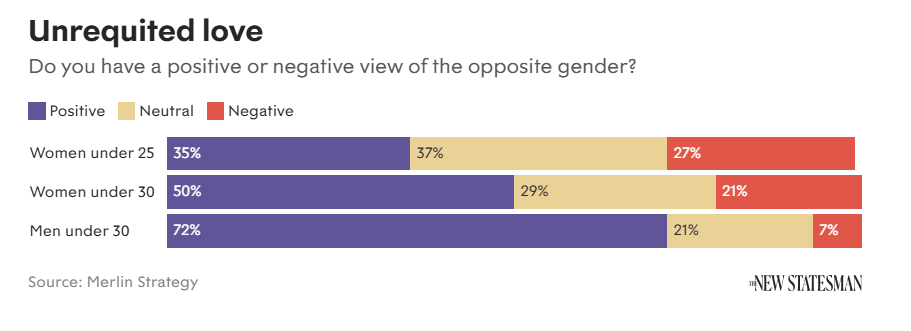
The ‘news’ cycle remains transfixed by the manosphere, as though the principal political danger facing Britain were the young men with microphones and poor lighting. Each new podcast produces another cycle of alarm: documentaries, parliamentary concern and anxious editorials asking why boys are becoming radicalised. Young men’s supposed drift to the right (under the malign influence of the algorithms) meanwhile fails to have much electoral, or physical, cut-through in Britain at all. This fixation is convenient. It lets respectable society imagine radicalisation as something that happens elsewhere: online, male, marginal, with an undercurrent of violence.
Lawford’s piece similarly explained the phenomenon of women’s radicalisation as one that is downstream of the internet. As a part of the social environment for both men and women, the online space, of course, exacerbates (and makes visible to outside observers) the radicalising process. But there is the other pipeline, at the heart of this trend, which does not run against Britain’s institutions, but through them.
The Pink Pipeline is the process by which young women are shaped into holding a set of moral axioms that unfolds into unequivocally left-wing sentiment, long before they encounter politics as a contest of ideas. No doctrine is imposed, and no movement is joined. It works through success, or the imitation of success. The better you do in the early stages of middle-class life, the further along it you travel — it often only becomes directly ‘ideological’ when one is confronted by the disappointments of adulthood.
My friend and I were taught the same things, and rewarded for the same things. School prizes emotional sensitivity and the correct expression of concern. University prizes fluency in the language of structural grievance. Professional life prizes conformity to prevailing moral assumptions, and punishes deviation from them more reliably than it rewards talent. I use the word radicalisation deliberately, and not without pleasure. The end state is a politics in which the other side is not wrong but wicked, and that is what radicalisation means.
By early adulthood, politics has ceased to be a contest between competing goods and become a distinction between kindness and cruelty. Immigration restriction feels mean. Punishment feels harsh. Borders feel exclusionary. Acknowledging biological limits feels impolite. Intent replaces judgement, sympathy displaces trade-offs, and politics becomes an extension of personal decency.
This is no longer merely a sentiment. At its conference in Liverpool last month, the governing party hung two words on every wall, every screen and every flag: ‘Hope Again’. The Prime Minister declared it time for Britain to have hope again. The Education Secretary said her department should be the Department for Hope. ‘Hope’ is a lovely thing to feel. It is a strange thing to govern by, and a stranger thing still to put in charge of the schools.
The difficulty is that governing requires decisions that goodwill alone cannot resolve. Someone must sometimes be excluded. Laws must be enforced. Resources are finite, and conflicting rights cannot always be reconciled. To a mind formed by the Pink Pipeline, merely stating these limits feels like a moral lapse. Disagreement therefore stops looking mistaken and starts looking suspect.
The sex and gender wars showed how quickly this hardens into professional consequence. Kathleen Stock left her post at Sussex after students campaigned for her dismissal over her views on sex. Maya Forstater lost her first tribunal, which ruled that her belief in biological sex was not worthy of respect in a democratic society, and had to go to the Employment Appeal Tribunal to establish that it was protected at all. Rachel Meade, a social worker, was suspended by Westminster City Council over gender-critical Facebook posts and had to win at tribunal to clear her name. None of these women was accused of incompetence. Their offence was heterodoxy, and the accusation alone was enough to make each of them untouchable.
What these cases reveal is that the enforcement is peer-to-peer. No commissar is needed. One simply notices, somewhere between the seminar room, the workplace Slack channel and the candlelit end of a Wandsworth dinner table, that certain opinions have become socially inexpressible. Belonging depends less on persuasion than on alignment. And the people most sensitive to the cost of exclusion, young women who have spent their lives being rewarded for fitting in, are precisely those most likely to comply.
None of this would matter much if it stayed at dinner. It does not. Young women have moved sharply to the left of young men. At the 2024 election, YouGov found that women aged 18 to 24 were nearly twice as likely as men of the same age to vote Green, while the men were twice as likely to vote Reform. The divide is sharper still on the question at the heart of the Pink Pipeline: in YouGov polling of 18- to 27-year-olds, 58 percent of young women said Britain is a racist country, against 37 percent of young men. Those same women are concentrated in the professions that directly shape the boundaries of respectable opinion. Women make up three-quarters of teachers in England, two-thirds of the charity workforce, a majority of the civil service and 56 percent of university students. These are not peripheral institutions. They decide what is taught, published, funded, promoted and defended. Every public institution that is ‘under-representative’ engages in even stricter measures to reshape its selective mechanisms and workplace culture to ‘feminise’ — for lack of a better word.
The point is not that every woman in these professions shares one ideology or that ‘progressive’ politics is inherently female. Indeed, most women of this kind reduce politics to a simple moral equation of whether one is a decent human being. Institutions with enormous influence over public life have developed powerful informal expectations about which views are acceptable, and these expectations are reproduced through recruitment, socialisation and promotion. By the time voters are asked their opinion, the terms of the argument, for women in particular, have long been set elsewhere.
This is why elections will struggle to correct it. Frustration registers at the ballot box while the culture of the institutions that interpret and implement policy remains stable. Ministers come and go, and the assumptions of public administration do not. Brexit changed the direction of government without changing the people through whom government operates.
Meanwhile, respectable commentary continues its ritual condemnation of the manosphere. The concern is not baseless; online communities can foster misogynistic anger with real consequences. But the asymmetry is striking. The radicalisation of young men is treated as an emergency requiring investigation; the radicalisation of young women into the assumptions of progressive professional culture is treated as moral development. The asymmetry is also self-defeating. Each denunciation confirms what alienated young men already suspect: that establishment opinion regards them not as citizens but as problems to be managed. The chief beneficiaries are the very online personalities the commentators hope to discredit. The contrast is difficult to miss. The manosphere radicalises men against institutions, while the Pink Pipeline radicalises women through them. One produces outsiders, and the other, administrators.
What makes the second kind so effective is that it does not feel like conformity at all. Those who enforce it do not think of themselves as censorious. They believe they are protecting the vulnerable, building inclusive workplaces and being kind. The possibility that their convictions might be mistaken rarely enters the calculation, because a conviction held out of kindness cannot, by definition, be cruel.
Women are more than half of the population and the electorate. Beyond what we have already seen, could the ‘Great Feminisation’ produce political effects that, on a societal level, we have no experience of responding to? Would it even be possible, by virtue of the inherent interpersonal and institutional dynamics for political actors themselves, for governments to permit the ‘necessary evils’ that may fall upon women? Men are, at least to a greater extent than women, socialised to understand that there are losers in social questions — and that, sometimes, they must be the losers. In the circumstances of, say, an economic recession, ‘taking it on the chin’ is something that is expected from men and male-led sectors — perhaps construction or banking saw downturns after 2008, and it is easy enough to have the conversation on what the appropriate size or regulations on either should be. This is a cost that ‘society’ and policymakers understand is sometimes necessary to impose. It may not be so easy for policymakers and electorates to say the same if the next recession, or economic transformation, will disproportionately affect women. The AI transition and its subsequent effects on the labour market are one of many events on the horizon that will put women’s institutional power to the test. It will almost certainly drive even greater divisions between the sexes.
The Pink Pipeline did not march or protest — even if its consequences may prove revolutionary. It advanced quietly through good schools, good universities and good jobs, until one set of political assumptions became indistinguishable from professionalism itself. At this point, my friend’s wish that people should simply be happy is no longer something idly remarked upon over dinner. It is already the operating principle of the state.
This article was written by Betty Bright, a Pimlico Journal contributor. Have a pitch? Send it to submissions@pimlicojournal.co.uk.
If you enjoyed this article, please consider subscribing. If you are already subscribed, why not upgrade to a paid subscription?
Betty Bright's analysis of the ideological changes happening, especially among girls and young women, portends serious political and societal problems, in my opinion. Perhaps the brightest prospect for stale, pale males (comme moi) is that most of the radicalised women she describes will almost certainly end up childless... (My wife has four children and eight grandchildren. So do I! And all four of our kids were home-educated. I wonder if there is a connection.)
Alex P-A