
‘But I was surprised that [Pelosi] didn’t do more in terms of Bush and going after Bush. It was almost — it just seemed like she was going to really look to impeach Bush and get him out of office, which personally I think would’ve been a wonderful thing…
Absolutely. For the war. For the war…
Well, he lied. He got us into the war with lies… By saying they had weapons of mass destruction. By saying all sorts of things that turned out not to be true.’
—Donald Trump, 2008
If Donald Trump made only three promises to the American people when he came down the golden elevator into the lobby of Trump Tower and announced his intention to run for President, they were the following: no more mass immigration, no more deindustrialisation and outsourcing, and no more pointless and costly wars in the Middle East.
On the first, the record is mixed. Border crossings have been reduced to zero, and deportations have increased. A fee of $100,000 has been attached to the most controversial visa route, helping lead to net negative migration for the first time since Hart-Celler was passed in 1965. On the other hand, the disastrous choice to encourage voluntary exits of illegals with highly publicised performative cruelty has greatly harmed the popularity of the restrictionist cause for very little gain, and the number of deportations has been woefully insufficient as a result. On the second, a year of tariff chaos has seen the manufacturing sector decline as a percentage of GDP, with Trump touting ‘the greatest economy in history’ whilst average Americans still feel the squeeze. Ostensibly strong growth numbers seem to be artificially buoyed by wealthy Americans spending returns from rapidly growing AI stocks on healthcare — not exactly the industrial renaissance that was promised.
Until February 2026, however, Trump could still claim — accurately — to be the only President since Carter not to have embroiled the United States in a war overseas. He had failed to end the Ukraine War, and appeared unable to restrain Israel in Gaza and Lebanon, but despite the increasingly grating attempt to distract from this by reference to his ‘resolution’ of conflicts to which nobody had paid any prior attention instead, they were not his wars — and as such he could largely escape blame. He had bombed Iran and kidnapped Venezuelan President Nicolas Maduro — but both of these operations were quick, successful, and arguably justifiable in terms of American interests. Despite all of this, he had not started a war of his own.
No longer. Now, Trump has declared not just another war in the Middle East, but the war in the Middle East that he campaigned against for decades. He has provided no consistent justification for this war, no plan for how it might end, and no explanation of how it might serve American interests or global stability. How will this betrayal play out in the weeks and months to come?
The price already paid
Let us summarise briefly the scale of the war currently and its impact. Fifteen countries are now involved. Every city from the Sinai to the Hindu Kush, as well as targets in Cyprus, Turkey, and Azerbaijan, is at daily risk of missile and drone strikes.
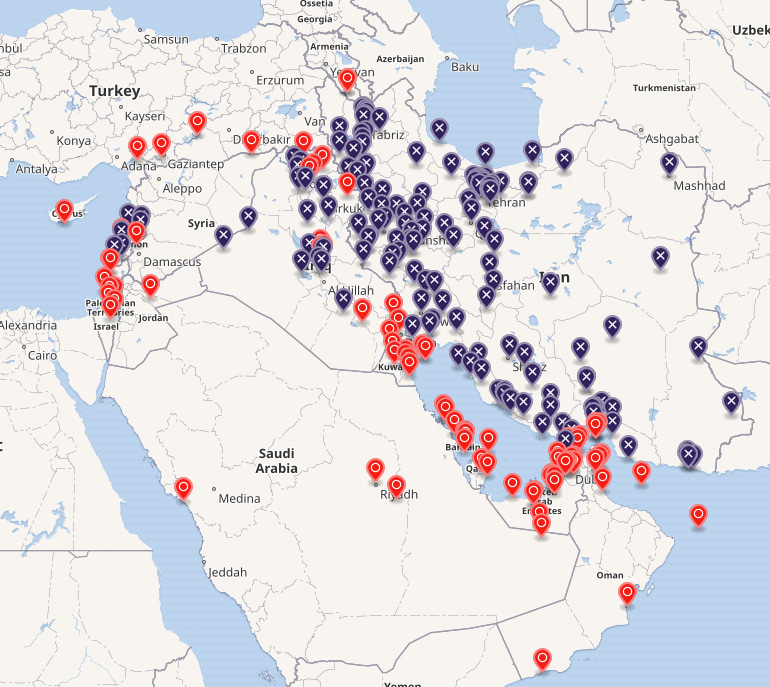
The Strait of Hormuz, through which 20% of global oil and gas supplies flow, has been effectively closed for nearly four weeks, since March 1. Oil is now trading at around $100 per barrel, having begun the year at around $60. Even this price does not reflect the severity of the situation: markets are currently pricing in an end to the conflict and a reopening of the Strait in the next week. Even if that does happen, it will still take several weeks to return output to normal levels, as production facilities which are meant to run continuously slowly come back online.
Whilst energy infrastructure has largely been spared thus far in an attempt to limit long-lasting repercussions, Israel did strike Iran’s South Pars gas field (part of the largest gas reserve in the world, which lies beneath the Persian Gulf and is shared between Iran and Qatar), leading to Iranian retaliations against Qatar’s Ras Laffan Industrial City, the largest gas production facility in the world. These attacks took out two of the fourteen production units in the city, reducing Qatar’s gas output capacity by 17% (Qatar represents 20% of global gas output). It will take between three and five years to repair the damage. As a result of this damage and the closure of the Strait, Qatar has announced a force majeure, halting all liquefied natural gas production and cancelling existing contracts. This will be particularly catastrophic for Europe, which — having decided to stop purchasing Russian gas and shut down coal plants in favour of unreliable renewables — is reliant upon liquefied natural gas, especially from Qatar, to keep the lights on.
The impacts are not confined to the energy market. The Strait of Hormuz is also a crucial transit point for fertiliser and other resources, and disruptions to the production and shipping of these supplies will cause substantial effects on global food markets. The increased cost of plastics will also soon feed through to consumers. Dubai and other cities which have built a reputation as safe havens for the internationally wealthy may never recover from the new perception of risk that has been introduced following Iranian drone attacks against airports, military installations, and even city centres. Gulf states have largely blamed the United States for this effect, which has compounded concerns over the unavailability of US defence tech (at one point, Qatar was down to only four days’ supply of patriot missiles) and led to a substantial pivot in diplomatic posture away from reliance on the United States and towards increased collaboration with Europe. The net effect of this is a substantial decrease in American influence in a region which has now been subjected to unprecedented destabilisation.
It is remarkable that the United States, the global hegemon, is at war with Iran, yet it is Iran that is currently peeling off America’s allies, with Qatar and Oman — historically the friendliest of the Gulf states towards Iran — paying substantial bribes to allow their ships to pass the Strait of Hormuz. Even left-wing Spain has been given the same opportunity as a reward for speaking out against the war. Spain is a NATO member state (albeit a parasitical one), and yet any neutral observer would describe them as being more aligned with Iran in this conflict. What other countries might follow these examples? Not even Trump’s tariffs on crucial allies against China in Asia or his threats over Greenland against Europe have caused so substantial a rupture.
For a world already teetering on the brink of global recession, suffering from persistently low business and consumer confidence, this is not a blow which can be easily weathered. The chance of 2026 being the year in which the global economy begins a shaky recovery has now evaporated. With it, the GOP’s prospects in the upcoming midterm elections (already meagre), have collapsed entirely. The Democrats will almost certainly take the House. The GOP may retain 50 seats in the Senate — a notional majority, but one which would rely on both Lisa Murkowski (R-AK) and Susan Collins (R-ME), both opponents of the administration, to pass legislation.
That congressional opposition will render Trump a lame duck in little more than seven months from today, limiting his ability to exert influence and thereby improve his party’s prospects for 2028 — admittedly, not that we could rely on his actions to have this effect. This is a disaster for America. According to current polling, both Vance and Rubio, Trump’s most likely successors, are already running behind Newsom, Harris, and even AOC in head-to-head match ups. Of course, the election is a long way away — but what evidence have we seen that the administration will rescue its reputation in the next two and a half years?
The hour in America is incredibly late. Trump’s policies have halted demographic change (at least via immigration) for now — but they have not begun to significantly reverse it. A Democratic Presidency in 2028 — with a revanchist and energetic leader — would lead to a reopening of the borders, likely combined with some sort of amnesty for the 20 million or more illegals currently living in the country. When California enacted amnesty, it locked in Democratic rule indefinitely. The same fate now awaits America as a whole.
How will things play out from here?
One upside of the rampant corruption of the Trump administration is that there are now several Polymarket accounts (likely belonging to family members of the Cabinet) which can be tracked to give some advance warning of US policy, and to divide noise and signal in Trump’s public statements. On Sunday, a number of these accounts placed large bets on a ceasefire being implemented before the end of March. Very shortly after, Trump extended the deadline for Iran to open the Strait of Hormuz by five days, thereby delaying planned strikes on Iranian energy infrastructure. Iran has denied that talks are occurring, suggesting that the Trump administration has climbed down of their own accord. It is impossible to know who is telling the truth, although peace demands have now been sent by both sides.
The American terms include:
A 30-day ceasefire whilst terms are negotiated.
Ending of Iran’s nuclear weapons program, with International Atomic Energy Agency supervision of civilian nuclear infrastructure.
Limits on missile numbers and ranges.
An end to Iran’s support for proxies in the region.
Reopening of the Strait of Hormuz.
Removal of all sanctions on Iran.
Civilian nuclear co-operation.
Iran has rejected these initial terms, and issued the following demands in response:
An immediate and permanent end to the fighting.
Reparations for damages incurred as a result of US and Israeli strikes.
International recognition of Iran’s right to exercise authority over the Strait of Hormuz.
The closure of all US military bases in the region (this was reported by Iranian state TV, and may not be a serious demand).
Removal of all sanctions on Iran.
Whilst the Trump administration is clearly signalling its desire to wrap up what even they recognise has been a calamitous embarrassment, US special forces continue to build up in the region, signalling some degree of preparation for further escalation. Trump has threatened a resumption of strikes in the face of Iranian stubbornness.
Strategically, Iran holds most of the cards in these negotiations. If negotiations continue under the status quo, Iran will continue to suffer from further strikes — but will impose greater damage on the rest of the world through the ongoing closure of the Strait. American war exhaustion, and the political necessity of ending the conflict, will only become more acute. It is in Iran’s interests, therefore, to hold out for better terms. The only response that the US has to this is escalation: striking Iranian energy infrastructure as planned. However, whilst this would represent a great cost to Iran, it would certainly provoke a massive response against energy infrastructure in the Gulf. We can see from the strikes against Ras Laffan what the impact of this could be: a 20% reduction in global gas and oil supplies for at least three years. If this were to occur, oil prices would hit an estimated $200 per barrel, and stay there until repairs were completed.
The impact of this would be a global depression worse than 2008 — and it is not even clear that it would force Iran to the negotiating table, because it would not change the fundamental strategic fact that Iran can impose more costs on the world than the world can impose on them, meaning Iran loses less from holding out than its opponents. On top of all of this, it must be remembered that the Iranian elite, while not the generation that were forged in the heat of the revolution itself, are deeply ideologically committed to a worldview that glorifies martyrdom and have spent their entire adult lives under a siege mentality, preparing for precisely this eventuality. They are not simply going to give in for hopes of an easy life.
As bad as all this would be, there is an even more terrifying possibility that emerges from American strikes on Iranian civilian infrastructure. Iran has, on a handful of occasions, threatened to target water desalination facilities in Kuwait, Saudi Arabia, and the UAE — America’s closest allies in the region. Desalination provides 47%, 18%, and 41% respectively of these countries’ water supplies, and up to 90% of drinking water in the region. Water reserves in the Gulf would barely last a week were supplies to be closed down. With the Strait of Hormuz closed, there would be very little opportunity to source alternatives. It’s impossible to know quite how bad this situation could get — but what is certain is that millions of people would be at direct risk of being left without drinkable water in one of the hottest and least hospitable parts of the world.
Trump is therefore left with three options: end the war largely on Iranian terms, allow the current situation to continue, or be directly responsible for the collapse of the global economy (and worse). One might normally expect that no President could ever select option three, but it is not in Trump’s nature to run away with his tail between his legs (to put it mildly). The bigger problem is that Trump has shown himself incapable of this kind of strategic calculation. As far as he is concerned, he has the strongest military in the world — so he has the leverage. The bigger fish will simply eat the smaller fish, or so he believes.
Worse and worse outcomes look increasingly likely. In particular, the US seems to be gearing up to attempt a seizure of Kharg Island (through which the vast majority of Iranian oil flows), utilising the special forces that have built up in the region in recent weeks. This desperate attempt to reclaim escalation dominance would be unbelievably risky. The island sits only 20 miles off the Iranian coast, rendering the US ability to prevent Iranian drone attacks woefully insufficient and making significant casualties likely — a textbook example of how a country can be drawn deeper into a war even against their intentions.
The collapse of MAGA
Trump’s betrayal over Iran, and the dire economic consequences of the war, will have substantial political impacts beyond dooming the GOP in 2026 and 2028. Many of the trends it will accelerate were already in motion beforehand. None of them are good.
A substantial fraction of the Republican base remains loyal to Trump as an individual, and will do regardless of his actions in office. As far as these people are concerned, Trump is correct to say that MAGA is him and him alone, defined only by his whims in any given moment. After Trump leaves office, these people will presumably transfer their support to whichever force lays the most legitimate claim to his legacy. The President’s embrace of foreign interventionism, and his drift away from the core issues of the 2016 campaign, has given an opportunity for those elements of the old GOP establishment which have kept their heads down and given some pretence of moving with the times to lay claim to this mantle. If MAGA means ‘American Greatness’ on the international stage (i.e., flexing military power), then MAGA is entirely compatible with the acolytes of George Bush and Dick Cheney. The claims of figures such as Lindsey Graham and Mike Waltz to a place in the future of the Republican Party have been infinitely strengthened.
On the other side of the equation, a substantial fraction of the MAGA base has begun to diverge from Trump as his focus has shifted away from the key planks of the 2024 campaign. Whilst they may cite frustration with the lack of progress on deportations, it is more common to hear them cite the President’s hesitance to release the Epstein files, generalised conspiracism, his failure to deliver on his economic promises (especially contrasted with his focus on ‘tax cuts for the rich’), and his preoccupation with foreign policy — particularly relating to Israel. This faction is a smaller part of the Republican electoral coalition, but according to friends of Pimlico Journal working in Washington DC these kinds of people are around one-third of young Republican staffers at the more junior levels.
The origins of this tendency are best understood as ‘pure populism’ — a distillation of the class politics that has been present since the beginning of the Trump phenomenon. Driven by resentment against ‘elites’ (and partially as a result of their overrepresentation among black and especially Hispanic Republicans), they place less emphasis on immigration. They were deeply suspicious of the alliance between MAGA and Silicon Valley, which incidentally motivates a deep suspicion of JD Vance in particular. You will often hear them complain about land being repurposed for data centres or housing stock being ‘bought up by BlackRock’.
The collection of issues which they care about is eclectic, but creates a Venn diagram with an unfortunate antisemitic crossover, about which they are increasingly self-aware. For many decades, the memory of the Holocaust has made any such intimations politically toxic to say the least. Holocaust memory is already fading, and the conduct of the Israeli government in the aftermath of October 7 has not only accelerated the collapse of this protective shield, but has reversed the moral valence of Israel in the American public imagination (at least for large sections of US society).
There is a much longer history of legitimate concern over Israeli influence on American foreign policy, levelled by academics like John Mearsheimer. It is true that the Israeli lobby has always had outsized influence, but attempts to describe US policy as solely driven by Israeli demands have historically been overblown. Under the Trump administration, however, these claims have been entirely vindicated as a description of the present, if not of the past. Absolutely no attempt was made to justify the Iran war as anything other than a defence of Israeli interests. In interviews, Donald Trump, supposedly the senior partner in this relationship, even explicitly deferred to Benjamin Netanyahu when asked questions about the war. It should not be a surprise that those who have staked the most radical position are now poised to reap the benefits.
Whilst Nick Fuentes, ‘Sneako’ and associated characters have been open about their views on this subject for many years, others, such as Tucker Carlson (who seems to have only recently shifted on such questions), have as yet kept it implicit; however, in the coming years, that will be less and less the case. If readers are tempted to dispute this characterisation of Carlson, and still believe that this tendency is still mostly confined to obviously insane people like Candace Owens, this quote from his speech at Charlie Kirk’s funeral should give pause:
[He] shows up and he starts talking about the people in power and he starts doing the worst thing you can do, which is tell the truth. And they hate it and they just go bonkers. And they become obsessed with making him stop.
I can just sort of picture the scene, in a lamp-lit room with a bunch of guys sitting around eating hummus thinking about, ‘What do we do about this guy telling the truth about us? We must make him stop talking!’
Perhaps this could have been defended at the time as nothing more than a cack-handed attempt to analogise Kirk to Jesus, but the later endorsement of the most lurid conspiracies about Kirk’s death by Carlson’s own brother have rendered this explanation implausible. Charlie Kirk’s murder should have been a unifying moment for MAGA, and an opportunity to refocus on the enemy to the left. Instead, the Sneako-Carlson wing of the Republican Party has blamed everything from Turning Point USA, to time-travelling Sumerian Demons, to — of course — Israel for his death.
For the first time in post-war history, it seems likely that antisemitism may become a serious political force in a major Western country. This might be shocking, but perhaps it should have been more obvious that this could emerge as the uniting force for the ‘multi-racial working class coalition’ within the new GOP.
This prediction may seem outlandish to some, but in fact it is already happening. The Florida gubernatorial campaign currently being run by James Fishback is, as far as we can tell, the first notable campaign in many decades to be run on a self-consciously (if still mostly implicitly) antisemitic platform. Of course, Fishback himself seems to be a dishonest grifter who sees where the winds are blowing and wants to launch some sort of career as an influencer, but that is largely irrelevant to the point. He is not going to win, but candidates like him will begin popping up all over the country in Republican primaries. It may even be the case that a candidate like this — perhaps even Fishback himself — makes an impact in the 2028 primary, if not as a significant contender then at least as a Ramaswamy-style high-profile no-hoper. On the other hand, if Tucker Carlson is the candidate of this faction — which currently seems unlikely due to his personal friendship with JD Vance, but is certainly not impossible — this will mean all-out GOP civil war.
Beyond being straightforwardly bad, this tendency will be disastrous for the Republican Party. It will continue to distract focus from the key issue of immigration — and we are already seeing prominent representatives, including both Fuentes and Carlson, increasingly raising the idea that immigration is in fact nothing but a tool used by ‘elites’ to distract people from ‘more important issues’. This will be most deeply felt on the right of the party, which should be the standard bearer of restrictionism. It will also demolish the party’s prospects at general elections. Even if these candidates do not win, their presence in the party will harm its candidates even more than the presence of figures such as Ilhan Omar puts many off of voting for Democrats.
Torn between these forces will be the heir presumptive of MAGA, JD Vance, once the Prince Who Was Promised to unite the tribes and continue the MAGA project, but now finds himself increasingly reviled by all. Vance is by no means perfect from our perspective, and has rightly become extraordinarily unpopular in Europe. But from the American perspective, if anyone was going to keep faith with the original goals of the Trump movement — immigration restriction, reindustrialisation, and international peace — it would have been him. His silence on the Iran war is understandable, and may well be advisable as he prepares for a Presidential campaign in which the necessity of running against his predecessor’s legacy looks more and more likely. Nevertheless, Trump will give no leniency for expedience. Vance may enter the race without even his endorsement, and with little support elsewhere.
This is the consequence of Donald Trump’s betrayal and failure: a right in disarray, with its worst tendencies in ascendence, quite possibly locked out of power for the foreseeable future. More importantly, even if the Republicans manage to return to power in a different form after a few election cycles, the demographic issue is now irreversibly lost. If there is still a slim European majority in America (current estimates put it at about 56%), it will be ended under the next Democratic Presidency. The territory and its people may continue to enjoy relative prosperity for some time to come, but the country as it has existed in the past will not exist in the future. That makes America the second Western country to be lost in the last few years, following in the footsteps of its northern neighbour: by the time of the next election (at which Mark Carney’s Liberals currently seem poised to increase their seat count), English Canada will be majority-minority even if French Canada keeps the country as a whole hovering just above 50%.
We on the other side of the Atlantic must reckon with that fact. Demographic replacement is not something that might occur in the far future. It is an imminent possibility. If we on the right fail, here and now, it will happen. The consequence of a distracted, amateurish right is that our countries as we know them will cease to exist within our lifetimes. If we do not learn this lesson, that is the fate that awaits us.
Where next for European populism?
Whilst Britain and Europe have thus far played little role in the conflict, we will pay a far higher price than America (at least in immediate economic terms) as a consequence. Whilst the US is not entirely insulated from global price shocks, its position as an energy exporter gives it somewhat more fiscal flexibility. Europe has no such reserves to draw upon. Moreover, it has become extremely reliant on LNG, much of which was meant to be sourced from Qatar. After years of stagnation, Europe is now at risk of a deep recession.
Typically, this would come with a dire prognosis for incumbent governments. That assumption should not be entirely discarded. Regardless of context, if people feel significantly poorer they are unlikely to deliver re-election to their leaders. The question is who will benefit from this, and who will be harmed. The perception of closeness to the Trump administration has already harmed the electoral prospects of right-wing parties in Canada, Australia, Norway, the Netherlands, and Denmark (albeit to a lesser extent). It seems likely to have a similar effect in Sweden and Hungary later this year. As economic prospects become more and more dire, this effect will only get stronger.
In France and in Germany, the national-populist right has begun to learn this lesson, with National Rally’s Jordan Bardella criticising America’s ‘imperial ambitions’ in Venezuela and Iran, and regional AfD leaders disavowing the war in Iran. It is crucial that parties elsewhere, including in Britain, follow their lead. It is still unlikely that Keir Starmer, given the sheer depth of his unpopularity and his historical closeness to Trump, could see any kind of resurgence — but a new Labour leader may bring better prospects. Nigel Farage is uniquely vulnerable to this line of attack, having been so tightly associated with Trump for over a decade. Reform have started to distance themselves over the Iran war, but it will be necessary to expand their hostility towards US policy as the situation worsens — and to do so ahead of time, if this shift is to be believed by the public. We have seen what happens when the right squanders the narrow opportunity we have available. Failing to do so now will not just be a disadvantage, but could be fatal, both for the party and for the country.
This article was written by the Pimlico Journal editorial team. Have a pitch? Send it to submissions@pimlicojournal.co.uk.
If you enjoyed this article, please consider subscribing. If you are already subscribed, why not upgrade to a paid subscription?
It's a little early.
This is an excellent piece that recaps many of the points I've been posting about since the war started. I think it is worth acknowledging that the economic impact of the war is not something down the line that will hit us in years, months or weeks, but is already here. Petrol prices at the pump are now hovering at the £2/l mark and only going in one direction. That means we already - right now, as we speak - have consumers cutting back on discretionary spending in order to fill their tanks. That is to say, we are in an economic contraction even if we're not, yet, in a recession by the orthodox "two consecutive quarters" definition. The only remaining question is whether that contraction will be (a) short and bad, but tolerable, (b) long and bad, akin to the 2008 crash, or (c) historically catastrophic, akin to the Great Depression. Based on what we know about the importance of Gulf shipping to global economic activity, especially wrt raw materials upstream of almost all modern life, the answer seems to be almost certainly (b) but only a fool or a charlatan would rule out (c).
It feels almost banal, if not churlish, to discuss meta-political consequences under such circumstances, but this is PJ so we must. I was pleased to see the reference to a point I have made many times on X, which is that real or perceived closeness to Trump/MAGA has already hurt RW parties in Canada, Australia, and Europe, a trend which shows no sign of abating any time soon. Some of the more intelligent, or at least less idiotic, RWers like the AfD in Germany or Meloni in Italy have already started distancing themselves from the Trump admin substantively and MAGA rhetorically as a result. Others are yet to cotton on, but if the recent French local elections are anything to go by, RW populists have little to be complacent (still less triumphant) about. One may also well note that LW incumbents in Spain and Ireland have also been given a fillip by their vocal opposition to Trump's current war in Iran as well as Israeli conduct in Palestine more generally. This is very much to the detriment of those nations' peoples, and reflects poorly on their RW oppositions.
Speaking of, while it would be too much to say that Trump has saved Labour's bacon, the elephant in the PJ room is that Reform have had an absolute shocker. The strongest case for Reform over Restore from a RW point of view, one made in these pages, is that Reform is a serious and credible government-in-waiting and not a personal hobbyhorse or a vanity project or a naked grift. I have considerable sympathy for that argument, but it gets harder to sustain in light of Reform's inexplicable decision to adopt a position that's opposed by around 80% of the British public, to say nothing of being atrocious on its merits. Between this, and other unforced errors (the defenestration of Chris Parry and nomination of Matt Goodwin to name but two) it is impossible to avoid the conclusion that the influx into Reform of former Tories with hardline Atlanticist and Zionist leanings has been an unequivocal disaster. Whatever Robert Jenrick, Suella Braverman, and Alan Mendoza are bringing to the table in return is very clearly not worth it. Once again, putting side the awfulness of their substantive positions, when the British public start to really feel the economic pain that's coming their way in 2027-8, I strongly doubt that they will be inclined to reward the party that spent March 2026 waving the Pahlavi flag and demanding boots on the ground. It's not too late - still - for Reform to pull back from the edge, change course, and excise the cancer that got them this far. As somebody who wishes the best for the British right, and nothing but ill towards the Labour/Tory Uniparty, I sincerely hope that they do so very soon.