
Saturday Night Live UK, the domestic iteration of the long-running US sketch show, must be understood as a success. Despite a modest broadcast reach, many of its sketches enjoyed social media virality. That it was recommissioned for a second series, which launched Saturday, evidences the rationale behind a £2mn-per-episode outlay – SNL UK will, for now, retain its position as Sky’s flagship comedy offering.
It’s not surprising that a well-funded spin-off of a well-known franchise should succeed – especially in the hands of writers and cast members drawn from the upper echelons of the stand-up circuit and social media alike. Yet SNL UK’s obituaries were penned even before its first broadcast. Some critiques were reasonable – such as questioning the efficacy of investing millions into live sketch comedy (itself a declining medium) while VoD viewership approaches parity with linear broadcast television. Others, however, rubbished the show for being distinctly un-British. Whether flouting this normative Britishness by virtue of its US sister show, its mere format, or something far more nebulous entirely, the now-disproven consensus was one of scepticism.
Given that these naysayers likely hold less stringent views on other metrics of national belonging, this does not evidence an emergent comedic nativism. Beneath this charge, though, lies a faint shred of patriotism – one entirely rooted in the notion that we alone can arbitrate what is and isn’t funny. In the US, this notion of a distinct British humour still carries weight – a key soft power lever when the White House sees London ablaze and our reputation is decimated by weekly migrant atrocities. This is a far cry from the early 2010s, when teenage girls with an internet connection and a >5 IELTS score were routinely inculcated into Anglophilia by way of Sherlock and Dan and Phil. With our PR at a historically low ebb, our panicked cultural commentariat can still retreat into a Blairite ‘England’s Dreaming’ – come what may, at least we are still funny.
This presupposes that British comedy is in rude health. Our lengthy back catalogue feels its age – neither Monty Python nor the Carry On films elicit more than a pity laugh. Repeating even the lightest of Bernard Manning’s material would now merit a knock at the door. The doddering, reheated Spitting Image reboot grappled with politics beyond satirical puppetry’s scope, and now finds itself reheated again to satirise the Gary Lineker-backed The Rest Is podcast series (a more fitting subject). That our better output from the bygone days required woke cosmetic surgery in 2020 can be blamed on concurrent events – but by and large, our pre-2000s canon does little to support our enduring claim to being uniquely funny.
On Legacy Panel Comedy
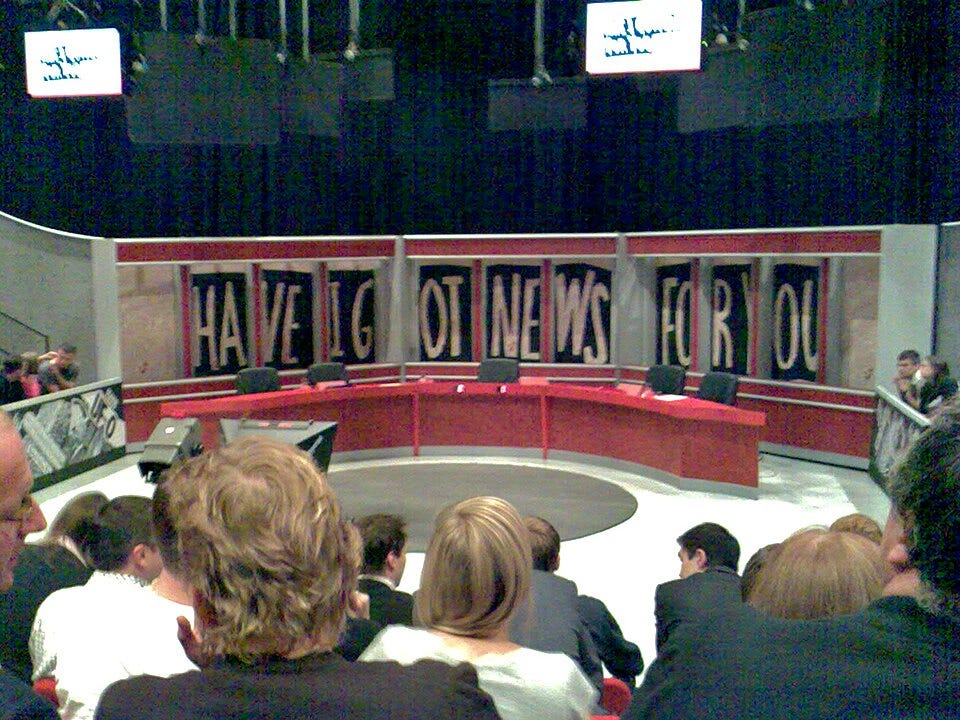
In recent decades, this reputation likely stems more from a robust standup circuit than yesteryear’s campy films. For the Fringe’s most prodigal sons and daughters, though, the advent of the panel show would prove far more lucrative and offer greater exposure. Have I Got News For You, first broadcast in the 90s, presaged the early-2000s boom period and informed the format of its progeny. HIGNFY would soon be joined by Mock the Week as both standard-bearer and perfect exemplar of the political panel show, though it would be remiss to exclude less overtly political shows such as QI and 8/10 Cats from this category. To maintain this article’s focus, and to spare your author from Stephen Fry, this section will concern itself with those expressly concerned with current affairs.
That Ian Hislop, perhaps the archetypal panellist, cut his teeth writing for Spitting Image illustrates the “closed shop” nature of British television comedy. This extends to comedians as well as public figures. There was much overlap between guest comedians in the panel show’s heyday – perhaps owing more to the Edinburgh Fringe pipeline than some shadowy plot to exclude right-wing comics. It was no accident, though, that the panel circuit became rigidly left-wing. Have I Got News For You would, by its nature, often feature a token right-leaning figure – platforming Farage three times, all before his elevation to arch-populist demagogue following the 2014 European elections. Again, without wishing to suggest conspiracy, this suggests that those on the right were only welcome should they not pose a threat. Geoff Norcott, a self-professed Tory, was the most transgressive guest invited (just twice) onto Mock the Week. This hardly inspired much pearl-clutching despite occurring during the Conservatives’ late 2010s ebb.
This was a rare moment of even-handedness. Inversely, a more palatable cabal would cycle weekly between shows. Any TV purchased after 2018 will, inevitably, have James Acaster’s likeness burned into the screen. The likes of Josh Widdicombe, Rob Beckett, and Katherine Ryan enjoyed sustained success after a stint professing safe-edgy on the panel circuit. Of the regulars, Nish Kumar would fly too close to the sun – his show being cancelled by the BBC, ostensibly for its egregious left-wing posturing. Frankie Boyle, once the closest thing to TV comedy’s enfant terrible, pivoted his career to penning political op-eds, in some bizarre sort of struggle session. His recent output seems far tamer, its vitriol outpaced by the algorithm.
Their audience
Younger readers may be forgiven (and envied) for not knowing these names, but the panel show once enjoyed a privileged position in the cultural canon. Scarcely a decade ago, clips of The Last Leg enticed millions of viewers with titles like “Westboro Baptist Church Rant”. Such was comedy before right-wing politics entered the English-speaking mainstream – the worst excesses of pre-Trump conservatism afforded left-leaning comedians ample material for their assumedly left-leaning audiences. There was an implicit raised eyebrow at those “crazy yanks”, and a relief that such overt right-wing politics could never find favour here. In hindsight, this all looks rather naïve.
This is not to say that panel shows were progressive prolefeed – they necessitated at least basic knowledge of current affairs, and conferred some degree of cultural capital upon their viewers. At least in the provinces, Have I Got News For You was seen as more commendable weekend viewing than Britain’s Got Talent or anything with Keith Lemon. By the time I started sixth form, I’d moved on to somewhat more niche political entertainment but was shocked to see Mock the Week listed as a learning resource for Politics A Level. Why bother with dreary broadsheet think-pieces?
It was as if, for a time, the panel show carried a vestigial coolness. News (but funny), for the left-leaning, young, and the in-the-know (but not in a wonkish way). It must be understood that peak panel show coincided with the mid-2010s zeitgeist with its so-called “youthquake”, “Milifandom”, et al. The Tories were at their then-lowest ebb with young voters: Brexit had stolen a whole generation’s future by requiring marginally more paperwork to study abroad. While the Glasto crowd chanted Jeremy Corbyn’s name, Theresa May recalled her halcyon wheat field days. Naturally, panel show comedians saw chance to make hay.
Today, their natural audience has drifted somewhat – more closely resembling the panellists themselves rather than a younger, cooler target market of days gone by. The now-residual circuit forms part of the Centrist Dad starter pack. The times have changed, making yesterday’s men out of once-transgressive panellists. Seven years ago, just 9% of 18-24-year-olds had read a copy of Private Eye, and one would not expect there to have been a post-Covid resurgence. There was once a time when Ian Hislop turned heads, but he and his diehard readership will soon pass into history. Look upon his works, ye mighty, and despair!
Comedy for yuppies?
The panel show’s dislocation from its audience owes a great deal to media fragmentation – no longer are there TV shows which have cross-demographic, national appeal. Rather than traditional comedy, young people more readily turn to the FYP’s algorithmic offering. Downstream of this is the emergence of a new set of cultural touchstones and sensibilities exclusive to Gen Z. This is not wholly cross-demographic (BAME Britain has its own cadre of influencers), but a particular element of this mood finds expression in SNL UK. Its humour is that of the urbane, university-educated, under-35s. Those who are downwardly-mobile in an economic sense, but retain the cultural trappings of a middle-class background.
So too are they Online. This is best illustrated by the fourth episode’s “Mr Bagley” sketch, the first forty-five seconds of which imitate, frame-for-frame, Ian Wright’s reunion with his former teacher. The original clip routinely circulates Twitter – winning it a far greater (and younger) audience than received by its original early 2000s broadcast. This streak is further demonstrated by the season finale’s British Pork sketch, which parodies a government-backed advert from the 80s. SNL UK’s target audience are unlikely to recall ever watching the source material – it inspires mockery of the absurd and archaic, instead of calling upon any nostalgia. As with the Ian Wright clip, the source material is transmitted online, after the fact. Of the show’s cast members, the eldest are at best late millennial and therefore young enough to be social media natives – which lends itself to comedy more relevant to the Gen Z lived experience than anything mustered by Acaster, Kumar, and Widdicombe (41, 41, and 43 years old, respectively).
Of the first season’s non-political sketches, the most dated makes reference to Mr Blobby, a character from 1992’s Noel’s House Party. This aside, the show’s touchstones predominantly date from 2000 onwards – spanning teleshopping, sensationalist women’s magazines onto e-scooters and so-called “brat summer”. This may (perhaps rightly) put readers off from tuning into the new season, but these are recognisable and current for the young and metropolitan. It’s hard to imagine the likes of Dara Ó Briain or Angela Barnes mustering a five-minute segue on situationships, nor is it likely that it’d land with their present audience. The merits of such jokes aside, they are dislocated from the twenty-and-thirty-somethings who once formed their target audience.
Without saying that SNL UK is the last stand of implicit whiteness, the lack of BAME-pandering is striking. For a start, that none of the twelve-strong cast are of South Asian heritage excludes the RS3-racing, balloon-huffing part of our shared national experience. SNL UK is touted as “Live from London!”, not the Balti Triangle. In fact, the show’s geographic remit stretches no further than the Banana. There are scant olive branches extended to the capital’s young scholars – in fact, the closest thing to a portrayal of roadman/”ends” culture is the second episode’s pirate radio sketch. Pirate radio may once have been a fixture of yesteryear’s Black British experience, but is now so archaic that its parodying here merely retreads old ground. The writing room may be littered with rejected gags about clean-up crews and Ghanaian aunties, but Black British lived experience finds little representation beyond a few interjections from Ayoade Bamgboye (who is almost fit enough to get away with it). SNL UK caters not to Croydon, but to Fuckinghamshire-on-Thames. That it makes no effort to ground itself in BAME lived experience is (obviously) not a political statement, but it perhaps demonstrates that whining about representative entertainment is old hat. One critique levelled against the panel show was that, in its glory days, it was an aggressively male space – in amending this, some of the humour was lost along the way. That a broadcaster’s flagship comedy offering has yet to be skewered for insufficient “representation” perhaps demonstrates that something has changed. At last, we can stop pretending to enjoy Afrobeats, and get back to tossing the pill about with Chuggsy.
From Mock the Week to Mock the Woke
If Nick, 30 ans sees his lived experience reflected in SNL UK, it extends to his politics. It should be understood that the cadre of Reform-voting grad schemers is a small one, as is the supply of right-coded comedy on display here. Trump, Palantir, and Israel are routinely the bêtes noires of the current affairs-centric Weekend Update segment, taking over from the Leave-bashing which once dominated panel shows. This time around, though, the jokes are usually funny enough to elicit a laugh from your jaded right-wing author.
In a recent interview, Dara Ó Briain noted that the 2010-2024 Conservative governments accelerated Mock the Week’s boorishly left-wing tilt. This incumbency factor explains why SNL UK punches left as often as it does right. George Fouracres’ portrayal of Keir Starmer featured heavily. The end of Andy Burnham’s honeymoon will likely coincide with this season’s run of episodes, and should provide ample material for George Fouracres’ impression. The first season’s only broadside against Farage was neither funny nor made a strong point. While we’re some way from this journal’s editor taking over Mr Hislop’s seat on the HIGNFY panel, the existence of TV comedy which (even reluctantly) punches left is remarkably refreshing. Gone are the days when TV comedy was wholly populated by early-stage Steve Brays.
For want of Al Nash revealing his power level, SNL UK cannot be understood as /ourshow/. Nor is it the harbinger of a decidedly more right-wing comedy circuit. It is, however, subversive enough to merit study. Weekend Update’s recurring Hand in Hand segment strikes me as rebutting the faux sentimentalism which predominated during the pandemic. While falling flat, the first episode’s Paddington Experience was a welcome jibe at the bear’s recent apotheosis. Poking fun at this sort of thing is nothing new, of course – case in point pre-woke Frankie Boyle – but the present national mood is markedly different than, say, twenty years ago. A volatile patriotic groundswell butts against a crumbling establishment, the dispossessed against those who insist that everything is fine. This latter camp have overplayed their hand over this decade – proffering mass lockdown hysteria before insisting that adding five million to the population has but positive consequences. They smell their own blood in the water, and are mooting how best to buttress their position – be it changing the voting system, or promoting state broadcasters at the expense of independent journalism.
These same broadcasters commissioned the aforementioned slew of panel shows, where blooded-in interlocutors could hawk the safe-edgy humour which set the terms of debate and shaped conceptions of our side. The dismissive classism embodied best by Russell Howard’s “muslamic ray guns” bit is now widely condemned, but such jokes framed anti-migration attitudes as low-status. Any self-deprecating humour was naturally verboten, as was anything which overstepped the mark and threatened the consensus. It would be folly to pretend that SNL UK operates without Ofcom’s oversight. However, a soft touch moves the needle as well. A major factor in the show’s success is that its sketches perform well on social media – likely by design. Readers of a similar demographic to the author will likely find that more of their Instagram mutuals follow the SNL UK account than those of any BBC/Channel 4 offering. If, as we’re led to believe, prolonged exposure to the Algorithm turns people into far-right extremists, there is some value in anti-government satire winning hundreds of thousands of views in an as-yet-unregulated public forum. It’s not unthinkable that these clips could send future readers of this publication down the alt-right pipeline.
I will not beseech readers to watch the second season. Not everyone shares this guilty pleasure, and those expecting truly cutting political satire will be better served by the timeline. I would, however, affirm that it has single-handedly improved the health of TV comedy. Peter Kay is yet to play Nick Griffin in a six-part comedy-drama about the BNP, but we’ve moved beyond the worst excesses of the 2010s.
More importantly, though, a generation which lost two years of freedom (and will pay £400bn for the pleasure) now has something close to representation in the media. Britain’s would-be yuppies are owed far more than this. Yet until Reform unwinds decades of sclerotic economic policy, and Zia Yusuf requisitions all dessert shops on behalf of Blank Street, this is a welcome reprieve.
This article was written by Lewis Gibson, a Pimlico Journal contributor. Have a pitch? Send it to submissions@pimlicojournal.co.uk.
If you wish to support what we do, please consider subscribing. If you are already subscribed, why not upgrade to a paid subscription?