
Each year, on August Bank Holiday, Notting Hill, a well-to-do neighbourhood in West London and the titular setting of Hugh Grant and Julia Roberts’ whimsical romance, turns into a Kingston beach party-turned-medieval feast day. It is a weekend of Caribbean culture, with costumes, steelbands, ‘wine dancing’ and plenty of jerk chicken. The holiday has a revelrous, rebellious spirit and has a long history of fighting for its survival. To top it off, it’s open to the public and free of charge to all people, being funded by grants, government councils, fundraisers and sponsorships.
But every year there is a conversation about its place in our country and its events calendar — is it worth the funding? Is it worth the disorder? Is it actually valuable at all?
Mariana Mazzucato — the left-wing ‘Rockstar Economist’ — makes a great point, asking, ‘What if we treated Notting Hill Carnival not simply as an event to be funded, but as infrastructure to be invested in?’ In her Carnival Economics project and New Statesman article, she argued that the standard economic models fail to measure the true value of the festival.
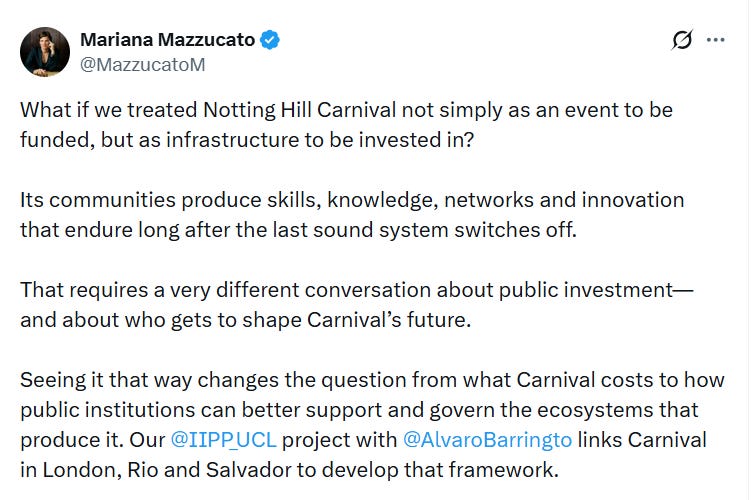
The event’s value is undercounted in several ways, Mazzucato suggests. As an institution, the Carnival brings together musicians, technicians, hospitality and media, all training and preparing for this three-day event, and this surely has value for the country, outside of the one weekend. Rio de Janeiro, of course, has a year-round ecosystem surrounding Carnaval, and thus presents a model to emulate. Most of the people who engage with ‘Carni’ are not formally employed by it — so even the economic activity it generates is perhaps undercounted. Cultural participation is also a form of hidden economic activity: it lowers the risk of depression, and associated health and productivity gains could be valued as high as £8bn.
Finally, and perhaps most importantly, it ‘creates immense public value by strengthening the conditions for change, builds collective capabilities and pride’ — and in the words of the president of Rio’s João Goulart Foundation, “Carnaval is hard power”. Mazzucato could also have mentioned its value in education and training, crowd management, governance, policing, and city infrastructure management. Presumably it brings in money through tourism. What’s not to like?
Curious to investigate the immense economic and public value described in Carnival Economics — I took to Ladbroke Grove to explore a sorely needed, untapped source of growth for the country myself.
Carni: a brief history
If you have ever wondered about the awkward significance and legal leeway granted to Carni, you will be comforted to know that, as with many other good British institutions, it has its origins in an act of minority honour restoration. The British Nationality Act (BNO) 1948 granted rights of settlement and status as a British subject to the new citizens of the Commonwealth. With the country facing post-war labour shortages, the ensuing immigrant influx came largely from the West Indies, alongside South Asians, Africans and peoples from across the Empire. HMT Windrush, and the ensuing ‘Windrush Generation’ are of course now a part of a mythologised narrative of the ‘building modern Britain’. The Jamaican-born RAF Ground Crewman, Sam Beaver King, was one of the West Indians brought to Britain on the Windrush, who went on to be a co-founder of the Carnival, the first black Mayor of Southwark, and to receive an MBE in 1998.
This happy account of history has been contested, including on the pages of this Journal. Britain had already been through successive racial fracas surrounding the presence of foreign seamen in port cities, particularly after the First World War. From 1920, the state was forced to respond to public hostility and developed administrative mechanisms, such as granting powers to port officials to prevent foreign seamen from landing, or mandating their registration as aliens to restrict the rights of non-white foreigners to migration and permanent settlement in Britain.
Though the Attlee government had, in BNO 1948, committed itself to a policy of defining British subjecthood with a link to Commonwealth citizenship, it was not blind to the deep popular opposition to former colonial (versus white dominion) migration. Following the Windrush and the immediate concerns of MPs in the face of this backlash, the Cabinet investigated de jure restrictions against ‘coloured’ immigration. In the end, the British government resolved to continue the subtle ways to minimise non-white migration — maintaining administrative screening at ports and introducing the European Volunteer Workers scheme to bring roughly 100,000 white Europeans displaced by the war as an easier way to plug labour shortages. By 1951, 76,400 Commonwealth immigrants had come to Britain.
Windrushers mostly rushed to South and East London, but of the around 150,000 total new entrants to London, Notting Hill became home to 5,000–10,000 of them. North Kensington, the area in which Notting Hill is situated, already had high rates of poverty, crime and violence and was also subject to soapboxing from Oswald Mosley’s Union Movement and Colin Jordan’s White Defence League with a clear anti-black immigrant message. Things between the locals and the newcomers came to a head in 1958, resulting in what has been termed a race riot claimed to have been perpetuated by ‘The Teddy Boys’.
If you read articles about the Notting Hill Riot, it often appears as though ‘The Teddy Boys’ were a specifically White Nationalist gang that based itself in the area. In reality, Teddy Boys were a post-war sub-culture, much like the better-known ‘Mods’ and ‘Rockers’ that appeared only a few years later. They were known for their Edwardian-inspired dress and rock-n-roll music. The Teddy Boys were generally working class, and indeed more rough-and-tumble than the later movements — some formed gangs and were identified as the perpetrators of other racially motivated attacks. Some at the time made claims that Teddy Boys were used as the Union Movement’s street muscle.
The Notting Hill riot was instigated when a group of Teddy Boys witnessed an argument between a mixed-race couple, the Swedish Majbritt Morrison and Jamaican husband Raymond Morrison, and intervened, resulting in a fight and the Swede receiving comments such as “Black man’s trollop”. The next day, mobs moved through the streets, looking for black victims to harass, intimidate and attack, shouting “Keep Britain White”, the exact slogan of the White Defence League. Police logs report weapons such as petrol bombs, iron bars, butcher’s knives and weighted leather belts. Caribbean men fought back, and the violence escalated into a five-day riot. Of the 108 people who were charged with offences, 72 were white, and 36 were ‘coloured’. PC Richard Bedford said he had seen a mob of 300 to 400 white people in Bramley Road shouting:
“We will kill all black bastards. Why don’t you send them home?” PC Ian McQueen said he was told: “Mind your own business, coppers. Keep out of it. We will settle these niggers our way. We’ll murder the bastards.”
The inaugural Carnival was in response to these riots. On 30 January 1959 at St Pancras Town Hall, Claudia Jones and the West Indian Gazette organised an indoor Caribbean Carnival, featuring steelband with Boscoe Holder and Russ Henderson, Calypso, other folk dances and beauty pageantry, as a celebration of Caribbean culture. Ticket sales profits were used to pay legal defence fees and fines for the black youths arrested following the 1958 riots. The BBC filmed and broadcast parts of it to the nation, who, largely, had never seen Caribbean culture or even Caribbean people in their lives. This event occurred yearly until Claudia Jones’ death, meaning a 1965 event did not take place. But in 1966, local activist Rhaune Laslett organised an outdoor community fair, inviting Russ Henderson’s steelband and reviving the carnival. As their set finished, Russ Henderson and his steelpan band carried on playing as they walked up Portobello Road, taking the crowd with them and, as such, a neighbourhood party became a street procession.
Notting Hill Carnival, however, has never been a wholesome family day out. In fact, there have been stabbings in every single year of the occasion since the late 70s. Its entire history has also been characterised by struggle with the law and local authorities. In 1976, the police expected hostility due to previous trouble; they stationed 1600 officers with stop-and-search rights, then known as the ‘Sus’ (suspicion) laws. In this episode, the crowd attempted to intervene in a police attempt to arrest a suspected pickpocket. The situation quickly degenerated into a full-scale riot, against which the police were forced to take a heavy-handed response. 1600 officers broke up the carnival, leading to the arrest of 60 people and injuries to more than 300 policemen. As a result, local borough councils, police and national politicians demanded that the Carnival be cancelled or moved away from residential streets, with alternative proposals to hold the event in White City Stadium or Hyde Park. This did not work — the Carnival community refused and took to the usual streets. The 1977 Carnival drew an estimated 250,000 people, for which the Met agreed to keep a lower profile during the event, but was nonetheless forced to divert 6000 officers to the event with newly issued riot gear.
Similarly, following the 1989 Carnival and several years of high arrest numbers, the Met presented plans to house the event in Hyde Park, enabling them to install fencing, metal detectors and bag searches (and thereby ease demands on police presence, visibility and resources). Again, a collective boycott by the Sound System Collective and bands forced the authorities to keep the Carnival on Ladbroke Grove — though the organisers did kindly agree to implement standardised route timings and earlier sound curfews in the end.
The history of Carnival follows a repeated pattern. Every time attempts have been made to adapt or control the event, the community and organisers have pushed back, and cemented the festival as an act of self-determination. Only COVID was enough to pause the celebrations momentarily.
My visit
With this checkered history, and Mazzucato’s promises of economic jet fuel in mind, what is it actually like on the ground?
I attended the Monday procession — the full fat, director’s cut, unlike the previous two days, which are reserved as more (but not entirely) wholesome family days. Here is the mass of gyrating hips, tongues out of mouths and women dressed in little but feathers and tattoos that are witnessed by most through the lens of the FYP page on X. The dancing on display seems biomechanically impossible to replicate. A deep voice on the loudspeaker tells all to ‘mash up da place’. The Turkish kebab shop grills meat, and smoke fills the air. A four-foot-nine ginger-haired, alabaster woman rolls on through the crowd. An Arab guy stands and shamelessly records a black woman twerking. Two mixed-race guys with blinding veneers smugly chat up heavy-set blondes in garish makeup. The loudspeaker voice instructs the guy at the back of the procession to stop harassing women.
It immediately became obvious just how much official photoshoots of Carnival contrive to hide the graffiti, rubbish and drug use. Of course, as a part of Britain’s multicultural universe, the 2017 carnival observed a minute of silence for the victims of the Grenfell Tower fire, with many festival-goers wearing ‘green for Grenfell’.
In public image and the right-wing press, the carnival increasingly takes on the identity of a minority festival with overtly anti-white motivations. Whatever they may be, it does still attract some native Brits, of two kinds: the first, the rougher and more unashamed; the second type is almost always at the periphery of the crowd — performatively bohemian posh girls in Woodstock vibe, flourishing their cans of Red Stripe. This fact apparently baffles many low-ranking influencers in the Restore Britain orbit. The Carnival ultimately remains a predominantly Caribbean affair. Barring the addition of Afrobeats and Jollof influenced by the newer African demographic, it doesn’t seem recent immigration has had much effect.
Over 7000 police are deployed in full force to stand guard and facilitate the event. Some are equipped with tasers and batons. Jobs include, naturally, ignoring the smell of cannabis, acting like this is a normal day, pretending to vibe with the tunes and staring at gangs of masked boys openly inhaling Noss while pretending they’re not too scared to approach them. Nitrous oxide was made a Class C drug in 2023. Having previously only been illegal to produce, supply, import or export for its psychoactive effect, it is now also illegal to possess. Illegal and very obvious when in possession. These guys stand around with big pumps with ‘Super Nos 3000’ on them, surrounded by a graveyard of little chrome casings on the floor. Nor are six blokes in all black holding up balloons particularly inconspicuous. But it is ignored by the police in full sight of them using it. Drug dealers and users are sidelined for the big fry: weapon wielders.
I can see that this year, the police do seem to have been given the ‘go-ahead’ on this count. Walking down the street, possibly every 20 metres or so, the police have another young black man against the wall being searched. Something might fall out of a pocket and clang on the ground; ‘Knife!’ the policeman might exclaim triumphantly. I witnessed a commotion roiling — police swarming a group of black lads just on the outskirts of the festival crowd proper. But, outmanned, the police were pushed back very quickly. When more help arrived, the Met was able to push back the crowd and isolate one of the gang, who still fought as he went down. ‘Eyyy’, ‘oh shit’, ‘oooh’ — the crowd showed no moral outrage for either side and were simply impressed with the drama. Some of his friends appealed to the police directly, holding up hands by their chests like footballers pleading with a referee’s red card.
The whole area is like this. The policing operation at Carnival is that the force is mobilised as well-equipped chaperones for a district-wide piss up: prevent stabbings, confiscate weapons, stop fights, and remain a jovial guardian while turning a blind eye to the otherwise dystopian scenes. To these goals, commendations must be made for the efficacy of the tech now on display.
Last year, the police finally managed to introduce cameras for facial recognition, metal detectors and perimeter checks, and this has worked pretty well. In 2026, the arrest count was 636 versus 2025’s 528 and 2024’s 353. Much of this came from arrests outside of the perimeter by facial recognition. Arrests made on wanted persons and bail breachers rose from 49 in 2024, 95 in 2025 and 121 in 2026. Partly due to these measures, there were only two knife assaults this year. Violent assaults meanwhile, were up to 72 from 53 the year before, albeit from 98 prior to rolling out the new tech. Theft and drug arrests have remained unaffected by the police’s new measures. Much of the rhetoric from the Met is that these new controls are to reduce sexual assault, but this has also remained the same over the years, still around 40 offences since 2022.
The ‘social value’ of Carnival
Overall, the number of criminal charges at the carnival has been going up since 2022, most likely due to increased police presence. If we return to our original question — ‘what value could this event offer us?’ — this factor introduces some interesting possibilities. The per capita arrest rate at Reading and Leeds festivals, still predominantly frequented by Bristol types (etc) who love the afters and a good sesh, is twice as high as Notting Hill Carnival. Out of context, this would be cause for celebration for a smug journo posting on Twitter.
Around 80% of arrests at the aforementioned festivals, however, are for drug-related charges — fewer than 10 weapons were seized at each of the almost entirely native events. Over the three days of Notting Hill Carnival, 68 weapons were seized. Though the Met has not yet published a full breakdown of arrests, the drug-related percentage in 2024 was a mere 31.5%, with the rest falling into the categories of weapon possession, violence against emergency workers, sexual offences, violence of other kinds, theft and robbery. This matches my experience witnessing the relatively harmless crimes being ignored.
What this demonstrates is that there is a cohort of criminals who are so dumb that they will walk through metal detectors with knives, or otherwise engage in crimes of a less-forgivable nature in full sight of police officers. Perhaps Carnival could be useful as a simple way to drive criminal types into a cordoned-off and highly policed area for efficient arrests? Having them congregate, ramping up police presence further and perhaps even tightening the screws on drug offences would reduce the externalities on others if similar events were held year-round. The cost of policing last weekend, however, totalled some £14 million, and kept 22.4% of the entire Met police officer staff busy in the North Kensington area.
If this isn’t the great win for the community of ordinary Brits that Mazzucato investigated in Carnival Economics, surely the commercial balance sheet paints a rosier picture. Sadiq Khan said this year:
‘On its 60th anniversary, Notting Hill carnival proved itself to be bigger, bolder and more vibrant than ever. It’s now the world’s second-largest street festival, attracting people from around the globe and generating a whopping £400m for our economy each year’
Four hundred million pounds is a big claim. Unfortunately, a report by the London Development Agency, commissioned by the then mayor, Ken Livingstone, on the 2002 Carnival estimated that the event contributed around £93 million to the London and UK economy. In 2003, the Carnival was run by a limited company, the Notting Hill Carnival Trust Ltd, so we have some reliable figures for running costs that turn out to be less than £1mn. We must also add an approximately £1mn cleanup cost, taken on by councils and TfL.
The £400 million figure comes from a 2024 James Williams study, commissioned by The Voice, ‘Britain’s Favourite Black Newspaper’, which presumably had no incentive to overstate Carnival’s economic value. It claimed total public cost is estimated at £16mn to £22mn and that over £100mn is generated through ‘tourism’, with at least £25mn direct spending on the ground, comprised of food and drink, public transport, hotels, nightclubs and retail. That £100mn figure, though, is of course London’s gross benefit over those days — but the customers are largely from other parts of the nation rather than from overseas; much of that spending would likely have occurred anyway, and London residents are very likely to have found another way to spend their time and money on the bank holiday weekend. Overseas tourist spending makes up closer to 25% of this total figure, as they are around 10% of the crowd but spend more money, given they are tourists and considering their need for hotels.
So, perhaps not £400 million, but conceivably up to £50 million, which isn’t so bad. But similarly unaccounted for is the cost to local residents in boarding up their homes, and possibly leaving the city for the weekend — with all of the events and meetings needing to be postponed or have extra considerations. What about the homes left unboarded with smashed windows, and vandalised cars? One Portobello Road resident said at the time: ‘We have the choice to either go away for the entire weekend or be prisoners.’
What is the value-for-money case for this particular investment — a PA system on a float and a hyper-efficient clean-up crew overnight? £50 million in a weekend isn’t terrible, but the income is received by the local traders, off-licences and hotels while costs are borne by the taxpayer. The London Marathon brings in £100mn, and summer tennis competitions bring in almost £400mn, and they fund themselves. If we must have bread and circuses for the nation, I’d rather just have more sporting events. Nice ones, with strawberries and cream and champagne.
The author of Carnival Economics might not even be wrong about the hidden value of cultural participation. Perhaps its commensurate value to society isn’t reflected in economic figures. We have had festivals and carnivals for centuries, replete with song and dance, vulgar acts, drinking, and much worse. They allowed people a release and an outlet to vent political frustrations, exactly as the Rockstar Economist insinuates about Carnival. But the elephant in the room is Mazzucato’s claim that the events around Ladbroke Grove ‘create[s] immense public value by strengthening the conditions for change, builds collective capabilities and pride’.
You do not need to go to Notting Hill to know she is not referring to your pride, or building the collective capabilities or conditions for change that might benefit you or empower your community. To most Brits, Carnival is both ridiculous and utterly alien. Families join in together, with mother, daughter and grandma all in strange burlesque-esque attire with entire behinds showing. Aunties and grannies shake their arse and grind with male family members and/or strangers. Others congregate on street corners, forty of them outside of my residence for that night. They vandalised cars, nossed and smoked weed.
We do in fact live in a multicultural country, and our neighbours are not like us. We might not like the same things, and don’t want the same things. And maybe that’s ok — as one Pimlico Journal editor said before sending me on my way, ‘Jerk chicken is pretty good though’, and sure, I get myself down to some Dub from time to time. It might be nice to give the communities that have bequeathed these cultural gifts upon us a couple of days a year to let off some steam. Maybe we can invest in Carnival and reap some compounding reward from deep stimulation of human capital, institutions and networks? I have answered none of these questions — but do you want your money and your state to direct its resources and energies towards something that will never be yours?
This article was written by Frederic Draper, a Pimlico Journal contributor. Have a pitch? Send it to submissions@pimlicojournal.co.uk.
If you enjoyed this article, please consider subscribing. If you are already subscribed, why not upgrade to a paid subscription?
It troubles me that only city dwellers get to experience this wonderful cultural event. Why not have a taxpayer-funded travelling Carnival visit one village every week so that residents of the Cotswolds may also experience the joy of "only two knife assaults"?
The reported number of arrests doesn't factor in the arrests and weapons seizures that are done in the lead up to Carnival, so Leeds/Reading is arguably even less comparable.
I always wonder what these pre-emptive arrests entail (and why they aren't being done regardless). I suspect - but may well be wrong - that there are a few people's civil liberties being violated to keep the Carnival on the road.