
Reform is performing terribly with young people. Despite their fluctuating support since July 2024, one consistent trend is that they have very little support in the 18-24 age group and only slightly more support among millennials. According to YouGov, Reform’s peak support with 18–24-year-olds was a relatively anomalous 21% in August 2025, but before and since it has consistently sat around 5-10%, with support reaching as low as 2% this August. In the most recent poll by More In Common (3-5th Oct.), Reform had 11% support among 18–24-year-olds, with 6% for the Tories and 3% for Restore (however, in the poll just before that, Reform scored as low as 4% and Restore as high as 7%, on par with the Tories), with older September polls putting the Tories ahead.
After Tory conference, the Tories have gained in support, including among young people, putting them ahead at 16% support compared to 11% for Reform. The relatively low sample sizes of around 1000 participants for these polls explain some of the anomalous results with high Restore support and shifting party fortunes each week. Taken together, however, the young right-wing vote seems to be somewhere around 15-20%. YouGov are by far the most pessimistic when it comes to Reform’s support among the youth (as they are with Reform’s support in general); other polling companies indicate that the reality is closer to Reform’s support among young people just above 10%, competing with the Tories to be the most popular right-wing party among young people, with a significant number going to Restore as well.
We must also remember that not all Tory support among the young is right-wing — most young rightists have moved to Restore or Reform. Before 2024, there could have been no doubt that the average young Tory activist was far to the right of both the party and the country on the whole. Ideologised young people of every stripe are inclined towards the radical distillation of ideas to their logical conclusions — and thus, young Toryism post-Reform found its final form in Kemi and chemsex. To put this more straightforwardly, the average modern young Tory is far more a centrist than in the past. On the other side of the spectrum, depending on the poll, either Labour or the Greens are the most popular with 18–24-year-olds, with the other following close behind.
Unless the polls are completely wrong, and there exists a right-wing silent majority among the youth ready to actually come out and vote for right-wing parties, the theory that British youth are rebelling against centre-left liberal institutions, searching for something else in the form of right-wing politics, will have been proven untrue. Much like the so-called (and thoroughly disproven) Christian revival, the fragile cultural thaw or reversal of attitudes against woke in recent years does not guarantee mass engagement or useful participation.
This obviously poses a major problem for the right in Britain in the near future. In the current electoral landscape, any party only needs around 30-34% to win an outright majority in parliament. Yes, this can be achieved with very little support from young people. But even in the best-case scenario, where Reform wins the next general election with a majority and achieves all of its basic ‘victory conditions’ in government, the older generations, on which Reform overwhelmingly relies for its electoral strength, will eventually die. Younger generations, which include larger proportions of migrants and their descendants, will become significantly more powerful as the population pyramid inevitably shifts downwards. Further, the past year of political developments has taught us that we cannot rely on best-case scenarios occurring, as many who belonged to Reform’s 2025 coalition have moved to Restore, back to the Tories or not voting at all.
Reform can no longer afford to mostly ignore a whole generation. Of course much of the current youth’s political orientation will change over the coming decades, but there are enough ways that it can go wrong for the right that it is worth considering the problem. This is especially the case as Burnham seems to be embracing pension reform while appealing directly to young people, simultaneously shoring up support with the old. Reform is forced to compete more fiercely for the retired vote in maintaining a firmly pro-pensions position, reinforcing the age divide that already exists.
From this, some are tempted to conclude that maybe the young are naturally left-wing, and the old boomer-isms along the lines of ‘you’re a socialist until you receive your first paycheque’ are correct. Yet one only needs to look to other nations today to see that neither the supposed ‘natural leftism’ of the youth nor the economic situation today is causing their aversion to the right here in Britain. This is not to say that the generational economic challenges the young experience today don’t make them more susceptible to left-wing politics, only that this explanation cannot explain various phenomena which will be elaborated below.
Firstly, in other Western countries, despite similar economic stagnation, young men are significantly less left-wing than in Britain. European countries are far less obsessed with polling than we are, but what age-related polling does exist clearly shows that radical right parties are far more popular with young men than Reform is with young voters in Britain. In France, a poll put RN under Bardella’s leadership at 25% among 18–24-year-olds, which is more than the entire young British right-wing vote combined. In Germany, in the February 2025 election, around 25% of young men voted for the AfD (and 35% of young women voted for Die Linke, representing one of the most radical political gender divides). This phenomenon is visible across developed nations worldwide.
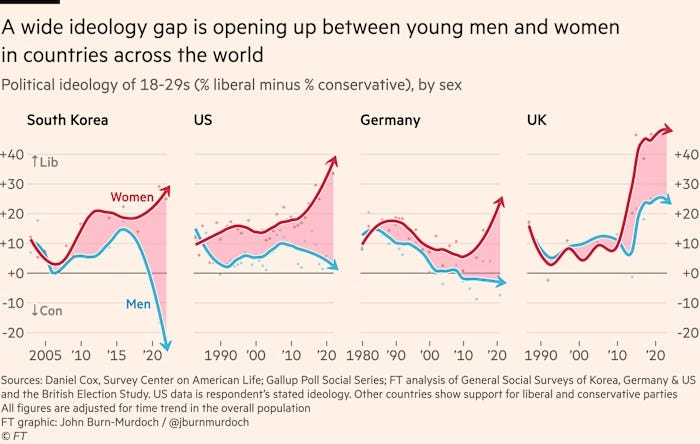
This commonly shared set of graphs is often used to illustrate the political gender divide, a well-observed phenomenon. But what is more interesting is that it also shows what the polling data indicates well: Britain is unique in the international trend of young men gradually drifting to the right while young women shoot to the left. In Britain, even young men moved dramatically to the left over the 2010s, and we are perhaps only now at a turning point.
As such, we should expect certain reasons that were unique to Britain for why this occurred in the first place. Their explanations run in two directions: first, young men (particularly educated young men) were pushed left for reasons outside Reform’s control, and this gives the party no immediate incentive to appeal to them. Second, Reform is failing to appeal to potential young voters, who could be persuaded, and instead pushes them away. Though the reasons of the first kind abound in Britain, as will be explained, it is certainly not the case that Reform is fully capitalising on their potential support from young people (particularly non-graduates) without sacrificing support from other generations.
These reasons for ‘young people’ not supporting Reform are fairly simple. On one hand, the faintest knowledge of young women (or, lacking that, the above opinion polling) will tell you that they are being radicalised leftwards by Instagram reels and other internet scaries, and therefore can be safely regarded as a lost cause. Young men, on the other hand, are a different story, and are far more receptive to appeals to their interests. The fact that in a recent, though anomalous, poll by More In Common, Restore is more popular with 18-24-year-olds than Reform is a telling sign that this is not simply the result of factors outside Reform’s control. To contextualise what Reform can do, I will start with the things outside of the party’s control which have moved young people in this country further towards the left than their cousins on the continent.
There are a few things unique to Britain that pushed young men in particular to the left. Of their counterparts overseas, Trump won a majority in 2024, Germany saw a very slow drift to the right, and South Korea… has South Korean sexual politics. The winning recipe for the right in all of these cases was convincing young men their parties were for them. The main reason the right lost ground with these potential voters in Britain, meanwhile, is the absolute failure of the Tories in government — who promised them nothing and acted directly against their interests.
For most 18–24-year-olds, their formative political years were the mid-2010s onwards. For those just older, they were set by the aftermath of the 2008 financial crash, and Cameron’s years following the election up to the Brexit years. In this period, the source of women’s nascent radicalisation — social media — reached mass usage. The corresponding reaction to e-feminism (and the hectoring of teachers in school) was libertarian in character. Young men wanted to be left alone; these were the heady days of Gamergate, the first rounds of online censorship and the proto-Woke efforts to regulate video games, internet pornography and so on. For most who lacked the political language to articulate what was wrong, these concerns had no viable outlet in Britain. As this generation of young men grew up, the more practical affairs of the day took priority in political preferences, or they checked out entirely.
These years of Tory government simultaneously saw young people go through a decade and a half of crawling economic growth, Brexit, and four years of political turmoil focused solely on the execution of Brexit — something they were mostly too young to understand and probably didn’t support in the first place. Later, it saw them locked in their homes for two years while witnessing the economic stagnation that followed, which they now experience firsthand as they try to get a job or rent a flat.
By the time they reached adulthood, all of the basics were wrong: they saw lower wages, inflation, a broken rental market and their student loans increased to £9,250 a year (paid back with ever-increasing interest), despite terrible employment prospects for most of them. When they reflected on this situation, and knowing who was in control during this time, they understandably concluded something along the lines of: Tory austerity prevented recovery from 2008, which then got even worse with Brexit. Brexit was sold to the boomers on populist lies about money for the NHS and reducing immigration, but only damaged the economy. Then Liz Truss and the last farcical years of Tory government blew everything up.
This is only a concise summary of that story, but anyone who has ever listened to the millennial leftist influencers who presume to speak for ‘the youth’, or has spoken to any young leftist, will know the sort of narrative being recounted here. As such, most young people in this country associate Tories, who are still conceived of by most as ‘governing from the right’ during the loathsome 14 years, as the sole cause for all the economic and social problems that exist today. What has this got to do with Reform?
Well, to young Joe McNormie, Reform takes these parts of the Tory party that they hate (right-wing beliefs in capitalism, anti-immigration populism and Brexit) and embraces them fully. The distinction that exists for those on the right between Boris Johnson’s Tories and Farage’s Reform basically don’t exist for the majority of young people — it is telling that many young people still see Farage as responsible for a failed Brexit — and they conceive both men as snake-oil salesmen for boomers who won’t address the real problems caused by Brexit and austerity. Of course, we know that this narrative is a fanciful one, the three biggest holes being that the Tories neither governed with right-wing economics (exacerbating some of the most perverse redistributive trends in policymaking) nor actually pursued immigration restrictionism before or following Brexit. Of course, they accelerated immigration after Brexit and the late Conservative governments were arguably more outwardly Woke than Keir Starmer, but this doesn’t matter to such a person. Ultimately, ‘the boomers are being sold populist lies by the capitalist right-wing billionaire interest parties and have destroyed the country for young people as a result’ is a convincing enough and popular narrative. They would like to see themselves alongside immigrants, minorities and women as fellow victims of this kind of politics.
This overall theory is confirmed further when we look at the support for the right in other countries. In France, where young people, especially young men, support the right at a much higher rate, their formative years were spent under an overtly pro-European Union, pro-immigration Socialist and then liberal government. As such, they can barely blame their hardship on the right in the way young people do in Britain. It is a similar story in Germany: The German youth grew up under Merkel, who, despite leading the ‘centre-right’ party, is the most famous example of a European leader completely embracing mass immigration, and is regarded as a catalyst for the anti-migrant politics across Europe that followed the early 2010s. Similarly, they can’t explain their current situation as a result of the right wing. Across the Atlantic, Woke itself and general left-wing radicalisation were spurred by the left’s disappointments in the Obama era, against which the Alt-Right and ‘Alt-lite’ revolted.
The second cause outside of Reform’s control is simply the structure of the British higher education system. This is important in two ways. First, the proportion of young people who attend university (and thus assimilate into a more left-wing milieu) is much higher than in other European countries. Britain has the highest proportion of young people attending tertiary education at around 60%; this is higher than the OECD average of 48% but only slightly higher than France, Germany and the Netherlands, which all sit in the 50s per cent. Yet it is important to understand that in these other countries, a greater proportion of people who attend ‘tertiary education’ are not attending university, but something more like technical colleges or polytechnics. When this is considered, a significantly smaller proportion of young people than is shown in these other countries attend what we would call university.
In Britain, this is a particularly acute problem as every non-self-funding student that attends university is saddled with on average £50,000 of debt, which for most grows faster than they can pay it off. By the time they graduate with all this debt, they see themselves struggling to get a job and, if they do, most likely find one that pays minimum wage or just above that. Though student loan repayments are still never particularly burdensome, a sum of tax ‘owed’ that grows arbitrarily in combination with their poor prospects, especially in the current economy, serves as a catalyst for alienation.
This was all after the promise made by their schools and parents that attending university sets one up for high-paying employment. Obviously, saddling a generation with high ‘debt’ while promising them jobs they cannot get does not leave students with a favourable opinion of ‘capitalism’. This is reinforced by their time spent at university existing in a sub-culture almost entirely devoid of those who voice openly right-wing opinions, particularly at the lower-ranking institutions. It is commonly known that within university life, right-wingers pay some social cost for their associations whilst non-white academics and students are frequently held to lower standards. That young white men are discriminated against in entering educational environments and in the labour market is, however, something that has generated long-running resentments in them, even amongst the average apolitical type.
The ‘material conditions’ are less of a problem in other European countries where many who attend tertiary education pay much less, if anything at all. Those of average intelligence (who tend to be far more socially intolerant over such matters), should they go to technical or vocational colleges, are not privy to the same intellectual firmament through which university-educated Caitlin, 20 ans, becomes assured of her moral legitimacy over others.
These are the structural factors outside of Reform’s relative control; summarily, they are 1. the Tories being terrible and 2. our higher education system being equally as terrible.
Now on to the areas where Reform does have relative control. Despite the difficult situation they face with youth in this country, they can still maximise their performance.
Firstly, I will rule out something that is an obviously moronic political strategy: abandoning the triple lock. No matter what you think of the triple lock, the fact is that Burnham’s commitment to reforming it has made defending the triple lock necessary for the right. It is necessary to win the vote of the older generations that Reform defends it, whether we like it or not. Further, the argument that committing to its reform would win over hordes of young voters is blatantly untrue: most young people don’t care either way, and, perhaps surprisingly, more support it that oppose it. It just isn’t important to most young voters. Committing to reforming the triple lock, or other policies unpopular with older generations, will simultaneously lose legions of pensioners to the Tories (which would be a disaster) and only win over an insignificant number of zoomer YIMBY nerds.
Getting on to what Reform can and should do: the major diagnosis of why Reform is performing poorly with young people already on the right is that they have pretty firmly lost the online space (ie: comms). It must be remembered that from the period after the pandemic and lasting until the 2024 election, British parties were incredibly slow to adopt new media in political campaigning. Reform, however, was not.
As a late-teen ‘Reactionary Catholic Zoomer’ (I kid) on TikTok during the years up to the 2024 election, my ‘For You’ page was full of Farage and other right-wing content creators like Jack Anderton. There was also no shortage of pro-Reform edits made by third-party accounts. It was this phenomenon of Reform being the only British party performing well on these apps that first birthed the very poorly aged ‘Reform are popular with young people’ theory. It was truly only after the 2024 election in Britain and the U.S. that establishment parties apparently became aware of the aesthetic formats on new media which appeal to politically engaged young people. ‘The edit’, in short, played a major part in Trump’s majority with the young and Reform breaching into the mainstream space. Yet, in the two years since the election, the other parties (especially Labour) have not only caught up, but have innovated beyond Reform in appealing to the youth online.
What is it that short-form video edits cut to music (that ‘goes hard’) achieve? As we have already mentioned, politicised young people emotionally desire radicalism, and more specifically war — the feeling that one’s opponents can be overcome, that victory is within reach, and that when it is grasped the cathartic moment of triumph will herald the beginning of something genuinely new. Silly as it might be, edits function as ‘agitprop’ in the strict Leninist and Plekhanovian sense of the word.
Labour, under Burnham especially, has adopted for itself the visual media format once the exclusive preserve of internet neo-Nazis. In doing so, it has practically turned the ‘Number10North’ government accounts on social media into Labour agitprop producing safe but effective pro-Burnham and ‘nationalist-in-vibe-alone’ edits that young people are lapping up (as evidenced by their views and likes). Meanwhile, the Greens and Tories have also developed and improved their online output.
Yet Reform seems to be primarily sticking to the clips of press conferences with a backing track or zooming drone shots of Farage with some questionable stock guitar music over the top, what many have called the ‘daytime TV aesthetic’ — very attractive to a Facebook audience but definitely not to those on Instagram reels or TikTok. And they still largely rely on third-party accounts to organically produce edits. This has become much less reliable, as these accounts have faded away or moved to Restore, which now monopolises the short-form ecosystem on the right. The particular aesthetic Reform universally adopts — daytime TV — with the pyrotechnics, sparkly lettering, zooming shots, flashy digital effects and smiling tanned faces, though very effective with the older generations, actively puts many young people off as community hall Phoenix Nights nostalgia baiting.
This is not to say Reform’s online output is terrible or doesn’t perform well. On the contrary, Reform frequently get hundreds of thousands of views and tens of thousands of likes on short-form video platforms, but it is that content which is aimed more at the tastes of young people which perform better. The daytime TV aesthetic is valuable for the relevant demographics, but efforts could be made to target different platforms more carefully.
Zia’s output in particular is very good. There are also good people in Reform who understand what youth find attractive, including in the digital team. But it could also be improved upon a lot, and good content should become the standard. It is a tired point to talk about the effectiveness of ‘based edits’, but it really does matter. Most voters are driven by ‘vibes’ and will vote for the party that they see as best tapping into their desires — perhaps ones they would not speak out loud, but know they feel when they see them visualised. Labour is beginning to understand this. Reform must understand this again too. If they already do, they must put it into practice better than they are at present.
Another related reason for weakness in the young right-wing vote is the latent fear of sounding and appearing too radical amongst the leadership. Note, this is a point on comms and not policy. In fact, it is precisely because of language and comms that most conceive of Restore as dramatically to the right of Reform, despite having policies nearly identical to the larger party. Other than Zia Yusuf, the general leadership of Reform is still hesitant to embrace the language that appeals to right-wing young people. This is, of course, complicated by the need to engage across different media ecosystems while Restore can safely choose one — Elon Musk’s Twitter.
But this hesitation exists simultaneously with Reform undoubtedly moving to the right in policy objectives. To illustrate this point, I would encourage the reader to watch Bardella’s speech at Reform’s conference in September, if they haven’t already. This speech was filled with all the right language for the right Reform spokesman to mobilise youth enthusiasm. It highlighted themes of identity, migration being a civilizational threat, and Reform (as well as National Rally) being a positive force for real change. It was, in my opinion, by far the best speech of the conference and appealed most to the younger audience searching for some hope for the future (it also helps that it was delivered by a man who is himself young).
This problem with Reform’s ‘vibe’ is sadly not fully remediable. What others think of you is not fully within your control, and this goes especially for political parties. A key difference that separates Reform from most other European right-wing political parties is that they are conceived as less anti-institutional than other parties. The AfD is understood by its voters, both moderate and radical, as a revolutionary movement to sweep away the old institutions which systematically lock them out of the political process at every level. In France, Le Pen, by name alone, is associated with that right-wing dynasty that has been systematically excluded from French politics by her being taken to court and her father being defeated in an election when every other party united against him. Farage, on the other hand, is certainly seen as on the fringe, but is largely seen as a man who achieved his primary political goal of Brexit and therefore won his place in the British establishment of acceptable politics.
Similarly, by taking former Tory politicians, Reform has further reinforced its fringe-of-the-establishment reputation — the problem with trying to look like the government in waiting is that people start to see you as the government in waiting, and therefore as a part of the current institution. Whether this is accurate or not is irrelevant to the fact that it comes at a cost to the explicitly anti-establishment narrative that Reform is partly running on. This establishment reputation is, after all, one of the biggest reasons for Restore supporters to not support Reform in the first place. Further, Farage has always sold himself as the last bastion of respectability and normalcy that can deal with the problems of this country while holding back the extreme elements of parties to his right (whether it was the BNP in the early 2010s or now Restore).
Young voters are much less likely to be inspired by the continuation of a movement that has been around for 20 years, which their granddad supports, than by a totally new and unapologetic party that rejects the politics of the past, whether recent or not. Again, this is dealing with the problem of appearances: a Reform victory at a general election would mean a total revolution in British politics and would be contested in every conceivable way by the establishment, as we have seen out in the open over the past 6 months especially. However, this reality often fails to find popular recognition and narratives and easy conceptualisations are much more effective. Reform can only partially resolve this problem through better and more demographically sensitive communications. However, much of the political story around Reform has already been written into history, and can only be worked around as effectively as possible.
The third reason is far simpler: Reform has failed to communicate that their policies would benefit young people in particular. There has been lots of positive work on university reform, capping student loan interest, repealing the Equality Act, scrapping DEI in public institutions, and the higher rate on employer NICs (which stands to benefit graduates struggling to find entry-level professional work more than any other group). The policies that have been announced should be driven much further. Repealing the 2010 Equality Act will mean an end to ‘positive action’ — the source of genuine ire for large portions of this demographic throughout their entire academic and professional lives. Reform could easily make more noise than it will make all institutional and workplace discrimination illegal. This is the kind of policy that will draw out, as voters, the (predominantly white) young men that have been politically disaffected since the mid-2010s. Large numbers of them already exist in right-wing (or right-coded) cultural and media ecosystems online, and yet they tend to be politically inert as no mainstream figure has spoken to them in their language. It was Trump’s message in 2024 that convinced their American counterparts that he was ‘for you, not they, them’. Reform’s greatest strength with other cohorts has been in exactly this: engaging disaffected voters whom the old parties successively failed.
The electoral competition is incredibly tight, with 3 parties on the right and 6 parties that will run in most constituencies at the next general election, absent electoral pacts. Reform needs to fight over every single percentage point they can get, and this can potentially come from young people who are their most underutilised demographic. It is impermissible that Reform are competing with the Tories with young people when evidence from almost every other similar country indicates that more youth should be with the new party. Though historical and demographic factors mean it will be an impossible challenge for any right-wing party to do as well with youth as their continental counterparts, it is imperative that Reform adopt the strategies that maximise support with every group. The future of the party, and the country, depends on it.
This article was written by James Hykeham, a Pimlico Journal contributor. Have a pitch? Send it to submissions@pimlicojournal.co.uk.
If you enjoyed this article, please consider subscribing. If you are already subscribed, why not upgrade to a paid subscription?
The young people I know ( who can't buy a house and start a family ) are angry & looking for revolutionary.
Can the Right produce it?
Classical Liberalism, reheated Thatcherism and pro NeoCon wars is 100% doomed to fail. But the big money donors on the Right want it and they usually get what they want.