
Good morning,
As 2025 draws to a close, we bring you our final newsletter of the year. We’ll be kicking off 2026 with a three-part roundup of the past year before normal service returns.
The much-awaited first episode of the Pimlico Journal Politics Podcast will release on Friday 9th January, and will be free for all readers.
A belated merry Christmas, and an early happy new year to you all on behalf of the team here at Pimlico Journal.
This newsletter’s agenda: The Alaa Abdel Fattah scandal (free); Labour’s looming Trade Union crisis (paid); The Church of England Reparations Row (paid).
The Alaa Abdel Fattah scandal
In December 2021, the Home Office under Conservative Home Secretary Priti Patel granted UK citizenship to Egyptian activist and software developer Alaa Abdel Fattah. Fattah has a long history of protest and activism in favour of various causes in his home country, and was heavily involved in the 2011 Egyptian Revolution, during which he organised protests against then-President and long-time dictator Hosni Mubarak. As a result of his activism, he has been in constant conflict with Egyptian authorities, and has been arrested many times.
Fattah was first arrested in 2006 after he participated in protests calling for an independent judiciary. He spent 45 days in jail before being released, and was not arrested again until 2011, when he was accused of inciting violence after 27 people were killed when protests he was involved in became riotous. He was charged, among other offences, with stealing weapons and shooting at soldiers, but after several months of legal and political strife he was released under a travel ban. In 2013, he was arrested once again for demonstrating against the new Egyptian constitution, and was sentenced to five years in prison, from which he was released in March 2019 with five years’ parole. In September of that year, he was re-arrested without charge and whisked off to Tora Prison, where he was tortured by a ‘welcome parade’, and eventually sentenced in 2021 to five years for ‘spreading false news and undermining national security’.
Beginning in 2006 but accelerating after his 2021 sentencing, Fattah gathered a large social media following which campaigned actively for his release on the grounds that he had been illegally prosecuted on trumped-up charges as a result of his political activism. Beginning in Egypt, this movement quickly spread, in part through the diaspora, across the world and particularly to Britain. As it turned out, Fattah’s mother (Laila Soueif) had been born in London, although she appears to have spent most of her life in Egypt, where she was a professor of mathematics at Cairo University.
Fattah began a hunger strike to protest being held under poor conditions in solitary confinement in 2022, which is when MPs and Lords began calling for the government to intervene in the case and bring Fattah to Britain. This quickly morphed into a cause célèbre which various public personalities jumped onto, including the likes of Olivia Coleman and Stephen Fry — the usual suspects. His mother began her own hunger strike in 2024, outside the Foreign Office headquarters in Westminster, to protest Egypt refusing to release him even after the end of his sentence.
Fatah was ultimately released on September 23rd of this year, following a presidential pardon. Then, on December 26th, it was reported that Fatah had been relocated to the UK to be with his family. Keir Starmer tweeted that he was ‘delighted’ at this news, at which point the controversy about Fattah on X began, as demonstrated by the community note issued under the post:
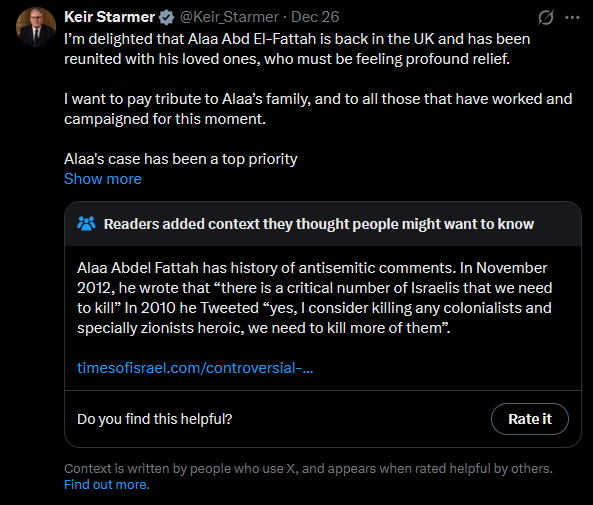
These are not even the worst things that Fattah has said:
In 2010, he wrote that ‘humanity will not b redeemed until we commit genocide against all white people’.
In 2011, he wrote that he wanted a drone so that he could ‘shoot Zionist weddings’ and that ‘police don’t have rights, we should just kill them all’
He endorsed suicide bombings if they ‘end a few Zionists’ lives’.
In 2012, he wrote that living in South Africa had convinced him that ‘the extermination of whites is a desirable thing’ and that ‘by the way I’m a racist, I don’t like white people’ — a clarification one can’t help but feel unnecessary.
In 2013 he wrote that he wanted ‘more fear’ to convince white males that ‘racism costs lives,’ and that ‘random shooting of white males’ was necessary.
He has referred to the British as ‘dogs and monkeys’.
This list could go on indefinitely, but you get the point: Fattah is a radical anti-white activist who despises Britain and its people. He comes from a family of Egyptian political activists who have no real connection to Britain, but who have manipulated citizenship laws to enable them to use a country that they explicitly renounce as a safe platform from which to conduct political activity abroad.
It goes without saying that the fact that a man whose only ties to this country are through his anchor-baby mother is eligible for citizenship and has been moved to Britain (likely at taxpayer expense) by our own government is egregious regardless of any specific facts about the person, but it is particularly aggravating given that an increasing number of our own people are being harassed by police and even prosecuted for social media posts far less incendiary than Fattah’s, yet his have somehow flown under the radar despite his public profile. Fattah did not even undergo the laughably flimsy ‘good character’ or 'Life in the UK’ tests when granted citizenship as a result of a Supreme Court ruling in 2019 which found these incompatible with the ECHR when citizenship is passed from a UK-born mother.
What is remarkable about this story is the breadth of ignorance displayed by our political class in relation to Fattah. A massive campaign of celebrities, intellectuals, and politicians from every establishment party — including the Conservatives — sought to release this man from prison and have him effectively seek asylum in Britain, despite these posts having been in the public domain for years prior. At best, it shows a complete lack of interest in ensuring that the interests of the British people are protected by the state when it considers who to allow into the country. At worst, it shows that our governing elite actively considers deeply-felt hatred for the British people a perfectly reasonable viewpoint which should have no bearing on a person’s eligibility not just for residency, but for membership in the political community. Even Liz Truss, who has been shrieking about the scandal across all of her social media channels, had to be reminded by the ever-vigilant Community Notes that she too campaigned for Fattah’s release and resettlement in Britain when she was in office.
On another level, it is painful to see how Parliament has become increasingly a base for irrelevant social activism by people whose politics is entirely telephonic, bearing no relation whatsoever to real issues faced by British people. The SNP and the Labour Party are particularly bad here, but many Tory MPs fall into precisely the same camp. It speaks to a deep weakness in our state that separatist parties are not only allowed to sit freely in the legislature, but also to campaign to import foreign political agitators without any benefit to Britain.
It is impossible to say for certain whether Fattah belonged in prison. Clearly, he was politically targeted as an opponent of the regime — but it is undeniable that he has been deeply involved in political activism which has, on many occasions, turned violent. The truth is that this question is of absolutely no relevance to anyone in Britain. Egypt is a corrupt dictatorship, and Sisi is known to be brutal; I sympathise with anyone who would oppose such a regime in their own country. Nevertheless, it is neither in the British national interest nor a goal of British foreign policy to seek the overthrow of corrupt dictatorships around the world. Fatah is a political actor in a violent country: he played the game, and he lost. It is not up to Britain to save him from the consequences of his actions, however sympathetic we may be, and it is in fact directly contrary to our interests to do so and thereby provoke ill feeling between ourselves and a foreign state.
Whilst Starmer has responded to yet another move blowing up in his face with his trademark inaction, the Conservatives have been quick to jump on the bandwagon, denouncing the Prime Minister’s support for Fattah in hopes of an easy comms win. It’s hard to understand this strategy, given that it was Liz Truss who began pressuring Egypt to release and relocate him, and that Priti Patel’s Home Office granted him his bogus citizenship. Time and time again, the Conservative Party — only a year since losing power — has attacked Labour for decisions that were clearly and obviously made during their administration — a fact which anyone with access to Google or Grok can verify in seconds.
This has been the consistent weakness of Badenoch’s political strategy, resuming ‘business as usual’ opposition to provide a generic alternative to Labour, staunchly opposing . ‘I wouldn’t have done that’ is not a credible line when, in fact, you were in government only last year and you did do precisely that! Attacks on the ‘Uniparty’ here are, then, completely justified, and Reform have certainly picked up on that opportunity. Indeed, they have reason to do so as the sheer hatred for Starmer begins to cover over memories of the last Tory government, and Badenoch’s party inches ever more reliably into second place.
Labour’s Looming Trade Union Crisis
The General Secretary of the Trades Union Congress, Paul Nowak, has recently given an interview to the BBC. Representing 5.5 million trade union members from 48 trade unions - some of which openly fund and campaign for the Labour party - he is one of the most influential organised labour leaders in this country. While reporting has focused on Nowak urging Starmer not to rule out re-joining the EU Customs Union, some of his warnings about where trade unionists are heading politically are very interesting:
