
The excellent recent report, Breaking the Blob by Cambridge Circus Research provides a timely examination of how parts of the UK non-profit ecosystem operate as unelected and unaccountable arms of the state. Parts of this ecosystem routinely seek to frustrate democratically-sanctioned government agendas in politically contentious areas such as migration.
This has, of course, been a problem even under Keir Starmer’s Labour government. Starmer took office understanding himself and his party to be the natural helmsmen of a system they believed to be correct and proper, and took the view that governance had only become dysfunctional because of Tory mismanagement and culture-warring. He began his premiership with the apparatchik Sue Gray as his chief of staff, offered substantive pay rises to civil servants for having been ‘on-side’ and took to increasing engagement with the voluntary, community and social enterprise (VCSE) sector in the development and implementation of public policy.
Early on, the government announced the Civil Society Covenant, expanding consultation between departments with over 1200 charities, social enterprises, faith groups, trade unions and other civil society organisations alongside mechanisms for ongoing engagement in the Joint Civil Society Covenant Council. By late 2025, however, the narrative had flipped, cue the many complaints from the Starmer team via the New Statesman that the system was unwieldy and that the ‘levers pulled’ did not produce the desired outputs.
Under a Reform government, which can only begin with an outright hostility to these frameworks, the scope for friction in the legislative and implementation processes will reach new heights. Large parts of the non-profit sector promote ends and means that the Labour-Conservative Party consensus of the past three decades supported, but that Reform rejects.
Under current guidance, charities can take part in political activity that supports their purpose, but ‘political activity must not become the reason for the charity’s existence’. The boundaries of the political, and therefore of what counts as political activity, are obviously not static. Much that was touted as part of a ‘common sense’ political consensus just a few years ago turned out to be political and contentious through and through — Net Zero being a chief example.
There are genuinely difficult issues about what charities are for and how they justify the privileges that the state confers upon them. Regardless of one’s position on their legitimate place, it should be uncontroversial that non-profit activity that frustrates the goals of the democratically elected government should not receive public support.
One difficulty for a reforming government would be deciding where to begin in tackling the problems that Breaking the Blob identifies. This article proposes a starting point that would be relatively straightforward, principled, and that would send a clear message: Nesta (formerly the National Endowment for Science, Technology and the Arts).
Nesta is rather unusual in that it is a private charity funded not by private philanthropy but, in large part, by a public sector endowment, more like a university than a charity — or the scheme by Viktor Orban’s government to fund the Fidesz-aligned think-tank Matthias Corvinus Collegium with shares in Hungary’s largest oil and gas company.
Per its own (and the current government’s) claims, Nesta has been effective at seeking and exercising influence over government policy, particularly on climate and energy. While Nesta is not a party-political organisation, it is self-evident that its priorities and the policy agenda it pursues would be thoroughly at odds with those of a Reform government.
The reassertion of control of the Nesta public sector endowment by a reforming government would be a relatively straightforward and principled first step to remedy the issues that Breaking the Blob identifies.
Nesta’s origins: more money than sense
What is Nesta, and where did it come from?
David Miliband (who is central to our story) fondly recalled in 2023 the moment of Nesta’s conception. During the draft of Labour’s 1997 election manifesto, he excitedly realised there was extra money to spaff up the wall: “The proceeds of the millennium lottery had not been allocated. So we suddenly thought, right, what are we going to spend this on?”
Labour’s answer, per its 1997 Manifesto, was the creation of a National Endowment for Science and the Arts, which would ‘sponsor young talent’. It even expressed the extravagant hope that successful artists would ‘donate copyright and royalties’ to the organisation. As it turned out, this never happened.
As an arms-length government agency squarely within the public sector, Nesta had from its launch the backing of an endowment of (initially) £250 million, funded by National Lottery ticket sales. Nesta would use the return on this endowment to fund its activities. It was thereby protected — by design — from normal government budget-setting and accountability, despite being a public body.
In its original incarnation, Nesta’s overarching goal as set by Parliament was consistent with the Labour manifesto and seems rather sensible: ‘to support and promote talent, innovation and creativity in the fields of science, technology and the arts’.
But mission drift was already evident by 2005, when Nesta changed its focus to ‘improving the UK’s capacity to innovate’. This pivot, coincidentally, synchronises almost perfectly with the enduring collapse in the UK productivity growth. Reading Nesta’s history, one has the sense of an organisation encumbered by its own existence by virtue of its endowment, lurching from idea to idea in search of a reason to exist.
Creative accounting
It is now often forgotten — in large part thanks to the other arm of the operation — that following the Conservative election victory in 2010, David Cameron and George Osborne promised a ‘bonfire of the quangos’. The idea was that the Blairite public bodies burdening the public purse should be out; some of the most notable cases include the UK Film Council, Regional Development Agencies, General Teaching Council for England, Health Protection Agency, the Competition Commission and British Waterways, which were either abolished, directly merged into government functions, or replaced by ‘independent trusts’. The reforms assessed public bodies against the metrics that they should only exist if they: a. provided a technical function, b. required political impartiality or c. needed to act independently to establish facts.
Cameron’s government imagined a ‘leaner and meaner’ Blob by taking down the total number of public bodies from 901 to 648. This was to complement the Big Society and Open Public Services agenda, which simultaneously institutionalised the decentralising impulse of the time. The state-led Blob 1.0 gave way to the Cameronite successor model we are now more familiar with.
Despite some fat trimming, by the Cameron team’s own criteria, Nesta had very little to show from its 12-year record. It should have been an obvious target for the quango pyre.
So it was. But jump forward to 2026, Nesta is still with us, now a private charity with a headcount of over 500 people and continued access to a public sector endowment. The Cameron government was clearly set on removing Nesta from the public sector, but for rather inexplicable reasons, it also saw Nesta’s continued existence as valuable. Perhaps it needed something to point to in the sparsely populated ‘Big Society’.
It also must have known that Nesta could not survive without its endowment. But transferring the endowment to an independent Nesta risked creating a minor fiscal headache: it would trigger an immediate hit to public sector net debt, hardly consistent with the aims of the quango cull. So, how to square the circle of getting Nesta out of government while keeping its endowment on the government’s balance sheet?
The solution was that the endowment would be held by a Nesta Trust, with a new independent charity, Nesta, as the Trust’s sole trustee. The government defined the Trust’s charitable objects (which might have set an appropriate purpose for the endowment) extremely broadly. Government would have no role in appointing the Nesta board, and therefore in the management of the Trust and its endowment. The only remaining formal tie to government would be a Protector appointed by ministers to ‘ensure the integrity of the administration of the Trust and the propriety of its procedures’.
According to the Office for National Statistics, the Nesta Trust remains to this day in the public sector as a ‘government-controlled charity’. Perhaps you expect that a ‘government-controlled charity’ would be controlled by the government? Or perhaps that there would at least be accountability to government and Parliament for how it uses its assets? In the Nesta Trust’s case, at least, you would be wrong.
The upshot of the arrangements was to secure Nesta’s exclusive access to the endowment and to keep the endowment assets on the government’s books while severing all Nesta accountability to its (public) funders. It was a small but egregious act of administrative vandalism.
What about the Protector, the tenuous remaining thread of accountability to government? Remarkably, no Protector has been in place since April 2022, meaning that this mechanism, promised to Parliament to ensure ‘integrity and propriety’ in the administration of the Trust, has been absent. One wonders what lies behind this delay, as even by government standards four years is a long time.
Charity begins at home
How does Nesta use its extraordinary privileges today?
Nesta’s current avatar has taken shape under the leadership of Ravi Gurumurthy, appointed by the Nesta board in 2019. Before leading Nesta, Gurumurthy worked for David Miliband, whom we met earlier, at the International Rescue Committee in New York. Before this, his career had already tracked the protagonist of our tale, David, across different roles in the UK government, from DEFRA to the Foreign Office. The Independent reported him flouncing off from his civil service job in 2013 to rejoin Mr Miliband in New York, in high dudgeon at ‘Treasury meddling’ in energy policy.
With Gurumurthy’s appointment, Nesta came full circle, from a twinkle in an excited David Miliband’s eye in 1996 to his long-term associate taking the helm. He took over from former Blair advisor Geoff Mulgan, who had held the reins since 2011, thus maintaining independent Nesta’s unbroken line of New Labour-linked leadership.
According to Nesta’s accounts, one change since 2019 is that salaries have risen rather healthily, with the number of staff earning more than £100,000 increasing from five to thirty. The CEO’s salary jumped by a handy 27% the year Gurumurthy was hired, from £164,000 to £209,000. The 2025 accounts show Nesta’s top earner taking home over £260,000, significantly more than the British Prime Minister and Cabinet Secretary, but Nesta’s annual report has coyly declined to state outright who its top earner is since 2021.
A BIT late, and a BIT much
Since 2019 Nesta has also dabbled in mergers & acquisitions.
In 2021 it paid £15.4 million – funded from the Trust endowment – for 70% of the Behavioural Insights Team (BIT). Nesta already owned the remaining 30%. BIT was a government-incubated consultancy organisation founded in 2010 as a vehicle for advancing ‘behavioural science’, also known as ‘nudge theory’, in government. Nudge theory reached its peak as a fad in the public sector in the 2010s by promising cash-strapped governments cheap ways of achieving difficult public policy goals. Its foundational policy triumph (pre-dating BIT’s creation by several years) was pensions auto-enrolment — rather low-hanging fruit. Nudge theory has failed to achieve a policy success remotely on a par with pensions auto-enrolment, and the ongoing replication crisis undermined the credibility of the theory’s underlying research base.
The coronavirus epidemic seemed to promise a salvific opportunity for nudge theory. Instead, the BIT’s CEO at the time somehow became the government’s mouthpiece for the controversial, and chaotically abandoned, herd immunity strategy.
Did a canny Nesta use these circumstances to negotiate a bargain-basement price for BIT? It seems not. According to Nesta’s accounts, since its acquisition BIT’s accumulated profit in the years to 2025 is a little over £400,000. In valuing BIT at £22 million, Nesta appears to have paid very handsomely indeed for such earnings.
What does Nesta actually do?
Perhaps none of this would matter if Nesta were doing valuable apolitical work that benefits the UK. So what is it achieving? Does Nesta deserve the extraordinary privilege of its public endowment? Although the Conservatives did their best to sever all Nesta accountability to government, the question remains valid.
As we consider this, a possible test to have in mind is whether we could reasonably expect the National Lottery ticket buyers who provided Nesta’s endowment to approve of how their money was being spent. Another is whether governments of different political persuasions would be likely to consider Nesta’s work valuable.
According to Nesta, its work today focuses on three self-appointed ‘missions’, or what in less religious terms we might call goals:
that by 2030, every child has the same chance of developing to their full potential in the early years
to halve the prevalence of obesity in the UK by 2030
to reduce home carbon emissions in the UK by 30% by 2030.
And what reasonable person could object to such goals?
The first, in particular, just seems really nice. It may also be exceptionally broad and ambitious, even for an organisation with Nesta’s privileges. But hey, Elon Musk is ambitious and look at him! When you think about the specific words — which presumably we are meant to take seriously — understanding what this goal actually means becomes less, rather than more, clear. Why ‘the same chance’ instead of simply that ‘every child will develop to their full potential’? You might conclude that we are left with little more than vibes.
Perhaps it is rude to nit-pick about such a worthy goal, it’s for the children after all. But if Nesta is going to realise its vision of universal justice in three years’ time, then it probably needs a strategy built on clear ideas. If Nesta does have them somewhere, they are certainly keeping them close to the chest.
Instead, we find on Nesta’s website scores of sub-scale, incremental, seemingly uncoordinated projects that keep its people busy. Will any of these have any discernible effect separable from the government’s own early years strategy? Who knows! What has Nesta actually achieved in the years since setting itself this goal? Nothing much. Anyone rooting for children to face an unfair start in life probably needn’t worry.
Regulation nation
What about goal number two, halving obesity prevalence? That’s certainly clearer and more measurable. And for this goal, Nesta is firmly committed to a theory that guides its action: ‘the most effective way to cut obesity is to change our food environment’. From this it follows, as the night follows the day, that Nesta’s solutions demand government regulation to reshape our ‘food environment’ to our benefit.
Nesta’s specific solution is that the government should impose mandatory data reporting, ‘healthy’ food sales targets and punitive fines for non-compliance on businesses selling food, starting with supermarkets. It calls this a ‘healthy food standard’. The standard is market-friendly because the government would not tell supermarkets how they should meet the targets imposed on them. (If they need help to meet their targets, they could buy the services of a ‘behavioural science’ consultancy organisation.)
It is here that Nesta has achieved its greatest success of the past six years, with the Labour government committing to adopt the ‘healthy food standard’ in 2025. What did the supermarkets, who may have useful insight to add to this idea, make of it? It seems neither Nesta nor the government consulted them. It was apparently ‘not Nesta’s job to consult with industry’. Stakeholder Engagement in action.
Putting aside the rights, wrongs and implications of such a radical expansion of the government’s regulatory footprint, presumably somebody did a rigorous analysis of the economic impacts before announcing the policy? It does turn out that Nesta commissioned a 26-page assessment of its own proposal (which is nevertheless ‘independent’) to a former regulator, Daniel Gordon. The economic case for health targets on grocery retailers showed that the economic cost will be small and supermarket prices probably won’t rise much. If I am in any way qualified to give word of professional advice to the good people of Nesta, an independent assessment of policy costs and rewards can seem less even-handed when it is called ‘The economic case for…’.
One wonders what departments other than the Department for Health and Social Care have made of it, given the government’s commitment to cut the regulatory burden on business by 25%. Fortunately for those of us who sense something problematic about the policy, the government seems to have had cold feet or is too distracted by its own collapse to drag it forward. One year after the announcement, an impotent Nesta is left to huff petulantly that ‘we are still waiting for a formal consultation’ and to lament that ‘the policy risks slipping down the agenda and not being implemented at all’.
Let them eat heat pumps
Perhaps the strangest of the goals in practice is the third, about reducing carbon emissions from home heating. Nesta has a theory underlying this ambition, and it is a simple one: the British people must install heat pumps in their homes.
In pursuit of their goal, Nesta has effectively become the propaganda arm of the heat pump industry and an outrider of Ed Miliband’s Net Zero department, whose 4,500 staff you might think already had it covered. As with the other two goals, there are lots of projects keeping Nesta staff busy, and there is a bit of something for everybody:
If you are lonely, you can join Nesta at the Heat Pump Unconference 2026 on 22 June
If you have already read everything else on the internet, try Nesta’s hot takes on the energy market, each of which comes with a preordained solution (you guessed it – heat pumps!)
If you simply want to cry yourself to sleep, try some Nesta-funded heat pump comedy sketches.
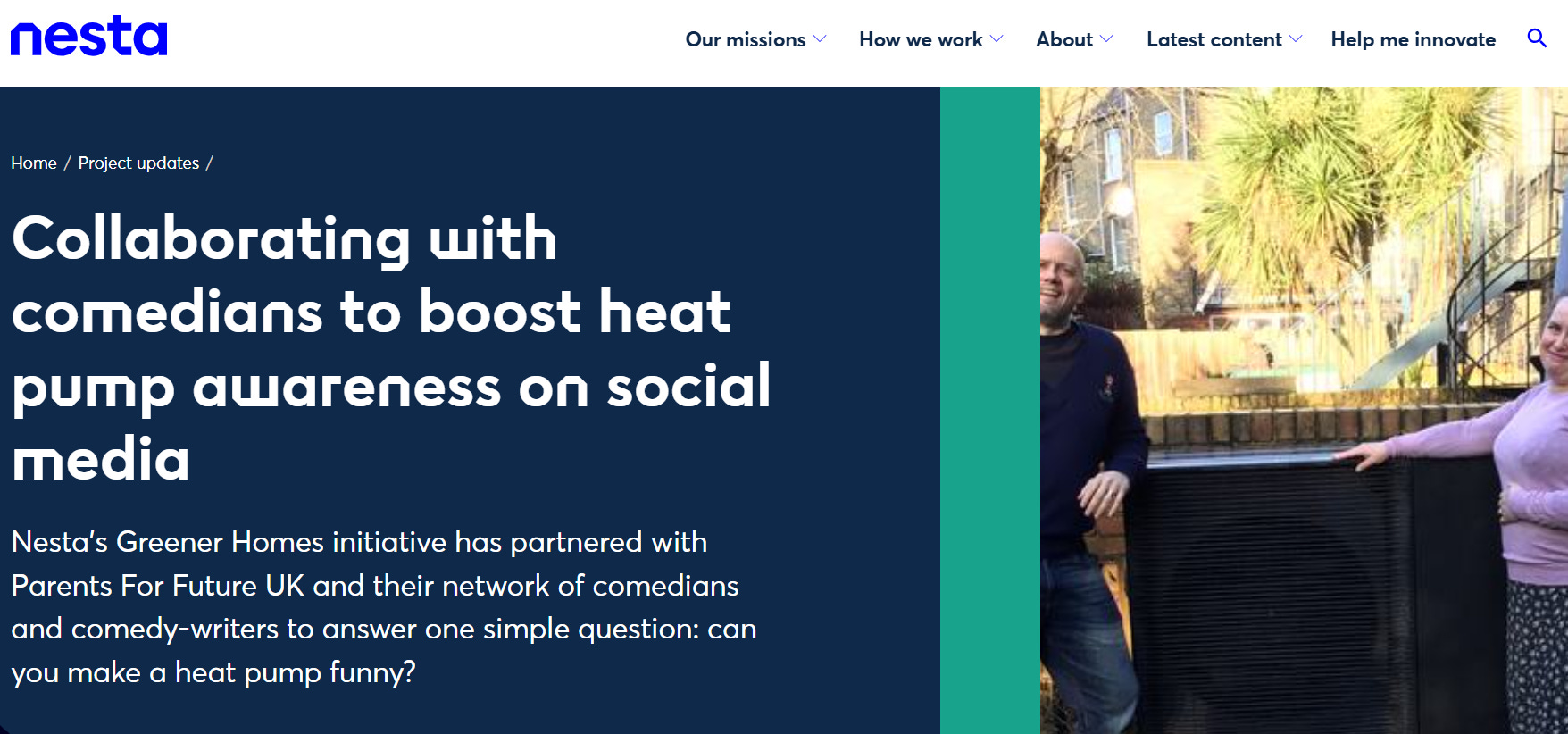
Putting aside all the noise, Nesta’s one substantive policy proposal in this area is to reliably change the relative price of electricity and gas faced by households, i.e., to keep turning the financial thumbscrews on the British people until heat pumps become attractive.
Based on the revealed preferences of UK householders, this would require a lot of intervention with extensive secondary consequences for government, consumers and businesses. But like the paperclip maximiser of AI lore and the Net Zero department that it seeks to influence, Nesta’s attitude to anything beyond its target appears to be: ‘Consequences be damned!’ In the context of a government instinctively sympathetic to Nesta’s dirigiste mindset and unusually vulnerable to bad ideas, some might consider this positively dangerous.
Putting Nesta to rest
Nesta, in its current avatar, exhibits an almost uncanny resonance with the current government’s appetite for regulation and the zero-sum economy that its actions serve to further entrench. It has become a kind of unofficial think tank for Britain’s brain-dead but hyperactive administrative state, a sickly British left’s answer to the US’s Abundance Liberalism.
Earlier, we proposed two tests for determining whether Nesta should continue to enjoy its unusual privileges: whether the National Lottery ticket buyers who provided Nesta’s endowment might approve of how their money was being spent, and whether governments of different political outlooks would consider Nesta’s work valuable.
Readers will make up their own minds about the first question. We think a likely response from many Lottery punters would be bafflement followed by weary resignation.
On the second, we venture that a Reform government (or even a pro-enterprise Conservative government) would find little of value in Nesta’s work and would likely find much of it squarely at odds with its goals and values. To the extent that Nesta is funded by the returns on a public asset, this is a problem.
The solution is that the Nesta Trust should be brought back properly into government control, consistent with its designation in the National Accounts, and ministers accountable to Parliament can decide what to do with its assets. Cameron’s Conservatives perversely tried to make this as difficult as possible, but the Trust’s designation as a government-controlled charity in the public sector provides the opportunity to correct the anomaly.
A Reform government might proceed as follows:
1. The new minister should dismiss the existing Nesta Trust Protector (if this government does finally appoint one) and appoint a Protector of their own choosing.
2. The new Protector should conduct a brief investigation into whether there are grounds for concern about the administration of the Nesta Trust by Nesta, including during the long period during which no Protector has been in place, and report their findings to the minister.
3. Should the Protector find grounds for concern, the minister may choose to replace Nesta as trustee of the Nesta Trust with a ministerial appointee and provide for an orderly wind-down of those parts of Nesta dependent on Trust funding.
Such action is hardly going to be top of the list of priorities for a Reform government. But apart from the practical benefit of freeing up £400 million of funds for alternative uses, Reform would be asserting a principle that ought to be uncontroversial:
That public money should, unless there are compelling countervailing reasons, be subject to government control, or there must at least be some chain of accountability to Parliament for the use of public money. The Nesta Trust should be considered a brief (in the scheme of things) and unfortunate experiment in what happens when this principle is disregarded.
This article was written by William Stanley, a Pimlico Journal contributor. Have a pitch? Send it to submissions@pimlicojournal.co.uk.
If you wish to support what we do, please consider subscribing. If you are already subscribed, why not upgrade to a paid subscription?
Blair started it of course. Destruction of the constitution.