
In November 2025, two others and I undertook a trip to Moldova. The route had a simple eastward logic, starting in the Romanian city of Iași, before going on to Bălți, Chișinău, and Tiraspol. This travelogue serves to recount that very interesting journey.
By way of historical background, Moldova (alternatively, Moldavia) was one of the two so-called ‘Danubian principalities’, the other being Wallachia. These principalities (along with parts of Transylvania, controlled by the Kingdom of Hungary) were populated principally by Romance-speaking peoples, claiming their origins from Trajan’s legions in Dacia, first known by foreigners as Vlachs (an exonym), and later as Romanians.
Moldova — like Wallachia — existed with varying degrees of sovereignty in the medieval and early modern period. It was wedged between the Carpathians to the west and the river Dniester to the east, meaning it sat at the historical intersection of Ottoman, Polish, and Russian interests.
After a long struggle, the Ottoman Empire firmly established Wallachia and Moldova as tributary states by the sixteenth century. Although neither was ever annexed, Ottoman interference in internal politics only grew over the next two centuries, with endless cycles of coups funded by Istanbul, followed by the new ruler reneging on their commitments, followed by another coup funded by Istanbul. From the early eighteenth century, the Ottomans tired of this circus and instead sent Greek Christians (the Phanariots) to rule the principalities; unfortunately for the Ottomans, the Phanariots were only marginally more reliable than the Romanians themselves, and soon went native.
The main foreign sponsor of the Danubian principalities against the Ottoman Empire was the Russian Empire. Needless to say, this did not come without a price. In 1812, the eastern part of this region was annexed following the Russo-Turkish War of 1806-12, the bulk of which now forms the Republic of Moldova. The Russians, despite their assistance against the Ottomans, opposed the growth of national (and unificationist) sentiment among Romanians and even briefly occupied the two principalities in 1853, which helped trigger the Crimean War. The western part of Moldova, which is divided from the east by the river Prut, unified with Wallachia in 1859, forming the basis of modern Romania.
At Trianon in 1920, Romania gained Transylvania, previously a majority Romanian province of the Austro-Hungarian Empire. But more importantly for our purposes, in 1917, a pro-Romanian local assembly took control of Bessarabia amid the breakdown of Russian imperial authority in the region. The following year, Romania took the opportunity to formally occupy and then annex the territory.
Just two decades later, though, Bessarabia was once again signed away to the Soviet Union by Nazi Germany in the Molotov-Ribbentrop Pact, with the bulk becoming the new Moldavian SSR and the remainder being absorbed into the Ukrainian SSR. One result of this was that virtually the entirety of Bessarabia’s long-standing German community, who were separate from the much more well-known Transylvanian Saxons, was resettled in Germany. After Operation Barbarossa in 1941, Romania regained control of Bessarabia, but the Soviet counter-offensive again restored Soviet control from 1944. In 1991, following the collapse of the Soviet Union, the Moldavian SSR became the independent Republic of Moldova, but did not choose to unify with Romania. Reunification remains an open question today (and is supported by the current President), but only a minority of Moldovans are in favour.
Transnistria, on the east bank of the Dniester, followed a somewhat different path. Controlled by Russia from 1792, it was never historically part of the principality of Moldova. From 1924, it was administered as an ‘autonomous republic’ within the Ukrainian SSR, with the aim of later expanding to regain control over the rest of Bessarabia. Transnistria was then attached to Soviet-controlled Moldova in 1940. There is some fairly strong circumstantial evidence that this decision was a deliberate attempt to dilute the Romanian character of the Moldavian SSR by increasing the Moldavian SSR’s Russian-speaking population. Transnistria, being strongly Slavophile, broke away from the Republic of Moldova (which now had a Romanian-dominated government) amid the collapse of the USSR. A war followed in 1992, with Transnistria, supported by Russia, becoming de facto independent, although it has never been recognised by Moldova — or indeed, any UN member state at all. Interestingly, Russia does not recognise Transnistria to this day.
Our route therefore moved through three related but distinct political worlds: Romanian Moldova, the Republic of Moldova, and Transnistria, an autonomous territory on Moldova’s eastern edge.
Iași
We flew into Iași from Luton, and our arrival was without any problems. Our hotel was a converted apartment block, clean and spacious enough, but humorously overstaffed with an extra person at the desk, and another sitting and chatting. Of Romania’s five major cities (Bucharest, Cluj, Timișoara, Constanța, Iasi), Iași is the poorest. Probably the main economic driver here is the city’s large (and, by Romanian standards, prestigious) university. Partly for this reason, as well as the important role of Iași in Romanian history and culture, the city has certain pretensions (and especially cultural pretensions) in spite of its relative lack of wealth.
We headed first to the city’s Palace of Culture, the city’s best-known symbol: a late neo-Gothic pile inaugurated in 1925 as the Palace of Justice and Administration. Inside, incongruously, a coffee fair of some kind was underway. Right next to the Palace of Culture is an enormous development (initiated through a controversial public-private arrangement involving land right next to the Palace) by Iași’s (probably) richest native, Iulian Dascălu, who, after operating large shopping malls elsewhere in the country, has made a big bet on the city’s growth.
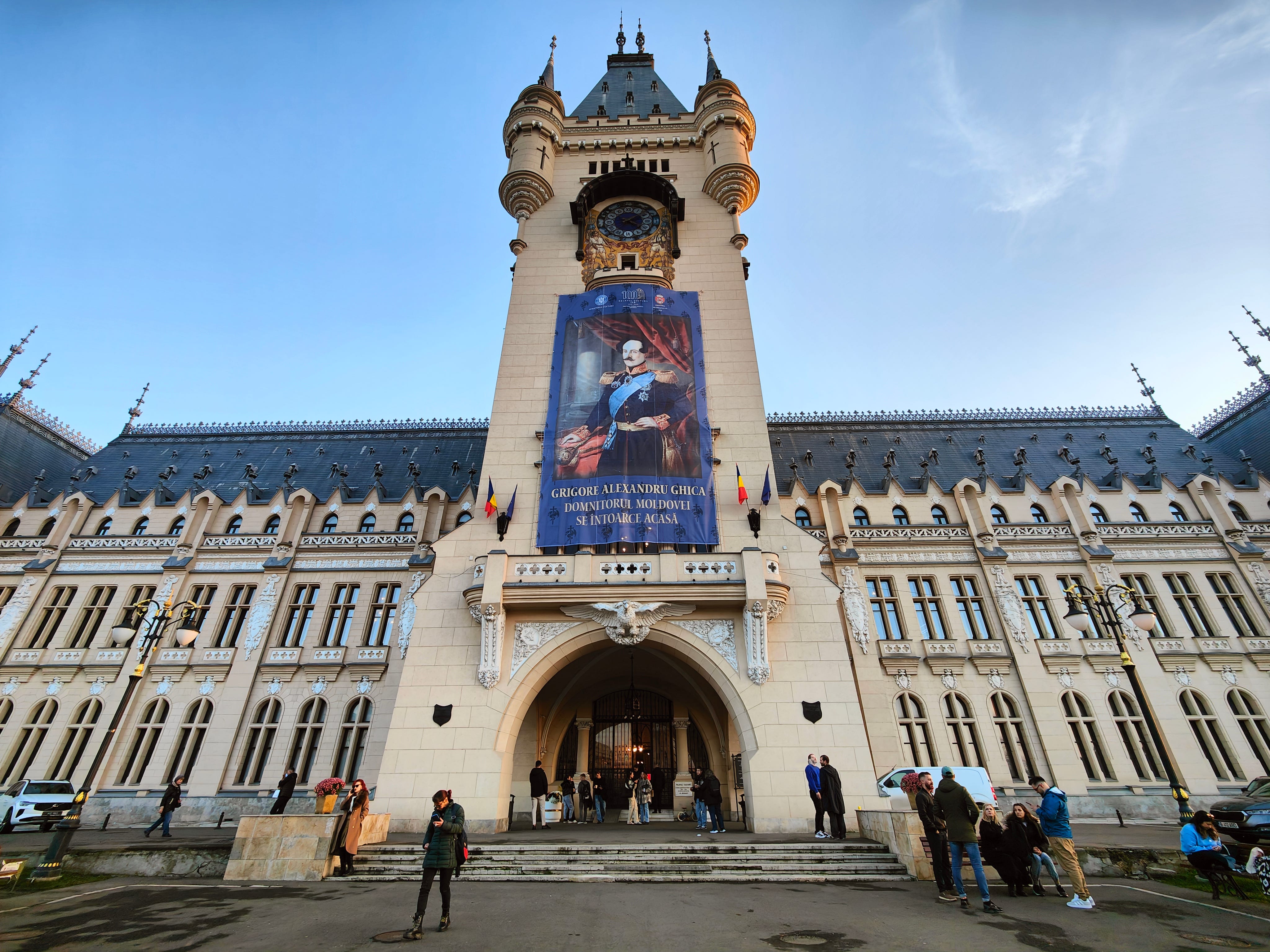
The city centre had very striking communist-looking architecture: impressive in a way, and quite monumental. We then followed the Carol I Boulevard northwest to the more affluent part of town, leafier and less touched by Communist redevelopment. The road was flanked by bicycle lanes on each side, neither of which seemed used at all. Somewhere in this part of town, we passed a building with a connection to the French military mission in Romania during the First World War. We also saw a couple jogging — one of the great indicators of a certain level of socioeconomic development.
That evening, we went to a couple of places of some note. The first was a bar called Vipard, recommended by the European Bar Guide. It was a slightly more refined version of a shop where one can also sit and drink. In this case it had a little more pretension to being a bar, in that it only sold booze and had tables laid out. Some older men sat chatting, and the TV played a YouTube playlist of folk music videos with imagery of rustic milkmaids. A man with a sort of hunchback was helping behind the bar, cleaning and moving things about. They had a beer tap, but there was no beer in it, so only bottles were available. It had a wonderful ambience.
We ate at Bolta Rece, a traditional Romanian restaurant with some historical significance. The restaurant was strongly associated with Iași literary culture, especially the Junimea circle and the friendship of Mihai Eminescu (whom both Romanians and Moldovans compete to claim as their national poet) and Ion Creangă. It’s the sort of place for grilled meats, pickles, polenta and borsch, and this was more or less what we had.
The second place we ended up that night was a funny subterranean development in the Communist-era city centre called Piațeta la Cub – ‘The Cube’. The origin of this curious development is that archaeological ruins studied in 1982 were largely covered with concrete, and that the underground space was supposed to become a museum. The museum plan was never completed; the galleries instead later held shops, and after 2000 gradually acquired a rock club, then pubs and nightlife venues. It was effectively a small student bar zone catering to the city university. (The Romanians, like many Europeans, seem to only ever go out drinking on Friday and Saturday, so be warned that the entire place will probably be deserted, if it is even open, on other nights.) Our party got talking to some medical students: Romanians, one from Cluj and one from a small town outside Iași, and also an Iranian girl studying medicine. We drank too much and went to bed.
The next morning, after breakfast, we headed to the bus station, an open-air place tucked away in what felt more like a parking area than a formal terminal. We asked about buses to Bălți. In any case, we found the right bus, and the driver, who had a very friendly and pleasant disposition, had to write down all our foreign names for the tickets, which was mildly comic. For those not interested in Bălți (which is probably rational), there is also a charmingly old-fashioned night train (the ‘Friendship Train’) from Bucharest to Chisinau. However, it takes over thirteen hours, partly because of the need to change from the European standard gauge to the Soviet broad gauge at the border.
Before leaving, we bought a beer at the bus station and drank it while waiting for the bus to fill up. It did so gradually: students and people working on the richer Romanian side of the river Prut, now going back home. At the border crossing, the guards took our passports and checked them quickly. Another official came on and asked whether anyone was bringing in exports. He specifically asked whether anyone had a rolled-up carpet; the logic behind this is that a carpet is the perfect smuggler’s device, concealing whatever is rolled up inside it. The border checks here are relatively slow, apparently as a consequence of Romania’s entry into Schengen (which has meant much more scrutiny of its border control). This means that while Iași is very close to the border, doing business between the two countries can be tedious.
Bălți
Across the Prut, the country became visibly poorer almost at once. Rural Moldova looked like rural Romania in its basic foundations, with the same village layouts, houses and garden smallholdings containing fruit trees and chickens. But in Romania, even in an average village, the older rusted bungalows are usually interspersed with houses that have clearly been developed with two-storey buildings from newer materials, the signs of remittances or accumulation or simply of a country moving gradually upwards. In Moldova, by contrast, the peasant bungalow type seemed almost universal, with very little sign of redevelopment.
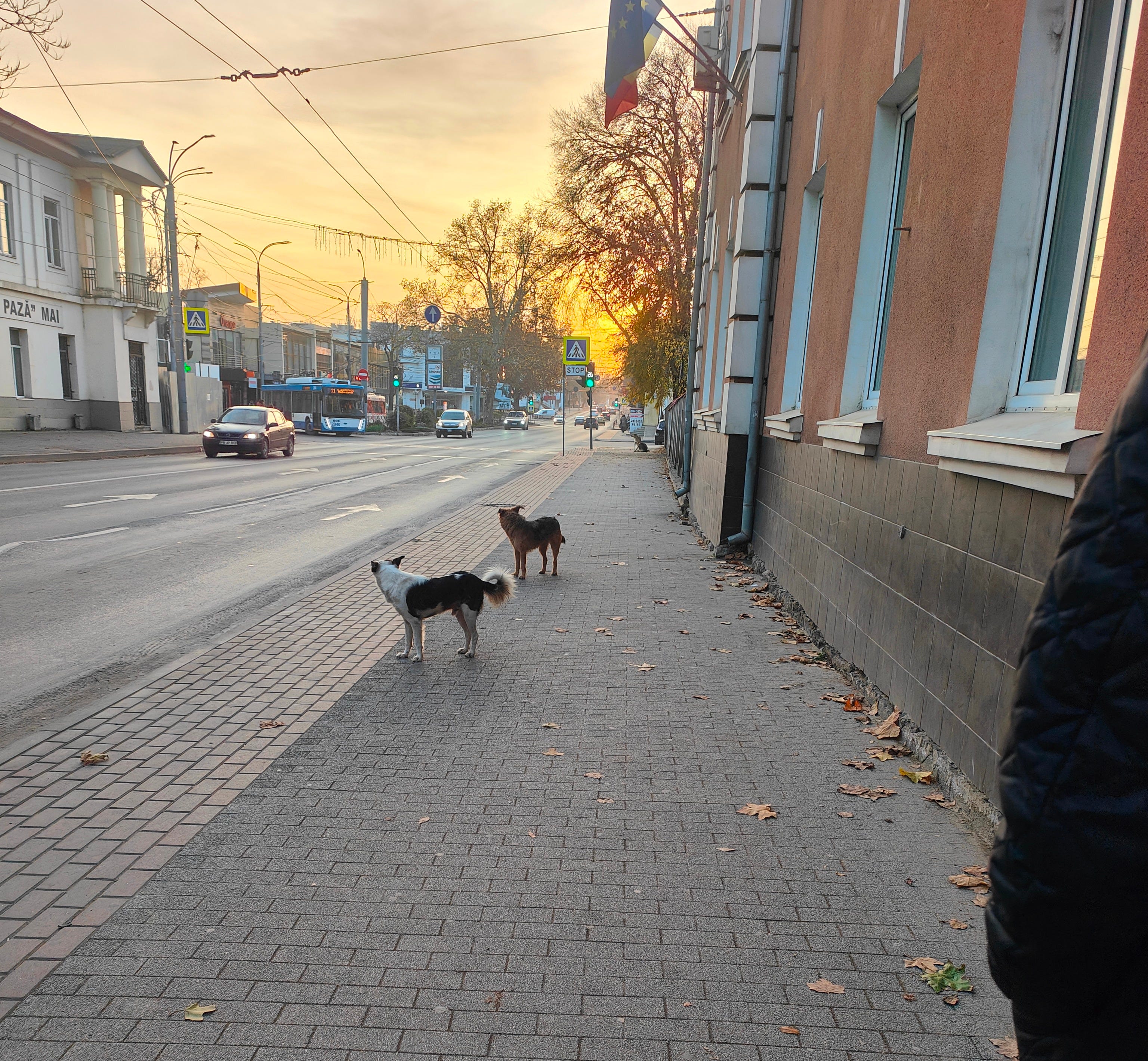
We arrived in Bălți and headed to our hotel. Walking from the bus station to the centre, we passed what looked like a derelict games arcade, now fallen apart and full of rubble. There were also little markets, pharmacies, and shops selling basic shoes and children’s clothes. There were stray dogs, too; although stray dogs are still present in Romania, the problem is now much more under control. The streets were rather poor: potholes everywhere, various muddy stretches and bits without paving. The name itself, in Romanian, appropriately enough, means something like ‘puddles’ or ‘ponds’. It’s a city that has clearly fallen on hard times since the end of the USSR and the decline of Soviet industry. Today, Bălți has a population of 94,000, which is down from a peak of over 160,000 in 1989.
Our hotel was called Elite Hotel, which was at the top of a shopping centre. By the time we arrived, the November darkness had already drawn in. The shopping centre itself was somewhere halfway between a bazaar and a mall. There were demarcated shop units, but really, it was a warren of little rooms.
The hotel was barely signposted. We found a side staircase and climbed into the darkness. On one landing, two security guards sat at a desk with the lights off; in the lobby, another guard sat in the dark with a torch. Eventually, a young woman with a professional demeanour appeared, turned on the lights from somewhere, and checked us in. There seemed to be three security guards in the upper part of the shopping centre, all sitting in darkness to save money.
We wanted to find somewhere to have a drink. This proved surprisingly difficult. Bălți, despite being a fairly big town, had very little in the way of bars. More generally, this was a city without much of a consumer economy; it simply did not have the money to sustain one. On Google Maps, many of the plausible venues turned out to be event restaurants, mostly wedding places. This made sense: even those who leave Bălți for work elsewhere may still return for weddings, birthdays and funerals.
Wandering as we did through the dark city streets (darkness, along with the namesake puddles, became quite a theme in this town), we made it to the one vaguely modern bar. This was Beermaster, a somewhat hipsterised brew pub. It served a variety of different beers and beer snacks. Folk musicians were playing. It was very cheap — I think a pint was about 50p. We drank up.
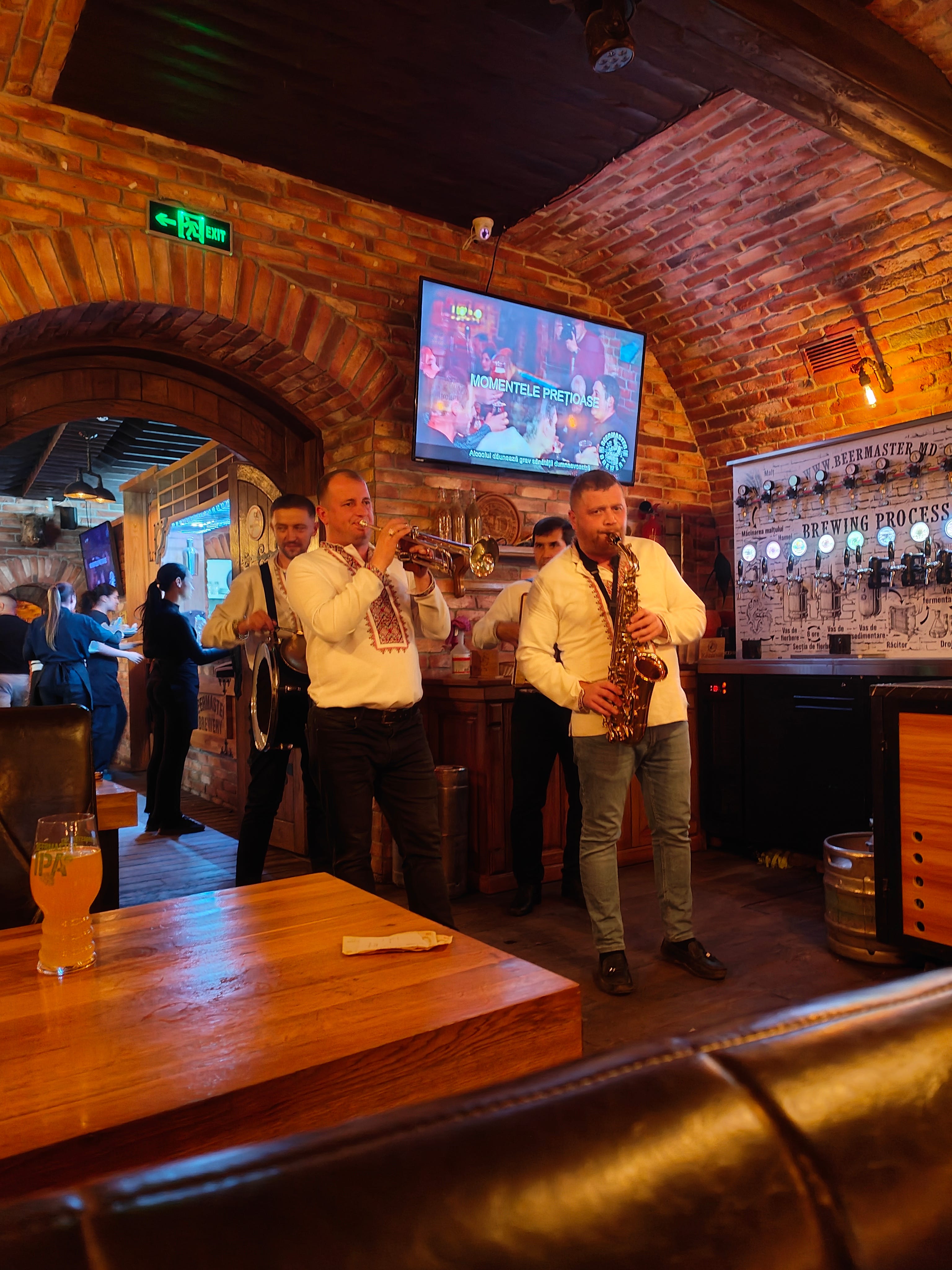
There was also an annex attached to Beermaster, a kind of shop where one could buy takeaway plastic bottles of beer and kvass. The shop seemed to be doing healthy trade. Bălți was definitely one of those places where home was a much more common place to drink than any bar.
For dinner, options were also very limited. The most sensible choice seemed to be La Plăcinte, a Moldovan chain restaurant serving Romanian-Moldavian fare, the same as the food we had eaten in Iași: soups, meat, pastry, polenta, all the rest of it.
One thing that was evident from the restaurant, but really reflected across the whole country, was its bilingualism. Moldova may be the most thoroughly bilingual country in Europe, if not the world. Nearly everyone seemed to have some command of both Romanian and Russian. Reportedly, a relatively small number of young middle-class Romanians and some Russian hicks do not speak the other language particularly well, but these people, if they do exist, are very much an exception to the rule. Most people you encounter, even drunks, seem to switch effortlessly between the two languages.
Nonetheless, official and printed signage in the country was always in Romanian: documents, billboards, bus stop names, or indeed anything with an official quality — one sign, among many, that nowadays the Romanians are in charge, and not the Russians. In the Soviet times, Romanian was written in Cyrillic, but not any more. More informal signage was sometimes in Russian, although even this has become increasingly uncommon. Very recently, the pro-EU government took the step of restricting the use of Russian in the Moldovan Parliament. And yet, despite the big (and growing) political divide between the Romanian-speaking population (who mostly, but not overwhelmingly, favour closer ties with the European Union) and the Russian-speaking population (who overwhelmingly oppose this), there is little obvious sign of the ethnic tension that one would expect from this situation.
There were two birthday celebrations in the restaurant that evening, one for a younger girl and one for an older lady. The staff came out with cakes and sang happy birthday, as restaurant hosts do everywhere. For the younger girl, they sang in Romanian. For the older woman, they sang in Russian. Presumably, this reflected the language used by each table.
Within our travelling group, I could speak Romanian, and one of my companions could speak Russian. This meant that both of us could address people, but only one of us would understand the reply, depending on the language chosen, which was occasionally funny. No one, in any case, asked why we had come to Bălți as tourists. Perhaps they were quietly bewildered anyway.
We fancied another drink and headed east through the darkness in search of somewhere else. We walked through the main square, Piața Independenței. In front of the City Hall stood a large bronze statue of Ștefan cel Mare (Stephen the Great), the medieval ruler of Moldavia, celebrated today on both sides of the Prut as a figure of Romanian and Moldovan historical memory. The central area was enormous and rather empty, almost North Korea-like: a wide pedestrian road, a Soviet tank, an eternal flame, the obligatory ‘I Heart Bălți’ sign, and what looked like an abandoned, half-finished commercial building.
We continued towards a Google Maps listing called ‘Public House’, somewhere near the edge of the core town, around a cluster of Soviet housing. On the way, we were propositioned by a haggard prostitute. ‘Public House’ itself, however, was shut, as dark as the streets around it.
Disappointed, we turned around and started walking back in the direction from which we had come. As luck would have it, we passed an actually functioning bar called Randevu. Inside, we found six locals in their thirties and forties, who seemed to be friends with the barmaid. They were mostly speaking Romanian with one another. We sat down, instantly conspicuous as the only other group in the place. They were listening to pop-folk with a beat, drinking vodka and beer, moving in and out, shouting, dancing, and randomly heading in and out to take phone calls and smoke cigarettes (the inside oddly still smelled like smoke). It was a chaotic scene. I ordered drinks, and suspect we were slightly conned (we certainly paid more than we had at Beermaster, despite Beermaster being a far nicer place).
During a strange lull where many of the group had inexplicably left, one of the men, who had almost no teeth, asked where we were from. He then began talking about jiu-jitsu and martial arts, and about how he was a fighter. Moldovans, he told us, were fighters. Moldovans loved to fight. The insinuation was that it might be fun to fight with us, too. We did our best to smooth over the awkwardness.
After a while, more of the group returned to the bar. One man, who was pleasant enough, with a deeply haggard face and weathered skin, told me about the time he spent working in Romania. Another large man simply stared at us silently, frowning with his arms folded, not saying a word to the group he was with (one of them told us that he ‘did not speak Romanian’, which is hard to make sense of, given that’s how his group was communicating). They put more music on through an AUX cable. During one dance, another one of the men (a gypsy; they are much less common in Moldova than in Romania, but are present nonetheless) comically thrust himself at one of the women in the group and began dry-humping her and ululating barbarically.
When you read about homicide in this part of the world, it basically comes from people like these: ne’er-do-wells hopped up on hard spirits who take the communal fire-axe and butcher somebody because of a perceived slight, banter gone wrong, or a small trigger which unleashes long-simmering tensions caused by an ex-girlfriend, or money. Some readers may remember the occasional stories of Lithuanians and other such people in Lincolnshire in the early 2010s killing each other in this way. We might also remember the strange bemusement of English people from the refusal of Polish builders to drink from beer glasses in a pub rather than from cans of Tyskie in the park. There is no doubt that, as incomes have increased in Eastern Europe, the steady transition from ‘vodka culture’ (which hardly even deserves to be described as such) to ‘beer culture’ has been a beneficial, civilising force — with far less murder as a result.
My two travelling companions went outside for a cigarette. I was, for a few minutes, held hostage by sociability and made to dance more with the group. They did strange peasant jigs on the spot, which I had never really seen before; an old village culture surviving inside a decaying post-industrial city. Eventually, I found a moment to excuse myself, got out the door, and we legged it the hell out of there. We agreed that Randevu was probably the roughest bar any of us had ever been to.
After that, we walked back through the town to Beermaster. Our experience had confirmed that it really was the one proper bar in Bălți. We reflected on how many places in post-Communist Europe of the 1990s must have broadly resembled the Bălți of today (albeit with far less depopulation) in its quiet dilapidation and lack of consumer economy. We had a few more drinks at Beermaster, listened to the folk band playing loud music, and then returned to Elite Hotel to sleep.
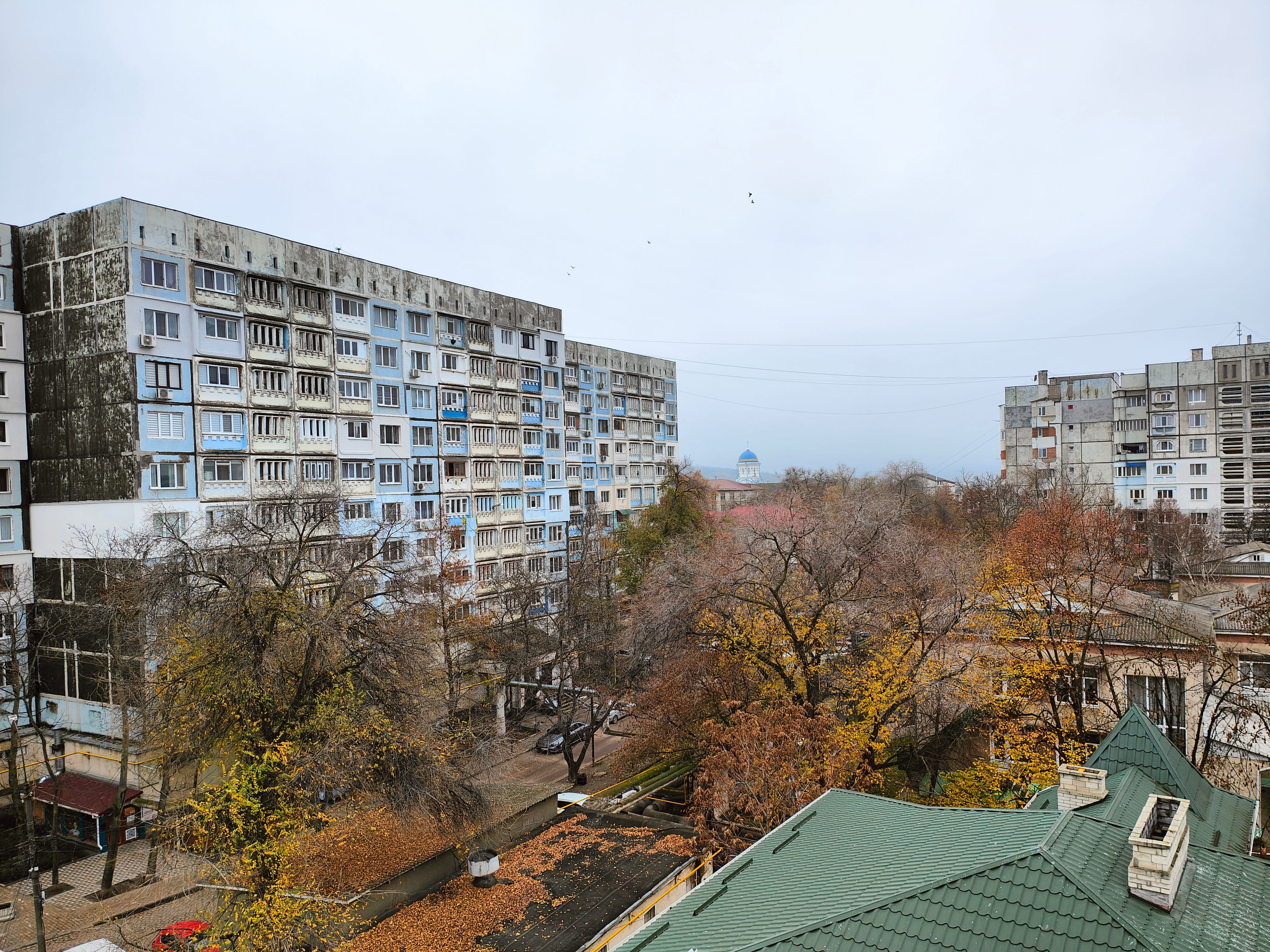
The next morning was Sunday. Sunday morning in Bălți was much livelier than Saturday night — perhaps a sign of the average age here. The night before, the streets were hardly trafficked at all. Now there were people seeing friends and family, people going to church, and elderly women selling old possessions and produce to supplement their meagre pensions.
After a coffee, we made our way to the bus station where our drivers were handily shouting ‘Chișinău, Chișinău’ over and over. We bought tickets. The driver, realising that we were westerners speaking English to each other, began speaking to us in German. Perhaps he had worked there.
We got on and sat at the back. My two companions decided to go smoke. One of them made the mistake of smoking in the sheltered bus station area, where there were no-smoking signs (though not especially conspicuous ones). A policeman lurking around the corner made a beeline for him and started demanding a €200 fine. My companion rather cleverly said he needed to go back onto the bus to get his wallet and the money. He went onto the bus and stayed there. There were still twenty minutes before departure, during which we waited for the policeman to reappear. As the bus pulled out, the driver stopped and spoke to him. For a second, we thought we had been caught; then the bus moved on, and we were clear.
The bus ride itself was fine enough. That said, Moldova has no motorways, only strange three-lane A-roads where the extra lane alternates between the two directions of traffic. In the countryside, the quality of the roads is especially appalling, probably matched in all of Europe only by Ukraine. Moldova’s low wages also mean that, at least outside of Chișinău, there are many very old, beaten-up cars on the road that — if you want to get anywhere in a reasonable time — you have to constantly overtake because they are so slow. This often leads to worrying driving amongst those who do have newer cars. We passed more humble villages of single-storey old bungalows in the traditional style, often painted with green motifs. There was one hair-raising moment when the van came very close to rear-ending a car; thinking back, I don’t think the brakes were working especially well. But we arrived in Chișinău in one piece.
Chișinău
Chișinău, with a population of over 700,000, is not a small city. The metropolitan area has a population of nearly 1 million in a country of only 2.4 million. According to the census, around half of the population speak Romanian as their first language, 28% ‘Moldovan’ (which is simply Romanian by a name with different political connotations), and 20% Russian — making it significantly less Russian-speaking than Bălți.
For its size, Chișinău is a quiet city. Nonetheless, you can get the sense that there is a growing consumer economy and, indeed, some level of actual wealth here — albeit clearly unequally distributed. There are even some bars and restaurants that cater to the country’s oligarch class, such as La Sarkis, which sells seafood pasta at London prices in a country where the GDP per capita is just $9350. This is a city on the up: Moldovan growth has been very strong over the past decade (nominal GDP per capita is now more than three times higher than in 2016), and there is no question that Chișinău has been at the centre of this.
And yet this is still, fundamentally, a poor city. We got into the bus station at the greyer, more proletarian end of the city. From there, we walked alongside a busy road for some time before reaching Chișinău’s Central Market: a tarp-covered bazaar where taller men had to stoop to avoid hitting their heads, where anything from veg to plastic tat could be bought, along with the numerous money-exchange booths of the kind we had seen in Bălți.
We stopped for Georgian food at a rather nice restaurant, outside which a sign advertised a set-menu ‘business lunch’ (бизнес-ланч) of the kind seen across the Russian world. Two besuited men at the table next to us spoke in Russian over espresso and had the appearance of ‘power brokers’.
We continued, passing the rather diminutive Triumphal Arch. There is an obvious comparison with the larger Romanian arch in Bucharest, although the Moldovan one is older. The Chișinău arch dates from 1840 and commemorates Russia’s victory over the Ottoman Empire in the Russo-Turkish War of 1828–29. The Romanian arch, by contrast, was built after the First World War and the enlarged Romania that followed. Opposite the Chișinău arch was the rather more overwhelming Government House of Moldova.
We walked on to our accommodation. Our place was near the Nicolae Sulac National Palace, a 1970s concert hall on Pushkin Street — that mainstay street name of the post-Soviet world. A girl met us outside the building on behalf of our ‘host’. We were brought up close to the top; it must have been one of the tallest buildings in the city! The flat was large and decked out in a faux-Versailles style. We were told to cancel the booking on Booking.com and pay directly (thus cutting out the platform fees). She confirmed the payment with the landlord on the phone, interestingly in English, suggesting that he was perhaps not local. Looking closer, I could see that the name of the recipient of my Revolut payment was an Arabic one.
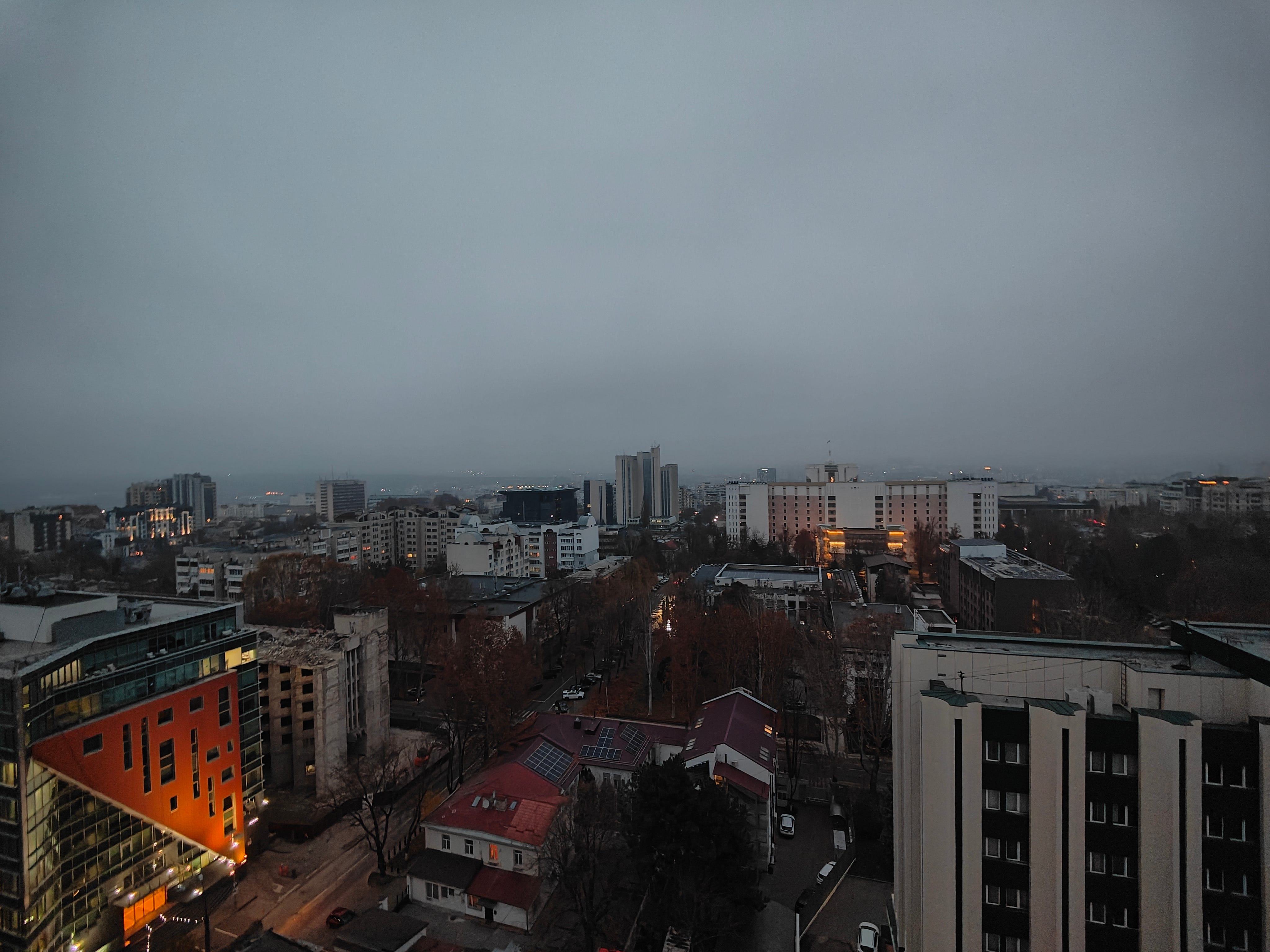
We set out to drink. We went first to a relatively generic bar, then to a branch of Piana Vyshnia, the Lviv-origin Ukrainian bar serving cherry liqueur. It was fine, but horrendously expensive by the country’s standards. It is a bit of a girly place and you can take the missus there, but the price of those cherries left a bad taste in the mouths of three blokes. In between, we had dinner at an Uzbek restaurant in full Central Asian-style booths.
We concluded the night at the agreeable Brothers’ Pub, where we knocked back the £2 pints. It was here that we encountered the first and only British tourists of the trip: a father-and-son duo, I think, from the Midlands, with a third companion, in search of something ‘a bit different’. We also decided to have a Călărași Divin, a local type of brandy, in cognac style. I cannot say that it was at all good. I initially thought it was from the Romanian town of Călărași, but it was in fact Moldovan, from a town of the same name; the word means ‘horsemen’. Most of the people out and about at night seemed to be speaking Russian; during the day, more Romanian seemed to be spoken.
Our night was less restful than we might have hoped. Twice in the night, there was furious banging at the door, though I slept through the first instance. Awoken by the second, I initially thought it was unusually early building work; by the time I got myself together and opened the door, the hall was empty. Disgruntled neighbours? I don’t think we were loud at all, but it is possible they were tired of a dubious foreign slumlord stuffing his flat with boozy tourists week after week and wished to nonetheless make their feelings known.
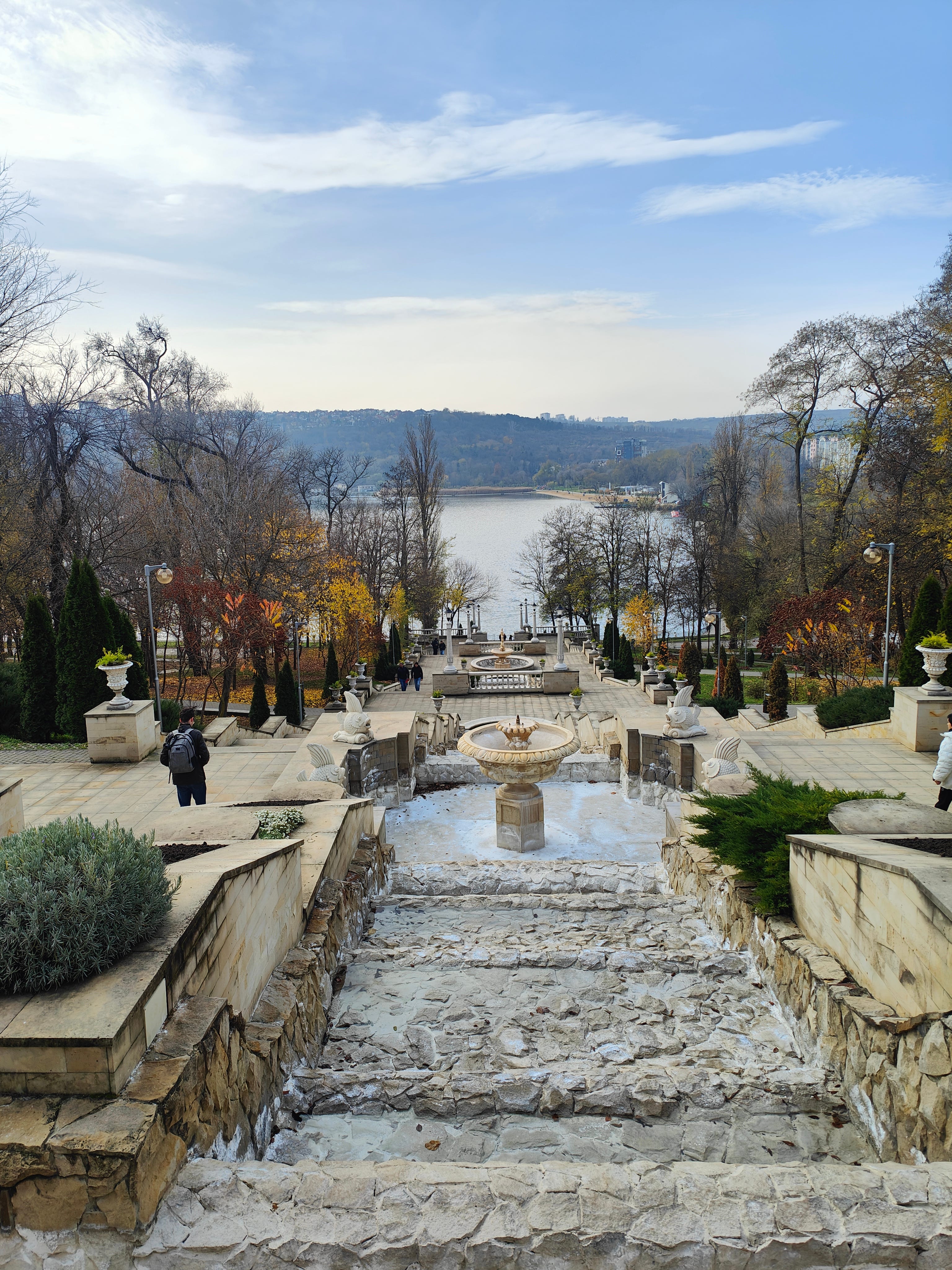
The next morning was gloriously sunny. After breakfast, we walked down to the Valea Morilor lake and park, with its Cascade Stairs, the water shut off for winter. The park was established in 1950 at the behest of Leonid Brezhnev, who was then First Secretary of the Communist Party in Soviet Moldavia. From there, we walked around the evidently more well-to-do neighbourhoods near the park. This was a very pleasant area, something like a smaller and lower-density equivalent of the lakeside north of Bucharest. I would happily live there. It confirmed that Chișinău had so much more going for it than Bălți — the second city of the country, if one discounts Tiraspol — it is hardly worth making the comparison.
This was all very nice. But we were not here to see a steadily developing Eastern European capital city which, while certainly still rough around the edges, will — in time — presumably be filled up with bike lanes, expensive coffee shops, and all the rest. You can already see that across much of Eastern Europe. It’s hardly unique to Moldova. No: we were here to travel back in time. And so, having had our fill of Chișinău, we made our way on foot back into the centre, and then to the bus station, with our final goal now to cross into Transnistria.
Transnistria
I must admit to a certain tension on the bus to Tiraspol. We didn’t really know how the procedure would go, or even where the border strictly was — it isn’t internationally recognised, so doesn’t appear on Google Maps. Should you lose your passport here, you’d really be in trouble, given that there is effectively no consular assistance. It’s not a long journey, not far at all from Chișinău, maybe an hour; some on the bus were even standing in the aisle. There was a Polish guy on the bus with us — another tourist interested in seeing the Soviet Union frozen in aspic.
There was one long stretch at the end of the Moldovan side where the fields ended and fed into a forested road. Moldova itself, refusing to recognise Transnistria, operates no border checks with it. Indeed, far from pushing to reassert control over Tiraspol, it would prefer that everyone pretended that Transnistria simply did not exist, given that it (probably correctly) views drawing any attention to it as an obstacle to EU accession. The porous, one-sided border that results has caused constant trouble with smuggling (especially of cigarettes), as well as permitting Moldovan criminals to flee from justice with ease.
The border now felt close. Then it opened up, and before us stood a Transnistrian border checkpoint. There was a small white cabin. All left the bus and queued up for the cabin. An officer took our passports, asked us how long we were staying, and gave us each a little white slip, a kind of visa, stating when we entered and when we needed to leave by. We got back on the bus.
The impression is immediately of a militarised area. I think I had underappreciated this aspect of Transnistria before actually getting there. The presence of Russian military power (more precisely, the Transnistrian army under Russian officership) was visible immediately. In Bender — the first town one encounters, which we would return to — there was a memorial to the 1992 Transnistrian War, which secured the territory’s autonomy, complete with a tank used in the conflict. Bender has a historical fortress, and to this day, next to the fort stands an army garrison. Further down the road, a striking mural shows two slightly abstract, stern soldier figures, one bearing the Soviet flag and the other, the modern Russian one. The green-and-red Transnistrian flag could be seen in many places, often alongside the Russian one (which it is legally co-equal to).
Some more things were immediately noticeable as we moved into Transnistria. Firstly, and perhaps most obviously, the language of daily life switched over to Russian. In stark contrast to Moldova, all roadside signage was in Russian, and spoken language followed suit — barring one passing snippet of Romanian, which I heard in Tiraspol. At one time, Transnistria was relatively ethnically diverse, but presumably, by now, many of the Romanians have left.
The standard of life, at street level, did not seem so radically different to that of Moldova. In Tiraspol, which has a population of around 130,000, public street buses were old, hulking great Soviet-era things; but on the other side of the ledger, there were some rather nice new residential buildings for the wealthier residents of the city. There certainly was much more life to it than there was in Bălți. We saw billboards for a barbershop named ‘Hooligans’ and a clothing brand called ‘Billioneire’.
The country — and its government — is largely controlled by just one oligarch (and, allegedly, a former KGB officer), a man named Viktor Gușan, who originally provided security to private firms. Soon enough, though, he went into business himself, founding the Sheriff Group, which was first involved in smuggling, before then expanding into other sectors, often via dubious means. According to the Financial Times, he now owns a cognac factory, supermarkets, petrol stations, banks, a textile factory, a caviar and sturgeon farm — among other things. But best known by far is Sheriff Tiraspol, the local football team which he bankrolls, famous mostly for defeating Real Madrid in the Champions League in 2021. Presumably, they are behind most of these new developments.
Indeed, at one time, Transnistria was actually significantly wealthier than Moldova. It had more industry (including one of the largest barbed wire factories in Europe) and, most importantly of all, could skim off huge profits from supplying Moldova with natural gas that it was given by Russia virtually for free at a big mark-up — a situation that was permitted by the fact that Moldova’s most important gas pipeline goes straight through Transnistria. Things were already changing even before then, but since the beginning of 2025, Transnistria has been cut off from Russian gas. This plunged Moldova into an energy crisis, requiring Romania to bail it out; however, for Transnistria, the consequences were far more severe. Even aside from the fiscal crisis that followed, most of the country’s industry soon shut down and unemployment skyrocketed. To make things even worse, since 2022, Ukraine has also cut off access to the port of Odessa, meaning that Transnistria’s main other lucrative business activity — smuggling — has become far more difficult.
Our bus moved along the main west-east road, Karl Liebknecht Street, stopping now at fairly small intervals. We got off. The first order of business was to acquire Transnistrian Rubles — something that wasn’t possible in advance at the multitude of currency exchange shops in Moldova proper, given that the territory is unrecognised. The lower-denomination notes feature Alexander Suvorov, the paramount national figure whose legacy is widely glorified in Transnistria, visible in statues and placenames. Suvorov was the general who founded Tiraspol in 1792 (the city name, like several other Russian cities around the Black Sea, founded after their campaigns against the Ottomans, was given a Grecian ‘-pol’ suffix; the first part comes from the nearby ancient Greek town of Tyras).
Cash in hand, we then headed to that mainstay of every Transnistrian tourist itinerary: the ‘Back in the USSR’ Restaurant. You guessed it: it was a Soviet-themed restaurant, of which ample photos can be seen online. We had pelmeni and other Russian things. And beer, and vodka. While there were a few other tourists present, there seemed to be locals too, and the prices were in fact very reasonable. Despite the Soviet theme, the music piped through the venue speakers was a mixture of Y2K Russian pop, and the western equivalents, like Britney Spears.
Then it was time to head to our accommodation. With a few drinks in our bellies, the odd apprehension of being in a breakaway republic on the edge of a warzone disappeared. Everyone on the street was, after all, evidently just a normal person going about their ordinary life.
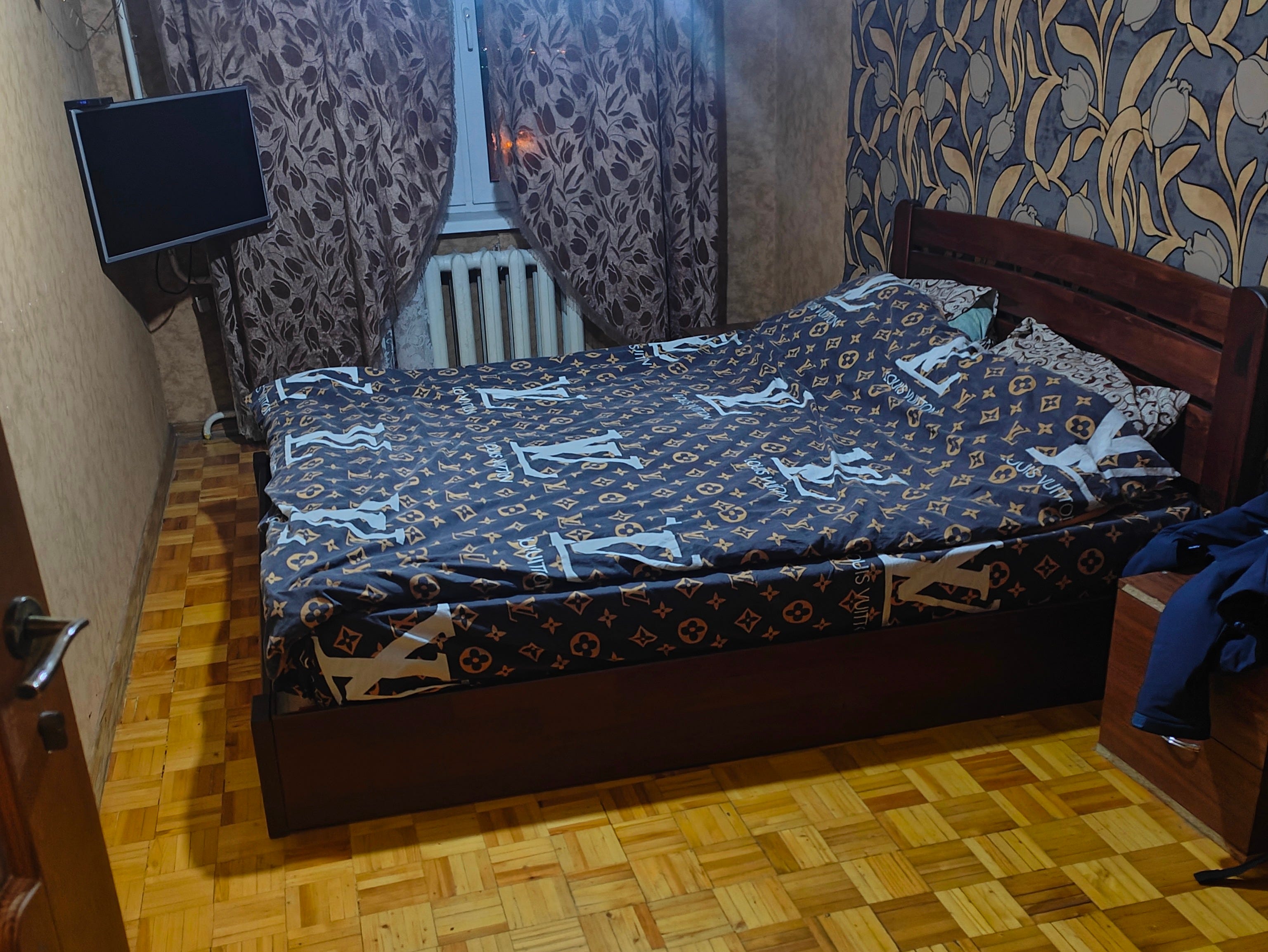
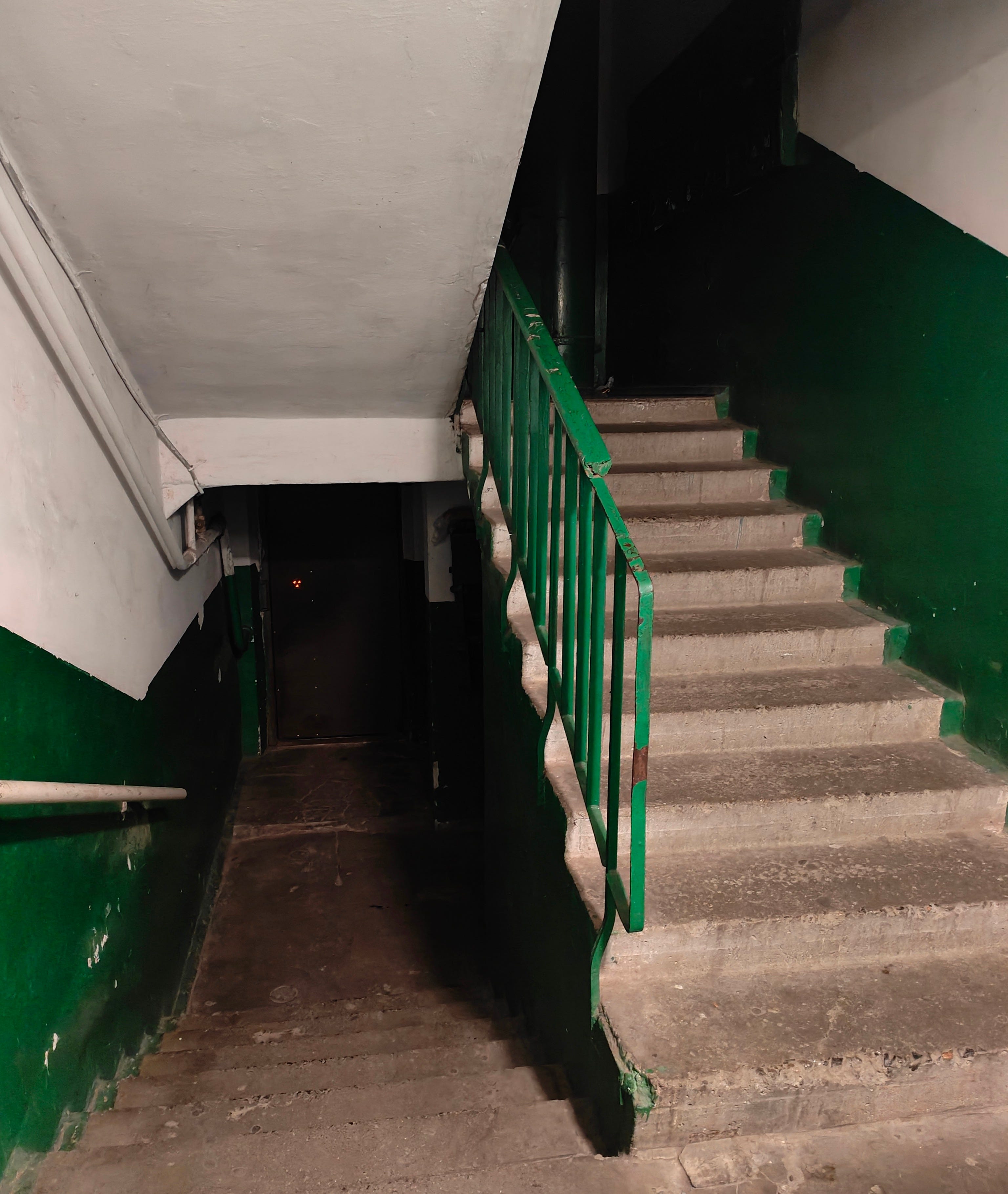
We stayed at a simple Khrushchyovka flat, and arrived greeted by our host. ‘First time in Transnistria?’, he greeted us with. I can only wonder how many times that is answered in the negative. We walked up the rather tired, simple concrete stairwell to the apartment. It smelled of old people — I suspect that the middle-aged landlord’s parents had lived here before. But it was warm and just what we needed. I enjoyed my Louis Vuitton bedsheets and original Soviet-era wallpaper.
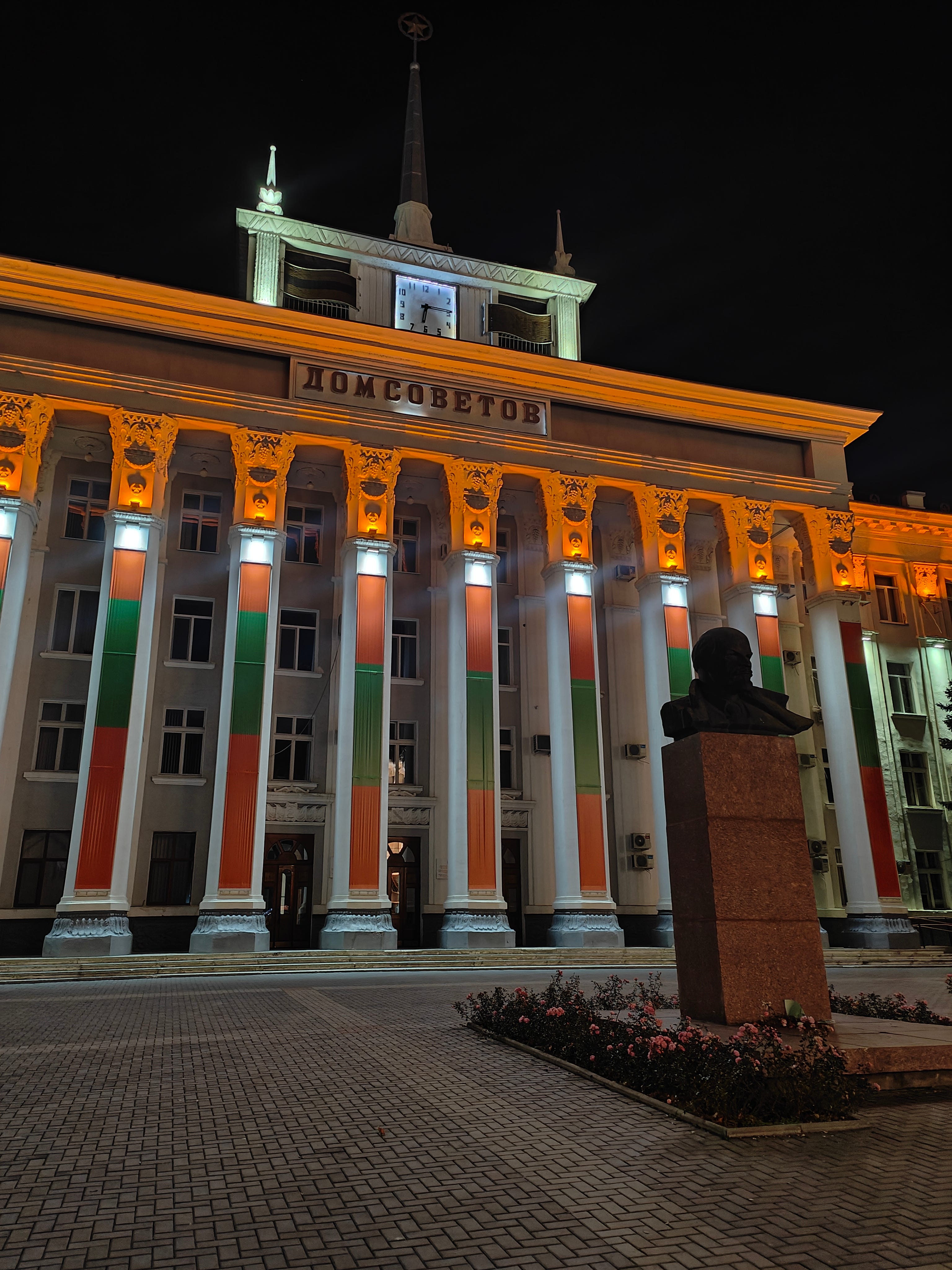
We went out in search of a drink and started wandering again through the streets at night. What stood out about Tiraspol was that it had a string of ‘prestige’ buildings, decked out in the Transnistrian flag and lit up. One example was the House of the Soviets.
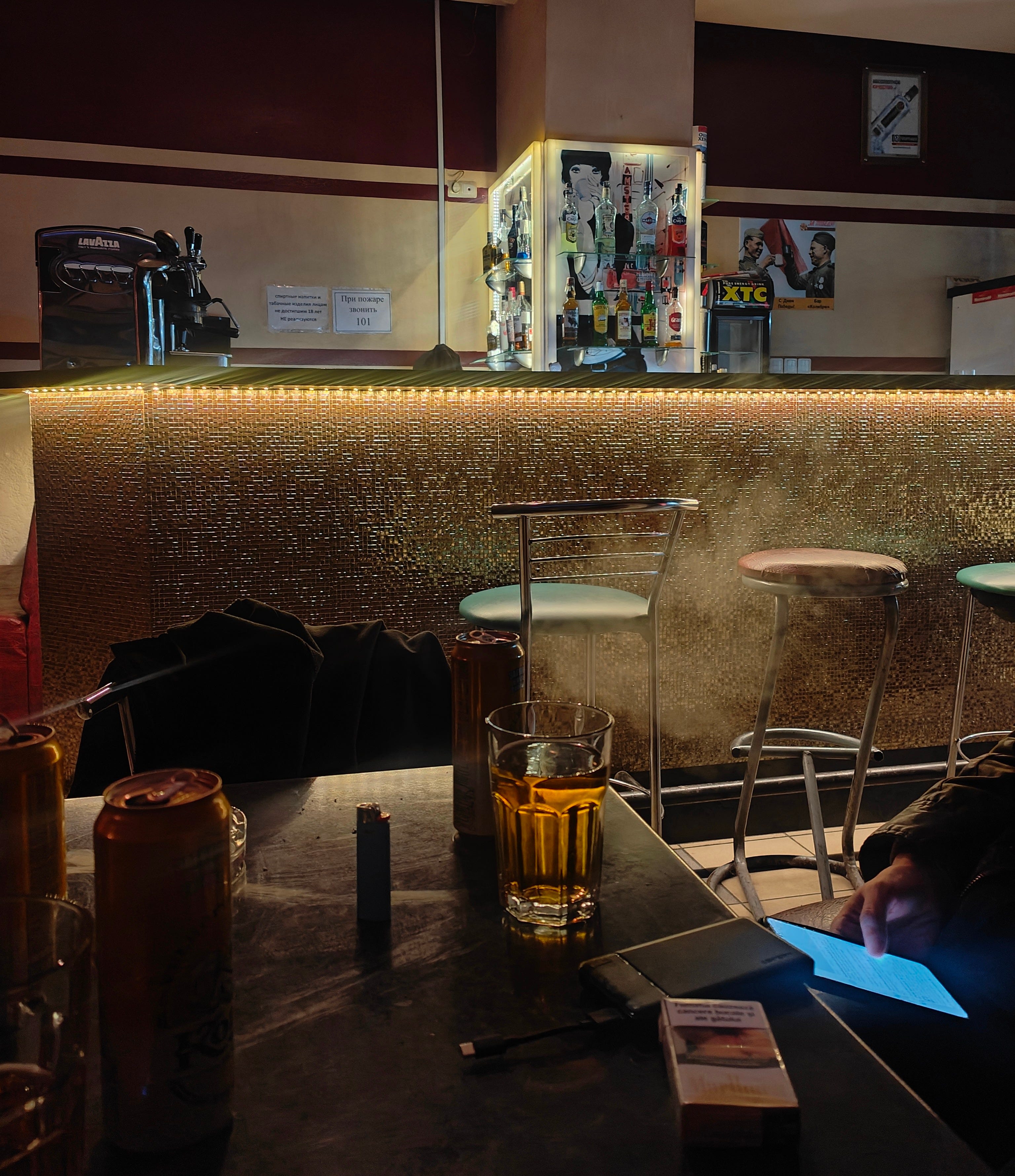
One place we stopped at was La Tocana, an otherwise ordinary restaurant that turned out to be quite interesting. It was much like La Placinte in Bălți. A bit of research later confirmed that it used to be owned by the same chain; La Plăcinte ended up in financial difficulties, and I believe that what we now saw was a ‘localised’ version of it, not unlike how McDonald’s restaurants in Russia became Vkusno i Tochka (albeit here in a manner unrelated to the political situation, as far as I could tell). The interior was decked out in Transnistrian green and red, yet it played Romanian music. I still didn’t brave speaking Romanian in this territory in the interest of keeping my head down, but it says something interesting about how there is still a nod to the ‘local’ Moldavian culture even here, where it is seemingly situated as the folk culture of the countryside.
On to the next one. We spotted a bar named ‘Craft’ on the map. We remarked at how appropriately named such a bar was at soothing the median Western normie’s fears that it would be anything other than acceptable. We took a taxi there (the driver applauded our Russian speaker for being an Englishman who spoke the language). Craft was, indeed, a fine place, and not unlike Beermaster in Balti. Furthermore — perhaps I shouldn’t have been surprised — their beer selection included drinks from numerous EU countries, including Belgium, Germany, Czechia, and Romania. We nonetheless stuck to the local house beer from Tiraspol, also called ‘Craft’.
We then went in search of another bar, and found one in the middle of town. To my regret, I forgot its name. It looked like the kind of place that was actually quite upmarket in the early ’00s, and then frozen aesthetically (but well-maintained) for another twenty years. The wall behind the bar had a small poster dedicated to the Great Patriotic War. A group of men — and one woman — occupied another alcove of the bar. It must have now been past 1 am, so we wondered what exactly they were doing. But unlike our experience in Randevu, this group left us well alone, and the atmosphere felt much more controlled.
And so to bed.
We woke up to a morning in Tiraspol. Our apartment overlooked a school building (named, as is common here, simply by a number, although I don’t remember which one). Emerging from my bed, I could peer out the window to see the teenagers reading and writing in the classrooms across the road from us.
We headed down to take in the city centre in daylight. There are, famously, many fine Soviet-painted murals and mosaics still in place on the sides of buildings, and in reasonably good condition too. There was a mighty statue of Suvorov, flags of the five raions of Transnistria, flags of Transnistria itself, and of course, of Russia (as well as, notably, Gagauzia, which is an autonomous region of Moldova, mostly occupied by Turkic-speakers, that also sought independence, but, unlike Transnistria, was successfully restored to Moldovan control).
We then hopped on a bus to Bender, from where we had entered the territory the day before, on the west bank of the Dniester still under Transnistrian control. The main attraction was the fortress which we headed straight to. Walking from the bus on foot, we saw a roadside billboard commemorating Tsar Nicholas II and his family decked out in the imperial yellow and black. This, the Suvorov imagery, a statue we had seen early of Catherine the Great, and in a way the fortress itself, were all part of the visual landscape and a reminder that while Transnistria is widely viewed as the most ‘Soviet’ country in the world, there is an imperial Russian foundation that sits beneath this.
There was hardly anyone else around at the fort. This definitely felt like a frontier, not least because there was an active military base next to it, and the wide river formed a natural boundary. This was of the westernmost advances of the Russian world, and it was very obviously perceptible.
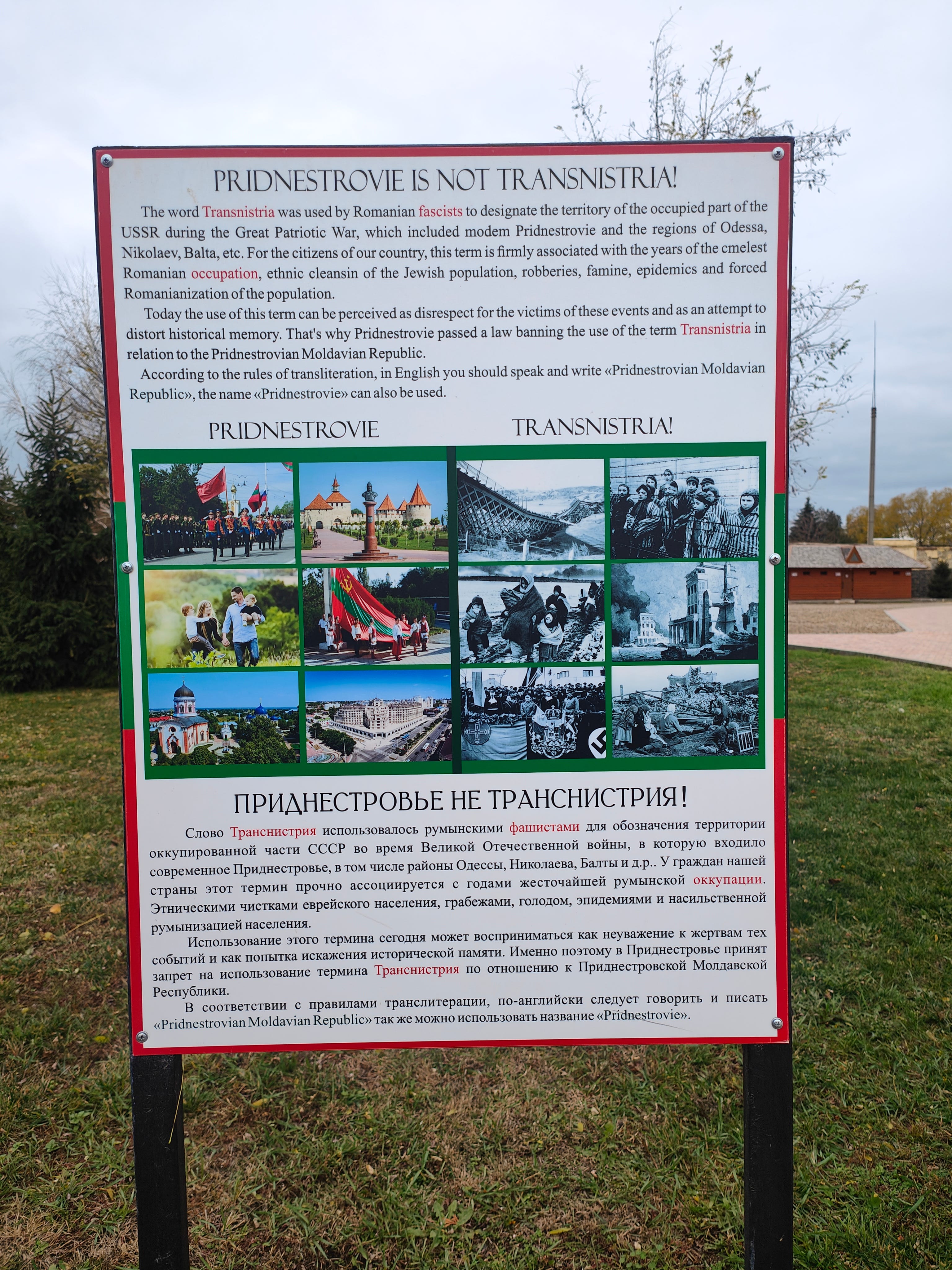
One particularly memorable sight was of this sign (image below), setting out why one should say Pridnestrovie and not Transnistria. This issue was something I was conscious of when first entering the territory. In 2024, the use of the term Transnistria was banned, with the argument that this was the word used by ‘fascist Romania’, with a risk of a fine or arrest. Pridnestrovie, for what it’s worth, means the exact same as Transnistria: across the Dniester. But one word evidently means twentieth-century murder, genocide, destruction, and the other means colour, joy, and stock images of happy families.
Leaving the fort, we wandered around Bender market a bit, where we saw a couple of older army officers walking around in their fatigues. We then found another Soviet-style canteen, this one somewhat more authentic and less self-consciously a tourist spot than the one in Tiraspol. We ate wholegrain rice and beef in sauce with salad. Like the other restaurant, the music choice was distinctly post-Soviet; I seem to recall that Not Gonna Get Us (2003) by the Russian girl group t.A.T.u was one such example.
Our time in Transnistria had come to an end. We looked around for a minibus from Bender back to Chisinau. Arriving at the bus station, we realise we had just missed it. But helpfully, there was a taxi driver at the bus station (middle-aged, as they all are) mopping up those unfortunate souls who had missed the bus, and we secured a journey with him for £6 a head. A female passenger (age about 40) joined us and sat at the front, with the three of us offering to squeeze in the back.
We chatted with the taxi driver a bit at the start. He told us that a nephew of his worked in Bucharest. His default language was Russian, but he was able to speak Romanian too, as could the lady at the front. After niceties with us the two locals at the front proceeded to chat away for the rest of the journey in Russian (more accurately, it was mostly the driver chewing the poor lady’s ear off for the whole journey as he had found a captive audience). His monologue to the woman consisted of a fairly standard set of TV-informed Soviet Citizen tropes about how the USSR was the good old days and a more stable world. Presumably, these views are shared by the (fairly large) number of Romanians in Moldova who continue to vote for pro-Russian (or at least anti-EU) political parties.
After getting back into Chisinau, we hung out at a nice restaurant and had a drink while waiting for our flight. We grabbed a taxi to the airport (this time, driven by a Romanian-Moldovan from Orhei, a town right on the border with Romania, himself with a son working in Bucharest; he had more pro-Western views) and caught our flight back to London Luton with no issues.
This article was written by Strategic Adviser, a Pimlico Journal contributor. Have a pitch? Send it to submissions@pimlicojournal.co.uk.
If you wish to support what we do, please consider subscribing. If you are already subscribed, why not upgrade to a paid subscription?
Fascinating article. This strikes me as a trip I would have enjoyed!
I went myself to Iași in 2024 to use as a base for exploring the monasteries in Bucovina. The houses in the villages in the countryside there were more frequently falling apart than described in this article but one thing is constant in Romania; the churches are always pristine. Something to do with the state funding for the Romanian Orthodox Church I would guess. I wonder if it’s the same in Moldova/Transnistria?
I tried to persuade my companions later that week to hire a car to drive to Moldova but found little interest sadly. Looks like it’s a really interesting trip.
A superb travelogue.