
‘I am the house now.’
Scott Bessent, September 2026
In 1966, the Nobel Prize-winning economist Paul Samuelson wittily summarised the uneven credit given to prophets of doom when he congratulated Wall Street bears on predicting ‘nine out of the last five recessions’. Predictions of an imminent financial crash are usually wrong when made, but will always be vindicated in time. This article should not be understood simply as another contribution to that tradition. Forecasting the timing of the next downturn is not the intention. Instead, the interesting question is what that downturn might look like when it comes — how it will differ from past experiences, and how governments across the West might be expected to respond.
True, American equities are undoubtedly expensive by historical standards. The total value of listed US equities amounted to roughly 42% of GDP in 1975 and 153% at the height of the dot-com boom in 1999; today, it stands at approximately 236%. Some of this rise reflects perfectly legitimate changes in the economy. American-listed companies earn a much greater proportion of their revenues overseas, intangible capital has become more important, and expectations of corporate profitability have changed — all while capital markets have proved extraordinarily effective at financing innovation. Market capitalisation is also a stock of claims on future earnings whereas GDP is a single year’s production, so there is no immutable ratio at which equities become ‘too expensive’. Nonetheless, the sheer quantity of financial claims relative to current production means that when expectations change, a very large amount of wealth may well be repriced very quickly.
This is a normal part of any business cycle and should not be regarded as an existential threat per se. An excessively valued sector falls, investors reassess prospective returns and capital is reallocated towards more productive uses. Historically, the financial system has also contained a powerful stabilising mechanism when this happens. Capital leaving equities tends to move towards safer government bonds at precisely the moment central banks are cutting interest rates. Bond prices rise and yields fall. Governments are consequently able to borrow more cheaply just as recession increases their financing requirements; tax receipts decline, unemployment and welfare expenditure rise, and governments may borrow more to support household incomes or stimulate the economy. The private-sector contraction therefore creates demand for the sovereign liabilities used to cushion it: the so-called ‘rush to safety’.
In our current situation, however, this comfortable dynamic faces uncomfortable headwinds. The central problem is that the sovereign will enter the next correction in an extraordinary condition, very different from that in which it entered the last great financial crisis, and indeed almost any comparable peacetime economic challenge of the modern era. US net federal debt held by the public amounted to only 26% of GDP in 1971; 35% in 2006; and roughly 40% at the end of 2008. In 2026 it is expected to reach 101%. Interest rates, and with them debt servicing costs, have increased dramatically. Federal interest outlays amounted to roughly 1.6% of GDP in 2006 and 1.7% in 2008; the Congressional Budget Office now expects net interest costs of about $1tn this year, or 3.3% of GDP, figures which will continue to rise as bonds reach maturity. The federal government is already expected to run a deficit of approximately $1.9tn, or 5.8% of GDP in 2026, and this is before the additional fiscal deterioration that would accompany a serious recession.
There is, however, a second difference which is at least as important as the debt itself: inflation. The stabilising mechanism described above works best when recession weakens demand and therefore reduces inflationary pressure, allowing investors to accept lower nominal yields on government debt. That was broadly the environment confronting policymakers after 2008. But the market-clearing yield on government bonds reflects expected inflation, the required real return investors, and a premium for fiscal and duration risks. If expected inflation remains at 5, 6, or 7% over the relevant investment horizon, a 5% Treasury yield implies a zero or negative expected real return. This does not necessarily prevent Treasuries from acting as a safe haven, especially if other assets offer worse prospects. Persistent inflation can, however, constrain monetary easing and limit the fall in bond yields that would otherwise help cushion a sharp downturn. As such, bonds may prove a less reliable safe haven than they were in the years after 2008.
The geopolitical environment makes that possibility harder to dismiss because the current supply shock is considerably broader than crude oil alone. Disruption in the Persian Gulf and attacks on Russian refining infrastructure have limited supplies of diesel, jet fuel and other middle distillates even as global oil demand weakens, suggesting that the problem increasingly lies in physical refining and distribution capacity rather than overheating demand. Gulf sulphur exports have also been severely disrupted, pushing delivered Asian prices above $1,000 a tonne and threatening to feed eventually into phosphate fertiliser and agricultural costs. Russian attacks on Ukrainian ports and infrastructure have meanwhile reduced Black Sea grain exports and forced more cargo onto lower capacity and more expensive alternative routes.
A shortage of industrial inputs exists at the same time. Copper prices are at record highs as tariffs, mine and smelter disruptions, and higher electricity costs driven by the data centre buildout alongside generally growing pressure on the grid push up input prices and constrain supply. Meanwhile, silver is entering another structural deficit amid continued demand from solar generation, electronics and AI-related infrastructure. None of these pressures is individually sufficient to guarantee persistent inflation, but together they create a much broader set of bottlenecks across transport, agriculture, fertiliser and industrial production than existed going into either 2008 or 2020.
There are already tentative signs of that pressure further up the price chain. US consumer-price inflation was 3.4% in July, but producer prices were 4.7% higher than a year earlier, suggesting that the inflationary pressure facing businesses is currently greater than that visible in the headline CPI. Meanwhile, the ten-year Treasury yield has already breached 5% (a high level by post-2008 standards). If expected inflation were to return to more than 5% during the next crisis, today’s yield would imply a negative expected real return before any compensation for duration or fiscal risk. If investors instead demanded even a modest positive real return of 1 or 2%, alongside average expected inflation of 5-6%, the arithmetic would point towards nominal yields of perhaps 6–8% before allowing for an additional fiscal risk premium (actual outcomes will depend on a range of factors; this is not a prediction). The market-clearing yield required to compensate private capital could move materially above the yield that a government carrying debt of over 100% of GDP can comfortably allow to persist. Financial repression begins to become conceivable precisely when the demands of bond investors and the necessities of the sovereign cease to coincide.
This changes the significance of the next stock-market correction. In 2008, falling private demand and collapsing asset prices occurred against a sovereign balance sheet with enormous room to expand and an overwhelmingly disinflationary economic shock. The government could borrow heavily, the Federal Reserve could cut rates, and the resulting flight towards Treasuries reinforced the fall in government borrowing costs. The same sequence may begin during the next crisis. Treasuries remain among the deepest and most liquid assets in existence, and an initial flight to safety would probably still support them, but it can no longer be assumed that this dynamic will continue indefinitely. A recession would enlarge deficits and entitlement expenditure from an already historically weak fiscal starting point. If inflation simultaneously remains high, private investors may demand substantially higher nominal yields than governments became accustomed to providing during either 2008 or 2020.
That is where the primary danger lies. The market may require a yield high enough to compensate the private holder for inflation and fiscal risk at precisely the moment the sovereign cannot comfortably afford to pay it. Yet if policymakers prevent yields from rising to the level required to clear the market voluntarily, they have not eliminated that required return. They have merely created an incentive for private capital to leave government debt for foreign assets, commodities, property, gold or anything else expected to preserve purchasing power more effectively. The monetary danger examined later in this article begins when there is no politically tolerable yield at which both the government’s financing needs and the private investor’s required real return can comfortably be satisfied.
One plausible macroeconomic consequence of such a divergence is stagflation, in which both inflation and weak growth coexist. Persistent supply shortages and increasingly expensive capital would weigh on real growth, while the fiscal and monetary response required to prevent financial liquidation would make it difficult to extinguish inflation completely. This is the central problem examined in this article.
It should be noted that the US has seen similar levels of public debt once before — immediately after the Second World War, when federal debt held by the public peaked at approximately 106% of GDP in 1946. Yet this burden was borne by a state headed for a period of enormous economic growth, supported by rapid adoption of new technologies and a population boom the likes of which have never been seen since. Today, ageing populations, mature welfare states, large deficits, and lower baseline human capital mean that the same problem is more difficult to overcome. Nor is this exclusively an American problem. At the same time as the United States government demands the fiscal support of large pools of private savings, so too do the governments of Britain, Europe, Japan, and many other countries. The historically familiar response to financial repression in one country has been the flight of capital across its borders; that becomes much harder when several major sovereigns are attempting simultaneously to preserve domestic financing and prevent borrowing costs from rising too far. The technological nature of modern finance makes the situation more unstable still. Capital can now move out of domestic bonds and currencies almost instantaneously, yet most private wealth is simultaneously concentrated inside banks, pension funds, brokers, custodians and other regulated institutions. The same digitalisation that makes capital flight faster also makes the direction of savings easier for governments to influence, potentially leading to unprecedented levels of financial repression via bond buybacks, QE, and capital controls.
That is why the next crisis may differ fundamentally from the familiar stories about an imminent 1929 or another 2008. The interesting question is not whether equities will eventually correct; they will, as markets always do. Rather, it is what happens after they correct if the asset that would normally absorb the flight from risk is itself the liability of an increasingly stressed debtor, while inflation prevents that asset from offering the very low nominal yields that characterised previous crises. If governments cannot tolerate the sovereign yields that free capital markets would otherwise produce, they will have to influence either the price of their debt or the ability of savers to allocate capital elsewhere. At that point an ordinary business-cycle correction begins to carry consequences for the monetary system itself.
The sections that follow explain why the conditions that made the post-2008 monetary regime possible are weakening, why war and deglobalisation make the inflationary environment less benign, why the United States cannot simply repeat the Japanese experience, and why the interaction between sovereign debt, inflation, mobile capital and increasingly administrable financial wealth raises the possibility of a form of financial repression unlike anything Western investors have ever experienced.
Why the post-2008 regime worked
If the scale of monetary intervention since 2008 seems incompatible with the relatively modest inflation that followed for much of the next decade, the explanation is not simply that quantitative easing was harmless. It is that monetary expansion took place inside an unusually favourable international system. That system consisted of Japan’s enormous pool of savings and exceptionally low interest rates, China’s role as both a producer of cheap goods and a supplier of surplus capital, and the broader globalisation of production, which allowed Western demand to be met by an increasingly international supply base. Together, these conditions enabled low financing costs and an expanding supply of manufactured goods, while weak demand and private-sector deleveraging limited price pressures despite this monetary easing.
For most of the period following the collapse of its late-1980s asset bubble, Japan combined extremely low interest rates with weak domestic demand, persistent private saving and recurrent deflationary pressure. The Bank of Japan eventually pushed policy rates effectively to zero, followed by quantitative easing and later negative rates and yield-curve control. One might have expected such monetary accommodation, particularly alongside a public debt burden that eventually exceeded twice GDP, to produce sustained inflation. It did not. Part of the explanation lies in the Japanese private sector. The bursting of the property and equity bubbles had left businesses and households less interested in borrowing aggressively and more concerned with saving to repair their balance sheets.
In addition, Japan’s excess capital did not have to remain inside Japan. For decades, Japanese institutions have accumulated foreign assets on an extraordinary scale. Japan entered 2026 with a net foreign asset position of around $3.7 trillion, and its current-account surplus reached 4.8% of GDP in 2025, driven principally not by merchandise exports but by income earned on that huge stock of overseas investment. This was reinforced by the peculiar economics of the yen. When Japanese interest rates sat close to zero while yields elsewhere were substantially higher, the yen became an attractive funding currency. Investors could borrow cheaply in yen and purchase higher-yielding foreign assets, a process known as the ‘carry trade’. Institutions could borrow yen at perhaps less than 1% and buy dollar securities yielding substantially more, provided the yen did not appreciate enough to erase the spread. This was an important escape valve.
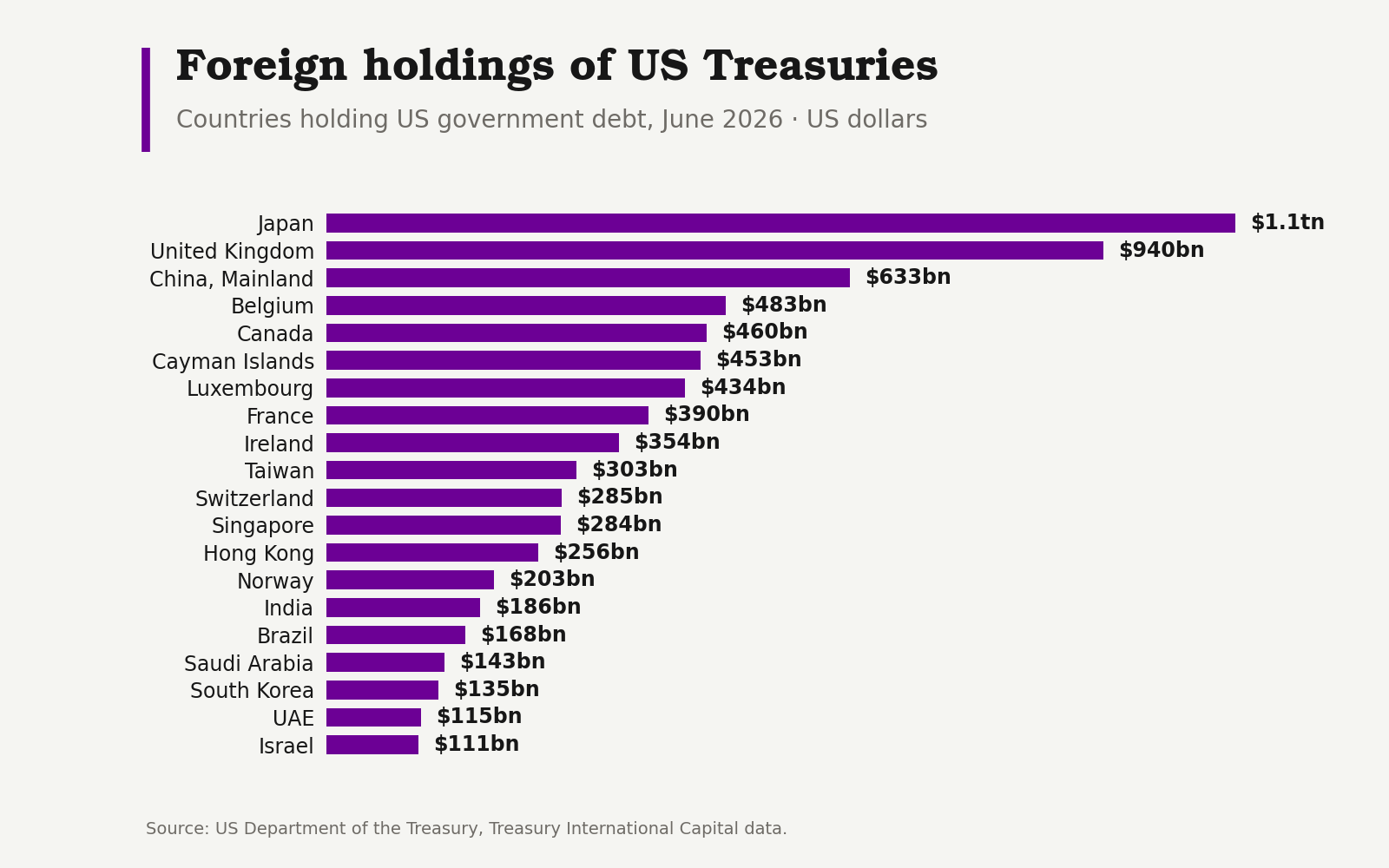
The United States was particularly well placed to reap the dividends. America possessed deep and liquid capital markets, the world’s principal reserve currency and an apparently inexhaustible supply of securities into which foreign savings could be placed. US Treasury debt provided the global benchmark safe asset. As of June 2026, foreign investors collectively held approximately $9.3 trillion of US Treasury securities. Japan remained the largest recorded foreign holder, with approximately $1.12 trillion, or around 12% of all foreign-held Treasuries. The United Kingdom ranked second at roughly $940 billion, followed by mainland China at approximately $633 billion (although this figure does not account for offshore holdings). China’s role should not be underestimated. Her national savings rate became extraordinarily high during this period, such that the current-account surplus rose towards 10% of GDP by 2007, an extreme figure for an economy of China’s size. A significant portion of these excess savings were effectively exported to the rest of the world — the beginnings of the transition from ‘made in China’ to ‘owned in China’.
Ben Bernanke famously described the broader phenomenon as a global savings glut. Emerging Asian economies, oil exporters and other surplus countries were supplying more savings than they wished to invest domestically. Bernanke’s argument was that this excess supply of international capital helped push real interest rates lower and asset prices higher, an important part of American external financing. China was therefore performing two disinflationary functions at once. The first was financial, and the second was physical. Chinese industrialisation massively expanded the global supply of cheap manufactured goods. At the same time, Western companies could relocate labour-intensive production towards jurisdictions where costs were substantially lower, keeping inflation low and shielding Western economies from domestic economic slack.
That combination helped produce one of the defining economic peculiarities of the period after the financial crisis, namely enormous appreciation in financial assets alongside persistently weak consumer-price inflation. Central banks could purchase bonds, yields fell, and investors could be pushed further out along the risk curve while property and equities could appreciate substantially. This explains why the post-2008 period confounded simple monetary predictions. It also explains why Japan became such an apparently devastating counterexample to warnings about government debt. Japan appeared to demonstrate that a state could accumulate public debt above 200% of GDP, have its central bank purchase enormous quantities of that debt, hold interest rates close to zero for decades, and nevertheless struggle to generate inflation.
This is nothing new. The observation is correct, but the inference frequently drawn from it is much more questionable. The crucial distinction that many commentators have not taken into account is that Japan itself was a net supplier of capital to that system, not its ultimate monetary foundation. Japan remains a huge creditor, but its interest rates are normalising. China remains an enormous exporter and saver, but its financial relationship with the West has changed. Global supply chains remain deeply interconnected, but governments increasingly treat the geographical location of energy generation, semiconductor fabrication, defence production and critical industrial inputs as matters of national security rather than issues of comparative advantage. The post-2008 regime should therefore not be understood simply as proof that vast sovereign debt and monetary expansion are inherently non-inflationary.
Can we all become Japan?
Japan entered its long monetary experiment as a major creditor economy whose private saving repeatedly exceeded domestic investment needs. The United States occupies almost the opposite position. At the end of the first quarter of 2026, Americans held roughly $43.4 trillion in foreign financial assets while foreigners held about $64.6 trillion in American assets, leaving the United States with a net international investment position of approximately minus $21.3 trillion. Japan’s prolonged deleveraging after its asset bubble also produced an unusually powerful private propensity to save, whereas the United States has shown a much greater willingness to support household and corporate demand directly during crises. Donald Trump has already proposed paying every adult American $5,000 if Republicans retained Congress in the midterm elections, a programme which would cost roughly $1.2 trillion and, absent very large spending cuts or new revenues, would have to be financed principally through additional borrowing.
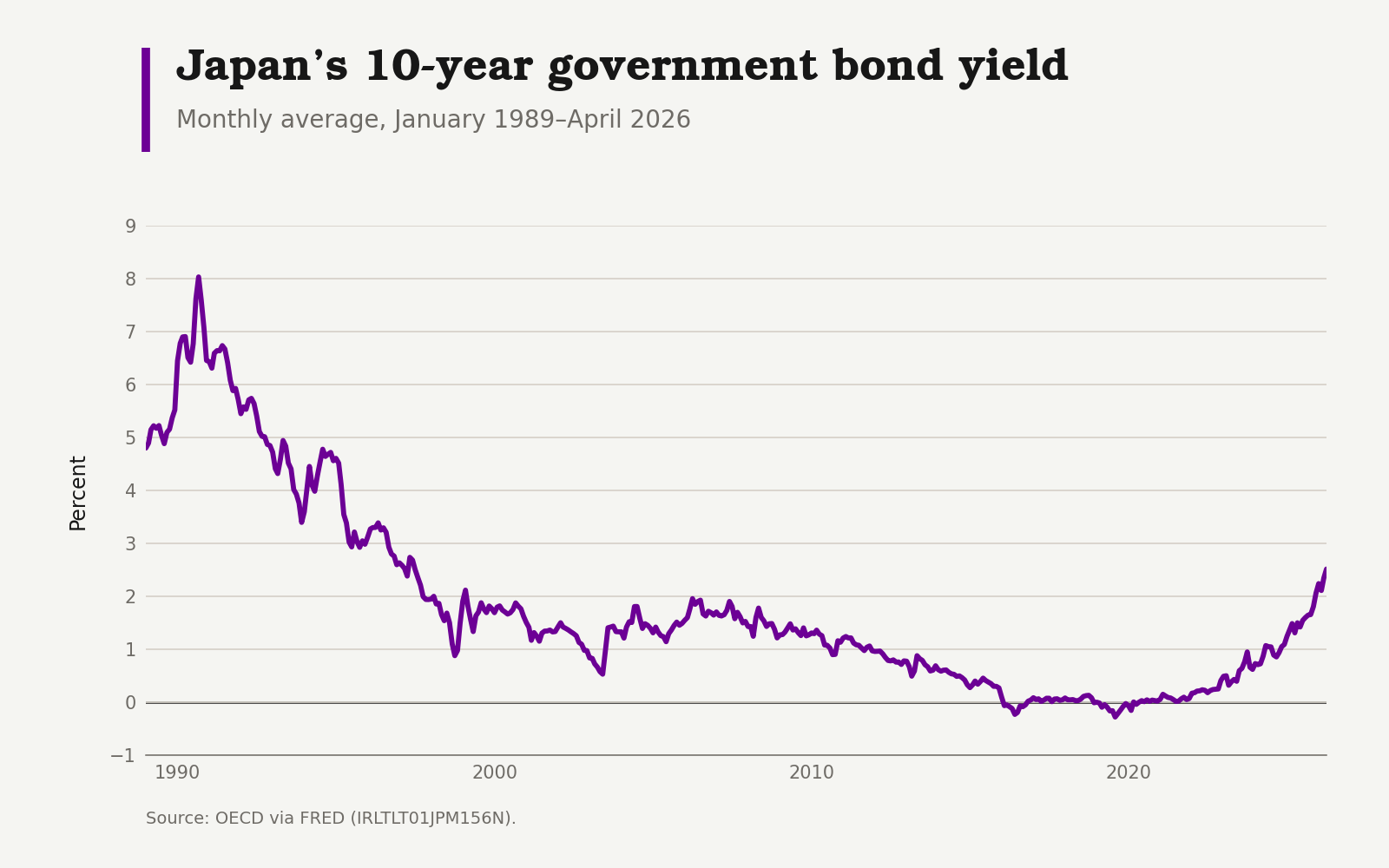
But Japan itself is also changing. Japanese government-bond yields have risen to levels not seen for decades (2.98% on the 10-year yield at the time of writing), making domestic securities increasingly competitive with foreign assets. The yen carry trade has therefore become less compelling. A Japanese insurer or pension fund which can once again earn a meaningful return at home has less reason to accept dollar currency risk merely to obtain yield abroad. Japan cannot simply suppress this indefinitely, because the pressure then appears elsewhere. The yen recently fell towards ¥164 to the dollar, prompting intervention on an extraordinary scale. Between 30 July and 26 August 2026, Japan spent ¥15.4 trillion, about $96.5 billion, supporting the currency (a record amount), which nonetheless enabled only a modest recovery to ¥159 to the dollar. Even the US stepped in to support the yen (with Euros, no less), with Scott Bessent’s conspicuous ‘to do’ list consisting of only one item: buying up to $10 billion of yen to support the currency. Meanwhile, the Japanese Ministry of Finance has requested a record ¥36.64 trillion for debt servicing in fiscal 2027, using an assumed interest rate of 3.8%, the highest in twenty-nine years. Japan is therefore being forced to choose among a weaker currency, higher domestic yields and greater intervention, none of which is costless.
The implication for Western markets is that the source of cheap global capital that could once be taken largely for granted is becoming less dependable at precisely the moment the United States and other developed economies need enormous pools of savings to finance their own sovereign liabilities. If several major economies become increasingly unwilling to tolerate market-clearing borrowing costs at the same time, they will rapidly find themselves competing for the same increasingly limited pool of capital. We will explore this problem further in part two.
The debt trap
Every year, a large volume of existing Treasury securities must be refinanced while new deficits require still more issuance. The Treasury has also become more reliant than it was earlier in the 2020s on short-term bills: they accounted for roughly 22% of marketable federal debt by the end of 2025, and Treasury continues to use regular bill auctions as the principal shock absorber for fluctuations in its financing requirements. A greater proportion of borrowing at the short end does not increase the debt stock by itself, but it shortens the interval between a change in market rates and the rate the government actually pays. A thirty-year bond issued at 2% can remain cheap for decades; a three- or six-month bill must shortly be refinanced at whatever rate the market then demands. Investors may demand still greater compensation if they begin to doubt the sustainability of the fiscal path. The critical relationship is therefore not any particular numerical yield, but whether the effective interest rate on the debt remains persistently above the growth rate of the tax base from which it must ultimately be serviced. At debt ratios around or above 100% of GDP, even relatively small changes in that relationship become damaging.
Britain is particularly exposed. The OBR expects public sector net debt to rise from about 95% of GDP in 2025–26 to 97% in 2028–29, while debt-interest spending rises from roughly £110 billion this year to £137 billion by 2030–31. Interest spending is already around twice as large a share of GDP as it averaged during the decade before the pandemic. Britain also has an unusually direct sensitivity to inflation because a significant portion of its government debt is index-linked, at 25%, far higher than other G7 countries, whose proportion of index-linked debt ranges from less than 1% (Japan) to around 12% (Italy). In the first two months of the 2026–27 fiscal year, higher-than-expected inflation alone pushed debt-interest spending £2.4 billion above the OBR’s forecast. The previous Conservative government’s failure to refinance debt on a large scale during the historically low yields of the COVID period has proven to be short-sighted at best.
The available escapes are unpleasant. Governments can restore fiscal credibility through some combination of higher taxation and lower spending, or hope that productivity growth expands the tax base faster than the debt burden. Failing that (which appears a certainty), they must either tolerate the market-clearing cost of borrowing or attempt to prevent yields reaching it. The political attraction of the latter is obvious. Financial repression socialises the cost much less obviously than austerity, explicit taxation or default. The danger is that yields remain elevated long enough for refinancing to make those rates the government’s average cost of funding. At that point, the fiscal system becomes increasingly sensitive to movements in the bond market and the authorities acquire an ever-stronger incentive to intervene before the repricing is complete. Suppressing the nominal yield does not remove the underlying economic cost, but merely determines where that cost appears. Once the sovereign can no longer comfortably pay the return required by private capital and instead begins influencing that return, a fiscal problem has started to become a monetary one.
The implicit yield ceiling
The debt trap becomes politically important only when governments reveal that there is some level of sovereign borrowing cost they are no longer willing to accept. That level need not be officially announced; what matters is whether markets begin to infer from repeated official behaviour that sufficiently high long-term yields will provoke intervention. In that sense, financial repression can begin before anything resembling formal yield-curve control. The first stage is simply the appearance of an implicit ceiling.
Recent US policy indicates that this may already be happening. In August 2026, after long-dated Treasury yields reached their highest levels in roughly two decades, the US Treasury announced that it would at least double the maximum size of its liquidity-support buybacks in the 10-to-30-year sector, from $2 billion to $4 billion per operation. Treasury’s formal justification is ‘market liquidity’ rather than yield suppression, and it continues to issue long-dated debt through its regular auction schedule. Treasury buybacks are not quantitative easing, because the Treasury cannot create central-bank reserves, and the programme remains tiny relative to the overall Treasury market. Yet the timing and political rhetoric around the programme are hard to dismiss as insignificant, as the recent resurgence in the gold price suggests. Treasury Secretary Scott Bessent has openly argued that long-term borrowing costs are too high relative to economic fundamentals, priming the market to expect negative real yields for the foreseeable future.
Although the number is small, it has set a precedent. It tells investors that the Treasury itself is increasingly attentive to the price, which is important because the long bond is supposed to perform a disciplinary function. If investors become less confident about inflation, deficits or future debt issuance, the yield should rise until enough capital is attracted to absorb the supply. The government may dislike that verdict, but the higher yield is the market’s mechanism for producing buyers. Once the state begins trying to prevent that repricing, it risks treating the symptom of fiscal deterioration rather than the cause. As long as public debt is modest, the conflict can be negotiated. At debt around the size of GDP and with annual interest costs approaching $1 trillion, it becomes unmanageable.
Nonetheless, governments can suppress a nominal yield more easily than they can suppress the economic forces that caused investors to demand a higher one. If inflation remains elevated, or the supply of debt continues rising, the concession must appear elsewhere. Real returns can fall, the currency can weaken, or investors can seek compensation in equities, property, commodities and other assets, as they expect the value of those to rise more than the real yield they obtain from bonds. The immediate effect of intervention may therefore be a rally in both government bonds and risk assets, even while the underlying fiscal position has deteriorated. Indeed, the latest US interventions have already generated discussion of a wider ‘debasement trade’, with the rise in the gold price indicating that the real purchasing power of the USD is declining, and suggesting that the market is already sensing the direction of travel.
The crash that may not last
The next major downturn, ‘the coming collapse’, a normal part of the business cycle, may therefore be important less for the scale of the initial market fall than for the response it provokes. A conventional financial crisis is recognisable; asset prices fall, bad investments are liquidated, deleveraging occurs, and the resulting recession eventually creates the conditions for recovery. The more unusual possibility is that the authorities once again prevent much of that nominal adjustment from taking place.
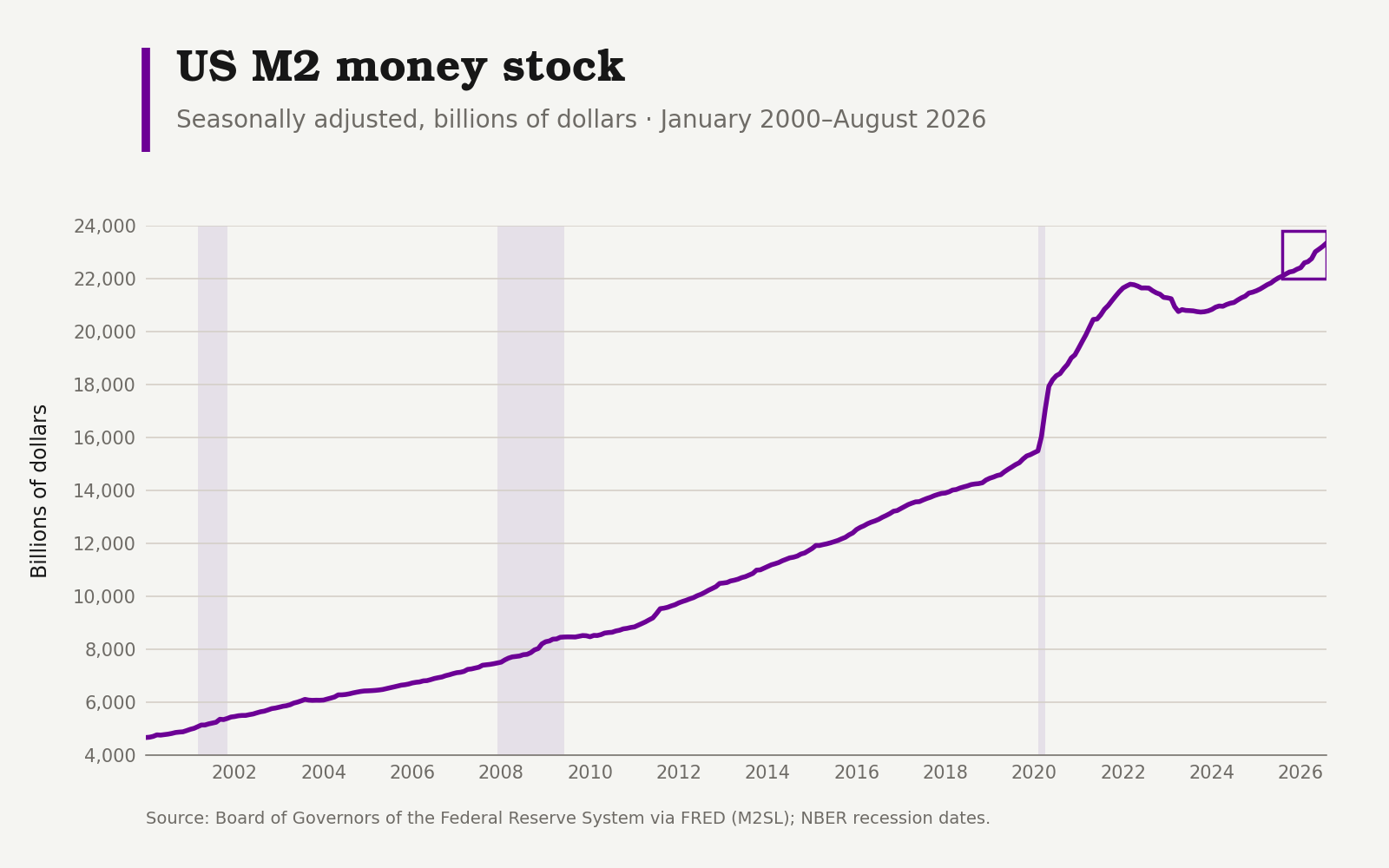
The pandemic provides the clearest recent demonstration of how quickly such a reversal can occur. The S&P 500 lost roughly a third of its value between its February 2020 peak and the March trough, while employment and output collapsed at a speed without modern precedent. Yet by June the index had recovered to about 94% of its February level, and by early 2021 it stood roughly 15% above its pre-pandemic peak. This recovery occurred alongside an extraordinary monetary and fiscal intervention. The Federal Reserve’s balance sheet rose from about $4.3 trillion in mid-March 2020 to almost $7.2 trillion by early June. Broad money subsequently expanded at a remarkable rate. M2’s year-on-year growth reached 26.9% in February 2021, higher than during either the post-2008 quantitative-easing programmes or the high-inflation decades of the 1970s and 1980s, and the level of M2 ultimately rose by roughly 40% between the eve of the pandemic and its 2022 peak. This was attributed not just to QE alone but to a combination of fiscal stimulus, monetary accommodation, unusually large precautionary deposit holdings and changes in the banking system. That distinction is important. The lesson of 2020 is that, with sufficient intervention, an economy can experience severe real disruption while fiscal and monetary policy simultaneously preserve nominal incomes and asset valuations. Inflation came, but only much later. US consumer-price inflation was still only 1.4% at the end of 2020, but reached 9.1% by June 2022. Energy and supply disruptions contributed heavily, as did reopening effects and other pandemic distortions, so it would be equally mistaken to attribute the entire increase to monetary expansion. Nevertheless, the episode demonstrated that the inflationary consequences of a rescue need not appear at the moment the rescue is conducted.
This creates a very different risk from the familiar prediction of an imminent stock-market collapse. American equities are historically expensive by several measures, and the present AI boom may eventually precipitate substantial consolidation, but neither observation implies that a correction must become a prolonged nominal bear market. If a sufficiently large equity decline threatens household wealth, pension solvency, private credit, employment and tax revenues at the same time that the sovereign is already struggling with high borrowing costs, the political pressure to intervene with renewed liquidity support, rate cuts, or otherwise, will be enormous, especially given the increased (albeit mostly one-way) connection between movements in the stock market and the fortunes of the economy as a whole. The question would be whether they are deployed while inflation remains high and equilibrium yields are higher. A rescue conducted under those conditions would be fundamentally different from the post-2008 interventions undertaken in an environment of low inflation.
Such a rescue could make the stock market look healthier while making the monetary problem worse. Equities might recover rapidly in dollars because the authorities have supplied liquidity, stabilised credit and reduced the attractiveness of cash and government bonds. But if an equity index gains 20% while the prices of gold, energy, property or a broader basket of scarce assets rise by 30 or 40%, the investor has become wealthier in the unit of account but less able to purchase those particular assets, even though their purchasing power above that of ordinary consumption may have increased. Once this is realised, it’s difficult to tell how bad things could get.
However, high valuations do not necessarily make equities an obvious short in an inflationary regime. A company represents a residual claim on productive assets and future nominal revenues. Thus, firms with pricing power, foreign earnings or ownership of scarce productive capacity may adjust more readily to currency depreciation than a fixed-rate government bond whose payments are predetermined in nominal terms. This difference between nominal and real performance is also the reason a future crisis need not resemble either 1929 or 2008.
War, weather, and the return of supply-side inflation
The difficulty with assuming that the next recession will automatically restore low inflation is that some of the most important present pressures on prices originate not in excessive consumer demand, but in the physical supply of energy, food and industrial inputs. A recession can reduce demand for these goods, sometimes dramatically, but it cannot reopen a shipping lane, rebuild a refinery, replace a missed harvest, or immediately replenish depleted inventories. The world is therefore entering the next phase of the financial cycle with a range of supply shortages quite different from those preceding the major financial crises of this century.
Before the Iran conflict began, the Strait of Hormuz carried roughly one-fifth of global oil and LNG flows. Six months into the war, traffic remains sparse and negotiations over reopening the Strait have repeatedly failed.
The consequences are no longer necessarily best measured by the headline crude-oil price, which might be compared more to a betting market on occasion. Benchmark crude itself is priced through an enormous derivatives complex in which financial contracts greatly exceed the quantity of oil changing hands for immediate physical delivery, and change on the whim of President Trump’s latest statement. Those markets remain anchored to physical crude through arbitrage and settlement mechanisms, so they cannot suppress scarcity indefinitely. But they can make the headline futures price an imperfect guide to where that scarcity is presently most acute. The physical market increasingly reveals itself instead through premiums for particular crude grades, freight and war-risk insurance, and above all the widening margins between crude and the refined fuels actually required by consumers and industry. In other words, a relatively low Brent price does not necessarily imply an equally well-supplied market.
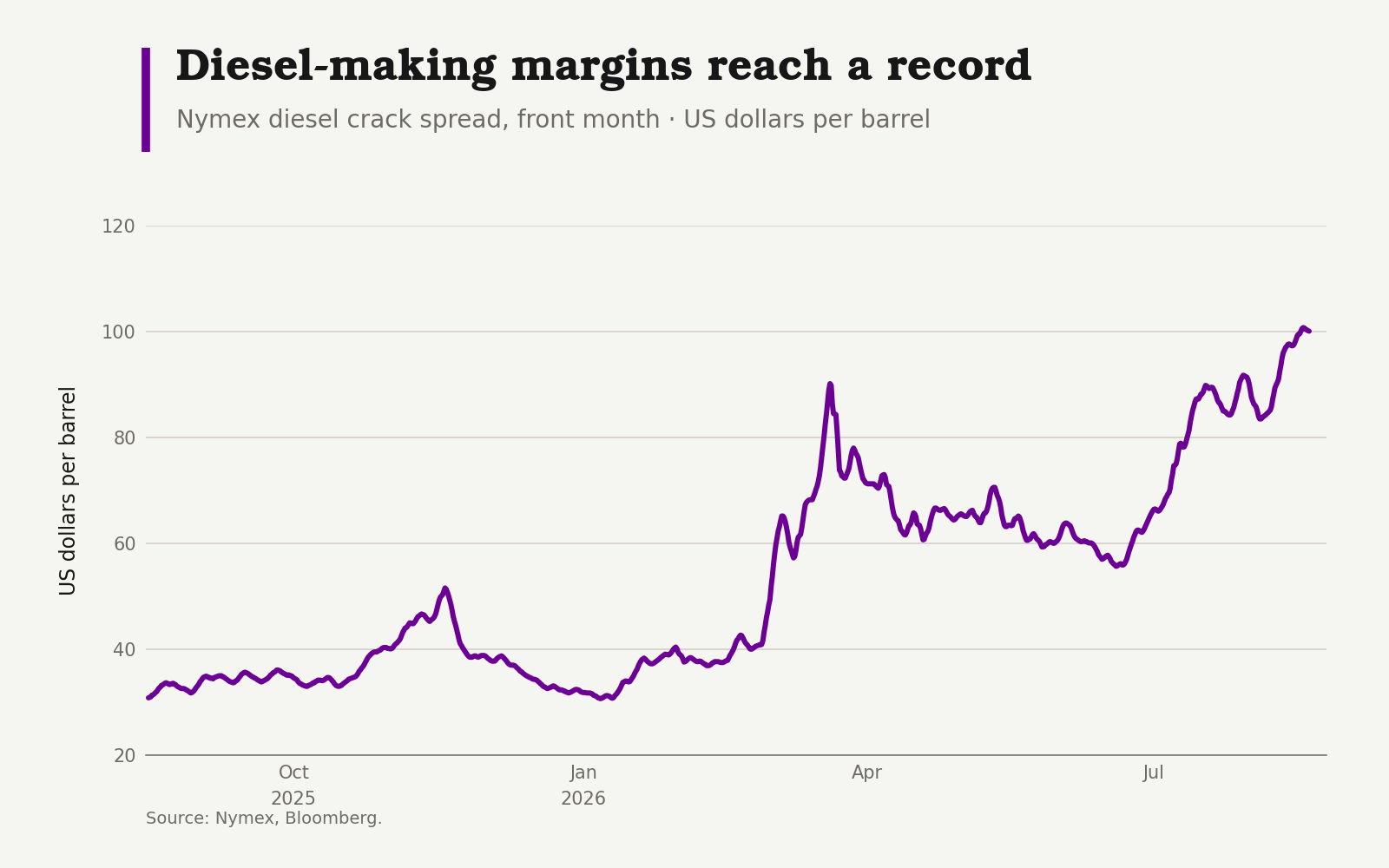
A better reflection of higher producer inflation comes through the refined products which are not as distorted by financialisation, the so-called ‘crack spread’. Global refinery throughput remained almost 5 million barrels a day below its year-earlier level in July, while diesel exports from Russia, the Middle East and Asia were around 1.3 million barrels a day lower, equivalent to roughly 20% of global seaborne diesel trade. Jet-fuel exports from the same regions were down by the equivalent of around 34% of global trade. Singapore gasoil refining margins have risen by more than 200% since the conflict began, while US ultra-low-sulphur diesel futures jumped 7.4% in a single session in August.
The apparent resilience of headline crude prices has also depended partly upon drawing down emergency stocks. The US Strategic Petroleum Reserve has fallen to roughly 285 million barrels, its lowest level since 1982, and previously agreed releases could take it towards 243 million. Emergency stock releases have helped replace barrels temporarily removed from normal trade and therefore moderated the immediate price response, but Japan is especially exposed to the exhaustion of this buffer. It imports virtually all of its crude oil and ordinarily obtains around 95 per cent of it from the Middle East; during the present conflict it has already announced a record release of roughly 80 million barrels from its own reserves and sharply increased purchases from the United States, but exports are drying up quickly. At current rates of depletion, their reserves will dry up around the middle of 2027.
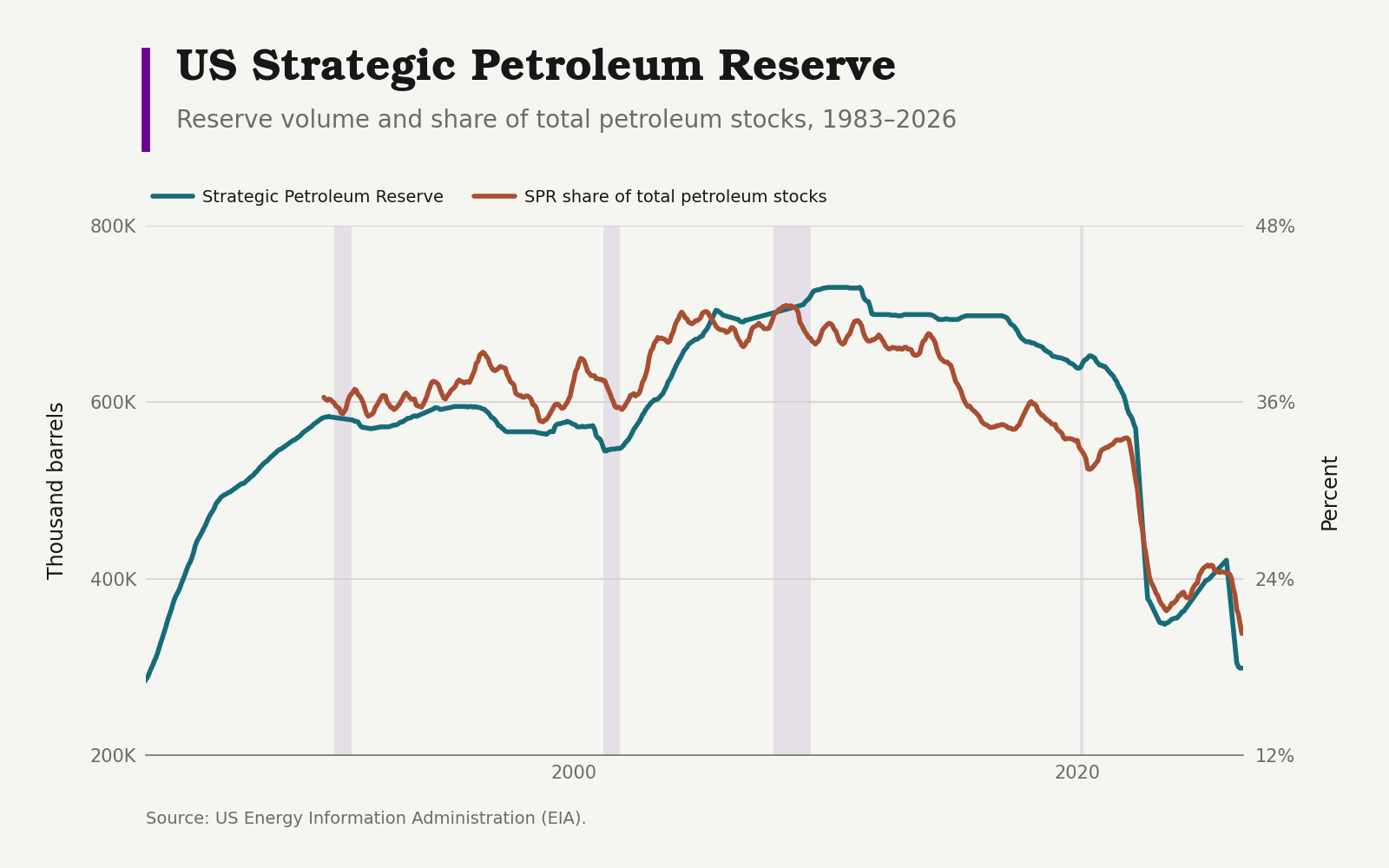
What makes this particularly notable is that these shortages are happening against weak demand. As of September, IEA expects global oil demand itself to fall by roughly 2.5 million barrels a day during 2026. The tightening in refined fuels therefore cannot be explained simply as the consequence of an overheating world economy. The problem increasingly lies in the physical capacity to refine, transport and distribute fuel. Diesel matters in particular because it is not merely a consumer fuel: freight, agriculture, construction, mining and much heavy machinery all depend upon it, allowing higher diesel prices to spread through the cost structure of the physical economy.
The Russia-Ukraine war is reinforcing the same problem from another direction. Repeated Ukrainian attacks on Russian refineries have reduced fuel production sufficiently for Moscow to extend restrictions on diesel, marine-fuel and gas-oil exports. Russia is normally one of the world’s largest exporters of diesel, making disruption to its refining system economically significant even when crude production itself remains comparatively resilient. At the same time, attacks by both sides on Black Sea ports and vessels are disrupting grain exports during the principal shipping season. During the first three weeks of August, Ukrainian grain exports were only around 539,000 tonnes, compared with 1.73 million tonnes over the same period a year earlier. Ukraine has consequently reduced its expected 2026–27 grain exports as exporters are pushed towards smaller and more expensive alternative routes, including the Danube.
Some of the less visible shortages may ultimately prove just as important. Sulphur is one example. Much of the world’s traded sulphur is recovered as a by-product of oil and gas processing in the Gulf and then converted into sulphuric acid, an essential input into phosphate fertiliser and numerous industrial processes. Qatar’s benchmark sulphur price reached $890 a tonne this summer, compared with $259 a tonne in August 2025, while freight and war-risk insurance pushed the delivered cost to China above $1,000 a tonne. Virtually no Qatari sulphur cargoes were confirmed leaving through Hormuz after 18 July. A shortage in what appears to be an obscure industrial commodity can therefore migrate through sulphuric acid into fertiliser, then into agricultural production costs and ultimately food prices.
Food supply is simultaneously being impaired by weather. Severe drought across Europe has damaged grain and animal-feed production. Britain is experiencing what is expected to be its worst cereal harvest since comparable records began in 1984, while French maize production may fall towards its lowest level since the 1970s. In parts of central Europe, farmers have already begun consuming feed that would normally have been reserved for winter and reducing livestock herds. India’s monsoon is meanwhile on course to be its weakest in nearly two decades, threatening soybeans, maize, pulses and the soil moisture required for subsequent winter crops, while heat and flooding have damaged corn, soybean and cotton regions in China. These pressures are arriving at precisely the same time as higher diesel and fertiliser costs, meaning that weather, energy and chemical-input shortages can reinforce one another rather than remaining separate inflationary shocks.
Industrial metals exacerbate the situation. Copper prices are at record highs as US tariff policy diverts metal towards American inventories, mine and smelter disruptions restrict supply elsewhere, and electricity-grid expansion and data-centre construction create additional demand for power transmission and cooling infrastructure. Silver is entering a sixth consecutive structural supply deficit while demand remains elevated from solar generation, electronics and, increasingly, AI-related infrastructure.
The result is an unusually broad set of bottlenecks spanning refined fuels, transport, agriculture, fertiliser and industrial metals. There may also be a slower monetary consequence from the geopolitical fragmentation itself. Sanctioned Iranian oil sold into China is already frequently settled in yuan, while geopolitical antagonism gives Iran, Russia and China continuing incentives to develop trading and payment mechanisms that reduce their exposure to the dollar. To the extent that a more fragmented commodity system gradually reduces at the margin the amount of trade requiring dollar settlement and dollar reserves, one longstanding source of demand for dollar assets weakens at precisely the moment the United States needs the rest of the world to absorb an increasing quantity of Treasury debt.
AI as an inflationary accelerator
Andro’s useful contribution in his essay earlier this year was to distinguish between the financing phase of an investment boom and the expenditure phase. During the first, investors exchange money for equities, bonds, private credit and other claims on future profits. Much of the capital is therefore absorbed into financial valuations. During the second, those claims are converted into actual orders for land, chips, electricity, construction, copper and other physical inputs. The monetary claim can be created almost instantly; the productive capacity required to satisfy it cannot. In that sense, financialisation can initially postpone the pressure on physical goods before releasing it later when financing becomes expenditure.
The scale of it is huge. Amazon, Microsoft, Alphabet and Meta planned capital expenditure of roughly $725 billion in 2026, potentially reaching $1 trillion by year-end, principally associated with AI and data-centre infrastructure. This expenditure coincides with physical shortages that cannot be solved by creating additional financial claims. US utilities are already struggling to secure transformers, circuit breakers and switchgear, with lead times for some high-voltage transformers extending towards three years, while data-centre power requirements are projected to rise enormously during the remainder of the decade.
AI therefore matters to the inflation argument even if every dollar invested ultimately proves economically justified. A sufficiently productive AI industry may eventually increase the economy’s supply capacity and lower costs, but the infrastructure required to reach that future productivity must be constructed before those gains are fully realised. In the meantime, hundreds of billions of dollars are competing for electricity, metals, industrial equipment, skilled labour and construction capacity whose supply responds much more slowly. The investment boom can therefore be disinflationary in the long run while simultaneously adding to inflationary pressure during the build-out at exactly the wrong time. Until productivity gains materially improve the fiscal outlook, bond markets will not be so forgiving.
It also competes with the government for savings. Increasingly, the AI build-out is being financed not simply from the enormous cash flows of the largest technology companies but through debt and increasingly elaborate capital structures. AI-related debt issuance has already exceeded $220 billion in 2026, roughly twice last year’s level, adding to an already enormous volume of American corporate borrowing. JPMorgan has argued that AI-related issuance could become comparable in scale with Treasury issuance by the end of the year. Private capital committed to financing a data centre, cloud provider or power project is capital which cannot simultaneously absorb a Treasury security at the same price. The AI boom can therefore contribute directly to the competition for savings that is already placing upward pressure on sovereign borrowing costs. In other words, sovereign and corporate debt demands are increasingly crowding each other out.
The industry’s financing illustrates how far this process has progressed. Nvidia has helped launch financing platforms targeting more than $500 billion for AI infrastructure and has agreed to provide guarantees of as much as $105 billion in connection with OpenAI’s enormous Ohio data-centre project. It has also experimented with providing credit support to smaller cloud companies purchasing Nvidia hardware while offering to rent unused computing capacity back from them, before pausing parts of that programme amid concern about increasingly circular financing relationships. None of this proves that the underlying demand is fictitious. It does demonstrate, however, how deeply the AI investment cycle has become intertwined with the continued availability of credit.
That creates the second way in which AI could become important. Transformative technologies routinely produce both genuine productivity gains and excessive investment. Railways, telecommunications and the internet all changed the economy while simultaneously bankrupting investors who financed too much capacity at the wrong price. After the dotcom bubble popped, the vast majority of internet and telecommunications companies went bust; Apple, Amazon, and Microsoft, whose values also collapsed by 60% to 90%, were among the very few survivors. AI may eventually go through the same painful process, because investors are far from perfect at identifying in advance which companies will ultimately capture its value.
When a market correction becomes a monetary crisis
The upshot of this is that, in this scenario, the government may need to borrow more at precisely the moment investors may already be demanding higher compensation for holding its debt. This could produce a paradoxical recovery. Equities might rebound because liquidity returns, and investors become less willing to remain in cash or fixed-rate government securities. The nominal stock market would therefore recover even though the underlying economy remained weak. The sovereign, already more indebted than before, becomes still less able to tolerate high yields during the next downturn. The next rescue must therefore be larger or more intrusive, and the expectation of that response gives investors still greater reason to escape nominal government claims before it arrives.
A crisis which begins in an overextended private market can, through repeated intervention, become a crisis of confidence in the public liabilities used to rescue it. Investors cease asking only whether Nvidia, the S&P 500 or the property market is overvalued. They begin asking whether the asset used to price all of them is itself being systematically diluted. Once that question becomes widespread, the speed with which capital can respond becomes crucial and potentially devastating. That issue, and the question of how states might respond to it, will be the subject of part two of this essay.
This article was written by Harry Yew, a Pimlico Journal contributor. Have a pitch? Send it to submissions@pimlicojournal.co.uk.
If you wish to support what we do, please consider subscribing. If you are already subscribed, why not upgrade to a paid subscription?
christ we really can't catch a fucking break