
No god and no human being: only their own youth unleashes this life, and with it you will liberate life for yourself. For it only lay hidden in a prison. It has not yet withered away and died — inquire of yourself!
But it is sick, this unfettered life, and must be healed. Many ills ail it and it does not only suffer from the memory of its fetters — it suffers, so far as we are principally concerned here, from the historical malady. The excess of history has attacked the plastic powers of life; it no longer understands how to avail itself of the past as hearty nourishment. The malady is terrible, and yet! If youth did not have the clairvoyant gift of nature, no one would know that it is a malady and that a paradise of health has been lost. This same youth also guesses with the curative instinct of that same nature how that paradise is to be regained; it knows the ointments and medicines for the historical malady, for the excess of the historical.
I denote the art and the strength of being able to forget and enclose oneself in a limited horizon… Is life to rule over knowledge, or is knowledge to rule over life? Thus science requires a higher supervision and guarding: a hygiene of life is placed close beside science, and one proposition of this hygiene would read: the unhistorical and the superhistorical are the natural antidotes to the stifling of life by history, to the historical malady. It is probable that we, the historically sick, will also have to suffer from the antidotes.
And here I recognise the mission of youth, that first generation of fighters and serpent slayers which precedes a happier and more beautiful culture and humanity without having more than an inkling of promise of this future happiness and beauty to come. This youth will suffer from the malady and the antidote at the same time; and nevertheless they believe to be entitled to boast of stronger health and, in general, of a more natural nature than their forebears, the educated ‘men’ and ‘old men’ of the present.
On the Uses and Abuses of History for Life — Nietzsche
Nowhere is the British excess of historical sensibility more visible than during ‘Remembrance Week’. This tendency is — as Nietzsche understood well before the catastrophes of the 20th century were consecrated in European memory — fatal to action, to life and ultimately to our understanding of history itself.
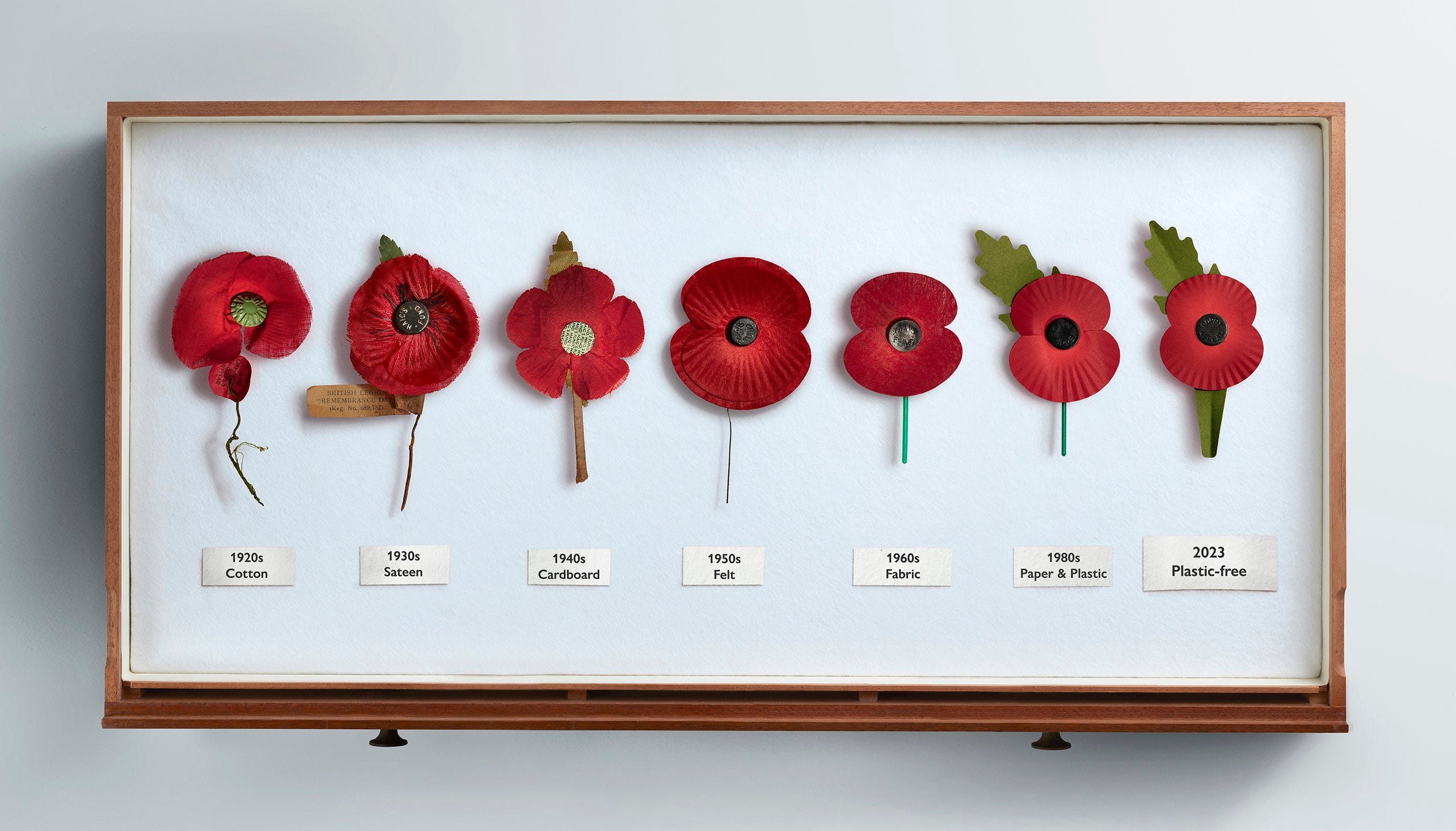
We are more than a century past the Somme. What is Remembrance (or, worse still, ‘Poppy Day’) today? Some on the right complain loudly about the progressive cheapening of materials used in the poppy pin. This is apparently a sign of our national frivolity or a mark of disrespect to servicemen and the fallen. Neither is true. The slow fade of the Wars from our collective memory, from foundational myth to mere event, is the first step in Europe’s overcoming the trauma of her century of humiliation. If anything, our national life would be far healthier with a dose more frivolity.
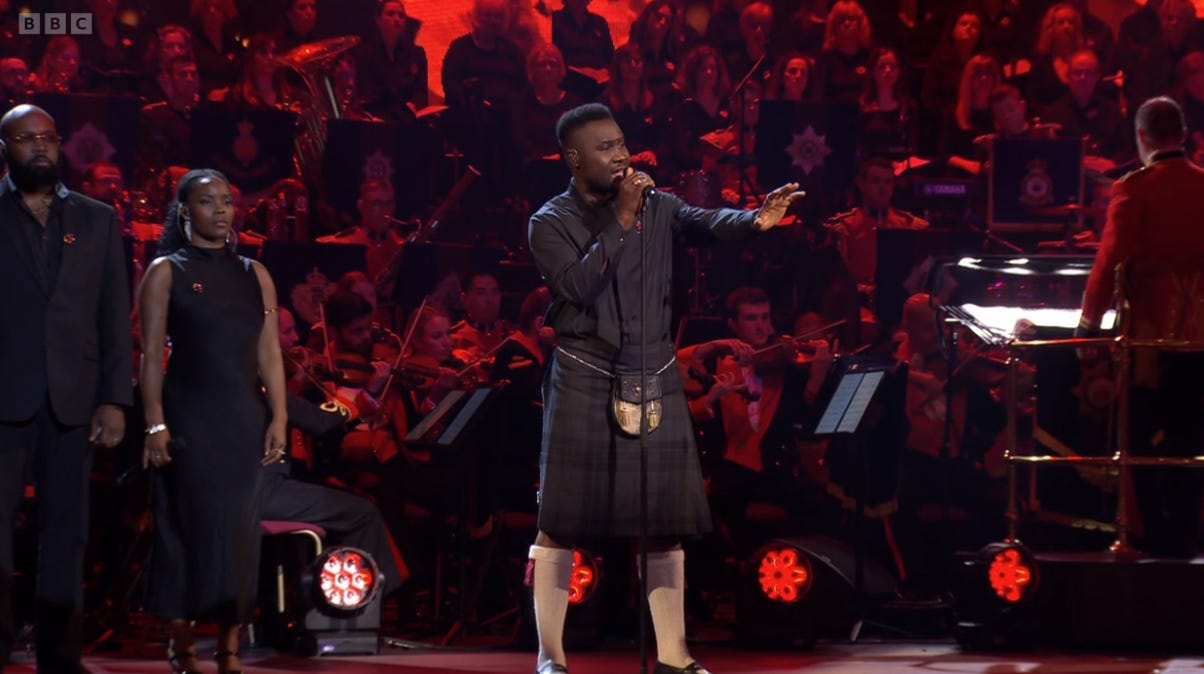
The ‘Festival of Remembrance’, held each year at the Royal Albert Hall by the Royal British Legion, is emblematic of the entire Remembrance charade. It is an abysmally saccharine and wholly self-serious display of the British historical malady. I advise all sentient readers to watch as much of last Saturday’s concert as they can stomach on BBC iPlayer: even those who (unlike myself) wish to preserve the memory of the Wars with solemnity and deference to the past are likely to come away confused, if not outright disturbed. Those familiar with the usual proceedings will know they have a tenor more befitting a Children in Need Charity Special of Michael McIntyre's Big Show than a night exalting the martial virtue of the nation.
Nonetheless, the King, the Royal Family, and honoured guests of His Majesty and their Royal Highnesses attend every year. That meant his box was flanked this year by those of Gravy Minister Andeh Burnham and His Majesty’s Most Loyal Yoruba, Aunty Kemi. Occupying the stalls were various notables, servicemen, their families and those who had purchased tickets. Presumably attendees without any particular connection to the Forces purchased tickets so they could drone on afterwards about how moving it all was, and how it ‘really puts things in perspective’.
One such person was Ivan Hewett, who wrote a summary in The Telegraph. Hewett described it as a ‘raw, humbling tribute to those lost in recent conflict’, a distinct turn away from previous years of the Festival in which focus remained squarely on the veterans of the Korean and Second World Wars: ‘They have passed into history, and the grainy battle films we were shown of that era seemed almost comfortingly nostalgic.’
Like other Remembrance activities, the Festival was held in ‘memory’ of those affected by every war. There is no need at these events for the ‘Glorious Dead’ to be either glorious or dead in these murky ‘conflicts’. The idealised, perhaps ‘sanitised’, veneration of the nameless Unknown Warrior has long been replaced by an annual rite of tear-shedding for the victims of global conflict. Perhaps this loss of focus is understandable as our perspective on the war becomes more historical and, thus, more nuanced; it is not exactly easy to answer whether Britain won the Second World War after all.
We are treated to renditions of pop songs backed by weeping strings, performed and received in full seriousness whilst processions of servicemen march in coordination with a garish telethon lightshow. These marches are interspersed with tales of soldiers and their families recounting the difficulties of separation and recovery. The emotional energy of Remembrance in the minds of most patriotic members of the public is displaced from ancestral gratitude into pity. ‘Remembrance is a daily appreciation of sacrifice and the opportunity I get to wake up every day and get on with my life…’ The entirely interiorising, borderline solipsistic nature of the concert is reflected in the lyrics of Tom Odell’s first bit of ‘sad piano music’:
‘When I close my eyes
the days can be so low
So I stay out all night,
My friends say take it slow,
I tell them that I try,
And then I close my eyes’
For Hewett, words such as these were the ‘reminders of the human costs of conflict’.
It is worth considering how dramatically the tone has shifted. Over the decade following the Great War itself — a time when every person in the country faced some loss in the cataclysm — the proper form of commemoration for the Glorious Dead in national memory was deeply contested. The mood after the Armistice and following the war was jubilation; servicemen and civilians alike attended Armistice Day Balls, jazz concerts and reunion parties on the same days they spent reflecting on real and personal loss. Entertainment, revelry and reverence for the dead could coexist. This push and pull of emotion was only natural to those who had lived and lost through the totalising experience of a total war.
Even the construction of a permanent Cenotaph (decried as a continental import by the arbiters of taste, Lord Curzon and Sir Alfred Mond) was heavily debated until the Welsh Superman, David Lloyd George, forced the issue. As it became clearer that post-war Britain would not be a Home fit for Heroes, the mood understandably became more solemn. The pacifist Reverend Dick Sheppard, the Archbishops of Canterbury and York and others began to agitate against Armistice parties as ‘thoughtless and ill-conceived’ — to the chagrin of many returning soldiers themselves.
One such case was the ‘Company Commander’, a pseudonymous respondent writing in The Times on Sheppard’s campaign, calling him a ‘killjoy’. The sole survivor of four brothers argued ‘the last thing [his brothers] would wish is that they should stand in the way of our enjoying ourselves’. Charles Carrington, a war writer and veteran of the Somme and Passchendaele, similarly resented that the ‘Feast Day became a Fast Day’ and that the ‘Do-gooders [had] captured the Armistice celebrations’. Many other ex-servicemen continued to reject the ‘sanitation’ of Remembrance, and wished to look back on their war experience with pride in their deeds and those of their fallen comrades. The funerary tone of Remembrance was only fully settled by the Baldwinite Turn to Woke. This may be regrettable, but it is not denunciation; the form of commemoration that the nation settled upon emerged out of an emotional soil particular to the moment, a subconscious admission that no one had truly won.
Today’s Festival of Remembrance is neither a celebration of our victories nor a funeral for our fallen. It doesn’t even share the spiritual aspirations of John Fould’s A World Requiem; it is a cadaver of the original possessed by the ghost of Gogglebox Britain which asks the viewer and participant to engage in masturbatory exercises of Men’s Mental Health and public performance of an unnuanced sadness.
Hewett’s review did not mention that the Band of His Majesty’s Royal Marines performed ‘Heart of Courage’ by Two Steps from Hell (I am not joking). For those unfamiliar with this instrumental arrangement’s title, you will surely remember the piece from early 2010s YouTube gaming montages and the film trailer for James Cameron’s Avatar (2009). The BBC camera pans to Defence Secretary Wes Streeting standing glassy-eyed. Kitsch as it was, ‘Heart of Courage’ was the only piece of music performed at the concert that was remotely evocative of what soldiers aspire to — heroism, undying fame, and the immortal deed.
Who is this for? For all but a moment, this year’s Remembrance seemed to forget that volunteer soldiers actually like fighting. In the second half of the concert, there was at last an acknowledgement by Squadron Leader John Peters that he was excited to fly the Tornado. One of his comrades described his motivation for volunteering for the RAF: ‘I was there for Queen and Country, but when it came down to it, I was there for my mates’. The men who chose above all else — yes, at a personal cost to their loved ones — to seek out danger and a life of adventure alongside friends are not victims of Men’s Mental Health, even if our moral language denies them the ability to admit what they actually seek. Whether their sacrifices in pursuit of adventure are to be celebrated, in fact, depends on the evaluation of their valour by their peers. A sclerotic ‘nation’ of pensioners and docile young pensioners-in-waiting can at best only conceive of such men as victims of the ephemeral force of ‘global conflict’, or, at worst, as something to be feared. And thus Sqn. Leader Peters’ narrative turned back to one of abuse at the hands of his Iraqi captors.
This turn to recent ‘conflict’ was inevitable. There is no way back to treating wars that a diminishing few have a real connection to with permanent deference. Nor are we able to dignify fighting men with the esteem that they seek from their pursuits — prevailing morality prevents us from doing so. For this reason, we should ask ourselves whether an inherited commemorative form based on ritual grieving, from a long-gone, entirely particular, and decreasingly relevant time, is appropriate to motivate life and activity in the present.
The lived experience of the Wars was itself generative for new life and art, even if it did ultimately have to contest its legitimacy in the aftermath of Auschwitz. As that experience has receded from our memory, we are left with a residual, ritual form of commemoration that psychologically encourages the cannibalisation of our other instincts. We can see this in the fact that few now celebrate any national victory — VE Day, for instance — but in the moral hegemony that was crowned by the Wars, many more feel obliged to ‘pay respects’ on 11 November. Remembrance, in isolation from celebration, has eased the false acceptance that Britain is an essentially spent nation. The British psyche has slipped ever deeper into depressive resignation.
Sustaining this exhausted form serves the comfortable old men who stand to gain by dressing up our national retirement as patriotism. Assessing historical sensibilities critically, taking a knife to the mythological roots underlying the moral framework that has led us to this state is perhaps the only route to easing our tortured psychological condition. Many will object to this plea for a radical break from our habitual engagement with Remembrance. In the hearts of the British people, Remembrance ostensibly lives on as a form of ethnic ancestor worship — much like the defence of monarchy as ‘Anglo Shinto’. Forgetting one form of collective engagement with history need not sever us from ancestry. The soldiers who rejected the sanitisation of their own service certainly did not want to be remembered this way.
A culture that promotes life must be able to combine collective mourning with celebration of the departed — it is soldiers who most of all desire celebration, and not empty pity. This was understood by all European peoples, as long ago as classical antiquity and as recently as 1945. Tomorrow, we should celebrate our triumphs with the frivolity of the ancients. Should we be blessed by Fate with the opportunity to perform feats of heroism, it should be our children, and theirs after them, who will sing and dance in merriment to honour our deeds until the day we are forgotten and new heroes are born.
This article was written by Francis Gaultier, Commissioning Editor. Have a pitch? Send it to submissions@pimlicojournal.co.uk.
If you enjoyed this article, please consider subscribing. If you are already subscribed, why not upgrade to a paid subscription?
Trust a Frenchman to write such unpatriotic cuck nonsense. 😉
In all seriousness, I would agree with all of this, except, in our threatened and fragile state, Remembrance Day is one of the last truly British experiences left for the native to enjoy a sense of guilt free patriotism.
Last Night of the Proms - murdered, by woke. The Monarchy - murdered, by woke. Protestant anti-Europeanism - died of neglect. Wars - lost to the poorhouse.
I saw a lot of photos and video of Remembrance Day services around the country and how refreshing it was to see hardly a Bomalian among them.
No, Remembrance must stay, at least until we have freed this sceptered isle from the invader. We can then have the frivolous parties that the author demands.
Remberance "Week"? Ugh...
I would suggest this as a replacement - the revival of the Harvest Festival, but for our labouring achievements and to commemorate our workers.
I would prefer it if we could give them some additional constitutional assistance first of course, but it would be more representative of the British people generally and would give voice to small businesses, the self employed, tradesmen and so on.