
Bismarck once said that politics is the art of the possible. To consider politics an art, one has to consider how it is produced. Our dreams of an alternative are the highlights and what is politically impossible are the shadows — and so a country arrives at a political culture produced from those two forces, with particular hues and contrasts. As all artists know, it is the constraints of a medium, and the attempt to create within those constraints, which produces truly great works. Britain is in a uniquely constrained period of its history, one which has begun to produce interesting results in the political and cultural expression of its people. A dawning realisation of our vulnerabilities, dependencies and weaknesses has arrived. The Brexit vote, whether as a conceiving spirit or baptismal affirmation, marked the beginning of a process which will continue to seep into our collective zeitgeist. Our post-imperial amnesia is finally wearing off, and we are searching for a new animating spirit of nationhood. The result will be a country which is alien to us in the present, but which in the future will seem to have been inevitable. Left or right, liberal or illiberal, leaver or remainer, it does not matter — everyone is a British nationalist now. Britain’s first post-post-war era is coming.
Speaking of the ideological crisis the Labour Party finds itself in, Tom McTague succinctly described the set of economic and geopolitical issues that the country has been stuck with for the last ten years. Our place as America’s concierge in Europe, a doorway between continental goods and Atlantic capital, was shaken by the financial crash in 2008 and broken in 2016 with the Leave vote in the EU Referendum and the election of Donald Trump as president of the United States. Much of the political turbulence this country has faced since those two consequential years has been a result of the shock they inflicted on our political leadership — who were (and are) faced with the necessity to confront the existential threats facing our country for the first time. ‘We just don’t have answers… nobody is coming up with an answer of how this country is going to get out of the doom loop it is in.’ McTague’s words ring true not just for the Labour Party of which he was speaking of, but also for the right.
What McTague did not address, whilst pointing out the cycle of failed Prime Ministers coming and going, is how far back the problem goes. The warm delights of post-war consumerism, of abundant access to international goods and capital, masked what was for Britain a deeply traumatic imperial collapse. David Edgerton proposed in The Rise and Fall of the British Nation (2018) that post-war Britain emerged independent of its own collapsing empire, in much the same manner as the post-colonial states of Africa or Asia, asserting its own national identity and interests. His conception of post-war Britain is one in which, for a brief few decades, there existed a British nation, one that had broken free from a global empire that was a playground for ‘gentleman financiers’, before it was subsumed into another form of globalisation by Thatcher, Major, and Blair. For the first time in its history, he argues, British politics, industry and economic life was oriented around the national principle in the years 1945-79. Along with Adam Tooze, Edgerton has become the darling of a certain kind of leftist. The aping of Edgerton’s National Left is best exemplified in Will Lloyd’s recent profile of Ed ‘British Gaullist’ Miliband — which specifically chose to highlight Miliband’s nationalism. After a decade of humiliation for the left, and the internationalist project overall, it is unsurprising that some of its supporters are beginning to reconsider their priors, and Edgerton offers the British left a certain kind of historical legitimacy that would be difficult to replicate elsewhere.
Though I have some sympathy with Edgerton’s view, I find the notion that we are entering our first big moment of post-war national self-conception more compelling than the idea we are entering our second. It would be nostalgic to retroactively look at the consensus that spanned from Attlee to Callaghan as something other than a transitory period in which the nation scrambled around awkwardly, looking to maintain at least some place in the sun. In many ways, we were no more disentangled from Empire between 1945 and 1979 than we were before or even after. As Edgerton himself notes, British industry and trade may well have been more ‘national’ than ever before insofar as it was ostensibly organised around the interests of the nation as a whole, but in other ways it was more imperial than the high mark of Britain’s formal control over foreign territories. It was in the 1950s that the share of trade with the Commonwealth was at its peak, and not a century prior, when the country was the uncontested workshop of the world. Attlee’s economy depended upon dollar exports of Malayan rubber and Ghanaian cocoa, and sought to foster new resource extraction initiatives (such as the Tanganyika groundnut scheme) to help maintain the strength of Sterling and avoid importing dollars. Though the architects of Imperial Preference had struggled to tighten economic integration with the Dominions and Colonies, the Empire had become more important to the British economy after the end of that framework. Imperial Chemical Industries, the largest chemicals manufacturer in Britain for a long period of its history, was never nationalised, but in 1955 a company book for employees and shareholders sought to explain the manner in which it ‘discharges its responsibilities to Great Britain and the British Commonwealth of Nations’. The process of disentanglement was ongoing and incomplete.
The post-war period was also mired by decades of distraction abroad, with far more conflict happening away from Europe than we had dealt with before the Second World War. Even after throwing away so much of our empire as quickly as possible, we were still left with dozens of anachronistic overseas territories which created defensive obligations and gave those who sought them opportunities to LARP Empire. It is in this context that territories such as Akrotiri and Dhekelia can be seen as barnacles on the hull of a ghost ship.
You may refer to Britain’s former continental love affair, best represented by men such as Ted Heath and Oswald Mosley, as evidence to the contrary — proof that Britain had turned away from Empire. The scars of the two European civil wars left many of their generation pining for European unity and the prevalence of collective common interest, against the protestations of anti-racist liberals such as Enoch Powell and nationalist socialists such as Michael Foot and Tony Benn. But, if anything, our entry into the European Economic Community was not the assertion of national and continental interests in the shadow of empire but a continuation of imperial ambition and the delay of national self-conceptualisation. Throughout our fall from first to second to third power status, we have continued to present ourselves as a leading player on the world stage. Our European Union membership sated our desire for the comforting illusion of a continued nineteenth century, with Britain arranging new Concerts of Europe, as in Humphrey’s dictum. Given that, from the bloc’s foundation, half of its members were set against our entry precisely because they knew too well the nature of our ambitions, it could never have been so — and as this became ever more clear, support for our membership waned.
Labour’s 1945 victory was a class — and national — revolution. The globalised elites of the imperial class system, the gentlemanly aristocrats, financiers and industrialists who saw the export of British goods, capital and savings as indistinguishable from the national interest, were replaced by a new type of technocratic management of national life and industry that emphasised the strength of the domestic market via demand-management and the principle of full-employment, meaning that for the first time policy sought primarily to guarantee the security of the working majority.
The world that came before was hierarchical and deferential to a degree we now struggle to understand. The myths of ‘Tory democracy’ and aristocratic paternalism may have eased Conservative acceptance of the new Keynesian paradigm and the welfare state, but writers on the left throughout the early-mid twentieth century argued unequivocally that working-class culture must be the national culture for a new democratic Britain. Yer da’s intellectuals — men like Richard Hoggart, Raymond Williams and R.H. Tawney — saw the communal, mutual-aid traditions of the working class as the only force that could provide an organically socialist alternative to Tory paternalism or bourgeois individualism. Hoggart despised the seeping commercialisation and Americanisation of mass culture. Their romanticised and rather parochial conception of the working-class experience, based on collective self-improvement, offered ways of living that could be extended to the whole society. Gentlemanliness was out; Britain, the real nation, was a workers’ state — or so was the hope.
The unprecedented security that industrial democracy and socialism brought to workers was underpinned by austerity and discipline. But as material comforts became increasingly widely available and the wartime spirit of restraint abated, the controls that sustained the national framework became increasingly unpopular, even if the post-war economic settlement itself was generally approved of. These contradictory demands, however closely held by the public, could not be sustained forever, and the partisans for a nationalist socialist Britain, such as Tony Benn, understood that their impulse to resist liberalisation — and preserve the new workers’ state — required a wholehearted commitment to what amounted to nothing less than a permanent siege economy. In the end, Labour’s austere industrial security gave way to SuperMac’s consumer society and bourgeois aspiration, a trajectory that could not be put into reverse. In this sense, by the 1980s, liberalisation had culminated in a fully-fledged revival of the economic forces of globalisation — especially of finance and its privileged place in the British system — which ultimately saw the Home Islands once again as a node within a global empire of free-moving capital.
Edgerton’s account of a nationalist golden age, as a man of the left, predictably falls most flat in its treatment of post-war migration and the issue of race — or in other words, the defining question of national identity. An obvious point of continuity between Edgerton’s post-war period and what came after is the distinctly anti-national endorsement of multiracialism and multiculturalism. Much of Britain’s political class indulged in this, entirely independently of the degree to which they championed economic globalisation. There is a widespread assumption on the online right that we had a self-consciously ethnic conception of British national identity before Blair. This is a projection of distinctly modern attitudes, which we assume must have been natural in a society with such demographic homogeneity. In fact, it is often the confrontation with the other that solidifies a certain understanding of identity. There is a distinction between a vague, commonly held understanding of some connection between a nation and an ethnos, and the explicit conceptual unification of the two.
Before Attlee, there may have been paper rights for all British subjects to travel freely across the territories of the Empire, but in practice very few overseas subjects made use of them. Pre-war governments had introduced regulations that permitted inspectors to prevent the docking and settlement of aliens, precisely because they were aware of the tensions created by even very small numbers of resident foreigners in Britain. One example is the fracas between black dockworkers and demobilised soldiers returning from the war as early as 1919.
Attlee’s government, however, codified and made real the inchoate logic of free movement, and in doing so pushed the legal understanding of Britishness away from the national principle. The 1948 British Nationality Act opened the door to immigration from the New Commonwealth, a shallow euphemism for the non-white colonies. Britain’s elite in the post-war period, just as much as in the decades of ‘neoliberalism’, had hoped to ignore the ugly and violent realities of ‘Empire coming Home’. It was in the nation itself that resistance to mass immigration manifested. Non-whites were excluded from British society, amenities and employment. Minorities faced violence from the National Front. Britain was indeed a racist society, and racial strife was an immediate fact of life from the first settlement of aliens. Resistance, too, was violent and ugly, and distasteful to our sensibilities — but, simply, the British people were never asked.
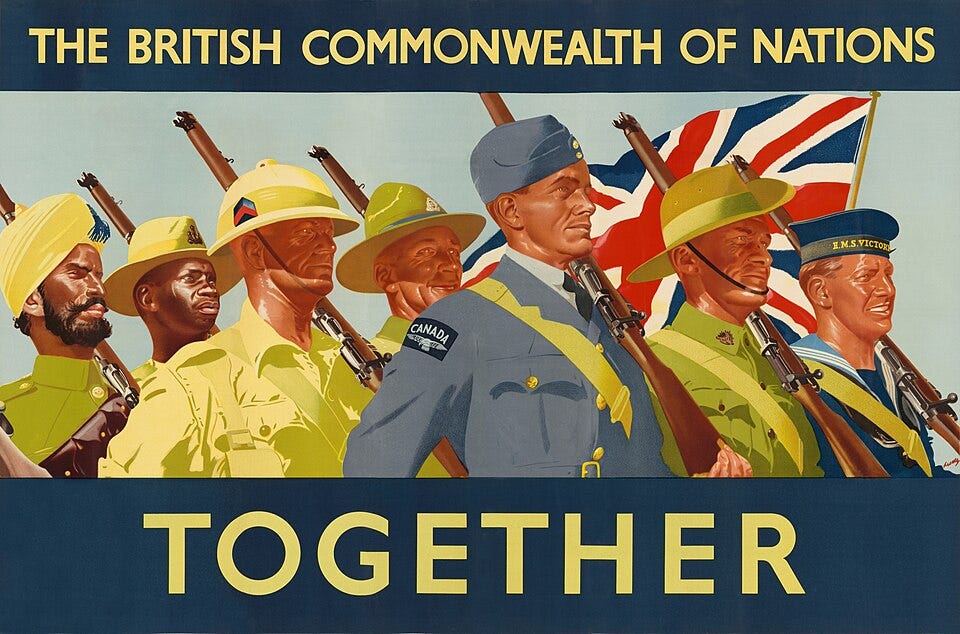
Governments were immediately aware of the fraught situation, and yet were resistant to straightforwardly rejecting the most overtly damaging legacy of Empire, partly due to new fears of appearing racially bigoted, and partly on the grounds that it would weaken Britain’s standing in the then-third-world New Commonwealth — which was increasingly flirting with Soviet influence. A fudge was reached on the race and migration question — implementing a directly American-inspired ‘civil rights’ anti-discrimination framework in response to the burgeoning reality of segregation, while arresting the inflow of Commonwealth immigration by new controls with Acts strictly limiting further Asian and black migration. Ultimately, the innovation of a British citizenship framework was established under Thatcher. The ambivalence our elites showed to the unprecedented and existential transformation of our country through mass immigration demonstrates the insufficiency of describing the period as truly national. There is a throughline from the ‘Together’ poster to today, as much as the British Pathé enjoyer might wish to ignore it. Kipling’s ‘Mandalay’ and Tennyson’s ‘Timbuctoo’ sit happily within the liberal conception of Britain’s past and present.
My issues with Edgerton aside, the left-of-centre motivation in adopting his frame is an entirely natural, and mostly sincere acceptance of the changing world. The role that Britain has played for the last half century no longer exists. Being the Milchkuh for American capital interests in Europe once gave us lucrative opportunities, but now all that remains is what we are: a cold, rainy group of islands in the North Atlantic.
Britain, going back to the Acts of Union 1707, has never had a set of conditions which meant that it had to conceive of itself as principally a nation first and a nation only — without interests outside of the British Isles, and unconcerned with the goings on of the outside world. Moreover, a truly historical people, such as the British have been — as contrasted with, say, the Slovakians — will always seek to answer the question of their place in the wider world, and cannot be satisfied with life in the Shire. Simply whiling the time away, living to perpetuate a way of life, is not enough — even outside of the economic costs usually incurred by isolation.
Neither of these conditions continue to hold in the Britain of today. As the left is beginning to recognise, we are caught in a set of economic and political circumstances which guide us towards a new isolationist period. As a people, we have been laid low enough, for long enough, that our horizons have shrunk to precisely those things which would previously have been insufficient. We remain capable of achieving great things, but not of imagining them.
When no international role can be pursued, isolation logically follows. Every proposal of potential foreign realignments today is met with some degree of animosity from various parts of our society. There is no substantial change to our position in the world that could be made which would be sufficiently widely approved for it to be embraced as a domestic political settlement, and ‘more of the same’ is not an option. A neo-Cameronite overture to China would now be met with Cold War hysterics, fuelled by our increasingly petulant American overlords. A pitch back to the European Union would cause widespread revolt, and would be an embarrassment internationally (especially among European leaders, who would extract far too heavy a price as a result). Any lingering warm feelings towards America are (rightly) seen as a form of slavish masochism. The suggestion that the Old Commonwealth, strewn across the world as it is, could form the basis of an international bloc, popular among late-2010s CANZUK enjoyers, is obviously laughable.
These barriers are not purely political. There are concrete reasons why each of these paths forward are blocked. Europe demands alignment with a sclerotic regulatory regime as the price for any deepened co-operation, a cost which even many who opposed Brexit now see as unaffordable in such dire economic times. America, similarly, demands its own (de)regulatory alignment, seeking to siphon our only remaining source of wealth, financial and professional services, off to New York. Whatever the flaws of American vassalage, few are eager to see the influence of the Chinese state over our country grow, alien and unpleasant as it is.
Our current political economy was constructed around the assumption of American benign hegemony as the enforcer of the United Nations’ post-national permafrost: free trade, globalisation, and the ‘international rules-based order’. Now that America has abandoned this role, we have been jolted into a world in which national self-reliance matters again, and we have found ourselves to be among the states most vulnerable to this sea change. The ability of blocs or individual states to project power, and the spheres of influence they can establish, are once again relevant constraints on a country’s ability to trade and interact with the world. Britain neither has the ability to pursue alignments in any direction, nor the ability to project power alone. In such a circumstance, any international engagement creates only vulnerabilities. No path forward into the world is worth taking, and so we turn inwards.
The pressures described above are already shaping our politics in ways you might not have immediately noticed. On the right, the shift towards nationalism and isolationism is clear, not just in the replacement of the Conservatives by Reform but in the growth of grassroots dissatisfaction with even Nigel Farage’s lingering commitments to international causes (in the form of alignment with the US and Israel especially). But the left, too, is being reconfigured within this same set of constraints. Keir Starmer’s government, in its latest doomed attempt to rebrand, has pitched itself as the steady defender of the British nation against the turbulence of the outside world. Ed Miliband increasingly describes his progressive alternative explicitly as an outgrowth of nationalist commitments, leaning into the emerging leftist fascination with De Gaulle. Even on the radical left, Aaron Bastani argues that Britain has not yet fulfilled the Brexit promise to ‘take back control’ — and that it should do so with vigour.
Britain is no longer conceived of as a beacon of progressive virtue, leading the world by example, but as a nation with interests that must be enthusiastically pursued. This nascent, cross-party British nationalism is emerging not just in the crude outbursts of a single politician, but is taking form across the political spectrum, breaking free of the reactionary cage to which nationalist politics has been confined over the past several decades. In their New Statesman podcast on abolishing the Monarchy, Oli Dugmore and Will Lloyd spoke of the state in which the country finds itself today, and the injustice of our national strife. They discussed, in sombre, loving tones, how far this country has fallen and how ambivalent our royal family has been throughout that process. Their animosity for the House of Windsor comes not from communist resentment, nor a desire to trample over our heritage — in fact, it arises from precisely the opposite sentiments. One could not imagine Dugmore talking in romantic, Granville Thorndykean tones about our country ten years ago, yet here he is today doing precisely that.
The second Trump administration has spawned (particularly among the left) a deep animosity towards supposed Americanisms, real or imagined. A certain snobbish anti-Americanism has always been a feature of British upper-middle class attitudes, but the fear and suspicion of outside influence as a corruption of our national life is more than just a radicalisation of what previously existed. What this means in practice is a conservative, xenophobic retreat into the cultural signifiers that shape our sense of Britishness. When Zoe Gardner, perhaps the most totemic manifestation of out-group preference in Britain, calls opposition to abortion rights ‘yank nonsense’, it demonstrates that the political framework of our time is ordered around whether something is foreign (bad) or autochthonous (good). The argument does not make sense, but the right to murder the unborn is wrapped in the Union Flag and given legitimacy simply as a point of distinction against the reviled outside.
Of course, in so many ways, their understanding of what defines British nationhood is not ours — the elephant in the room is immigration, an issue on which the left has yet to break ranks, even as the Labour government makes increasing rhetorical (and to some extent material) concessions to restrictionism. This point, however, is not strictly relevant to the thesis I am presenting. The left’s increasing antipathy towards foreignness is genuine, and their justification of their politics as an outgrowth of nationalism is not simply a skin-suit, even if their definition of ‘foreign’ and ‘indigenous’ is not our own. Again, for someone like Zoe Gardner to be working from such assumptions to validate her beliefs is evidence of something having profoundly changed in our country’s political epistemology. That the Liberal Democrats have a Gott strafe Amerika leader in the form of Ed Davey is also part of that same phenomenon. Attacks on tax-dodgers, notably including emigrants to Dubai currently under threat from Iranian drone attacks, as traitors to the country are genuine, even if some readers may feel them unjustified.
To say that the left is often wrong in their interpretations is not to say that it is entirely devoid of valid manifestations of nationalist politics — even including forms which remain unrepresented on the right. Due to the nature of the mainstream right’s electoral coalition and the understandably narrow focus of its patriotic ire on the issue of mass immigration and demographic change, the right has thus far sidelined many other budding strands of nationalist sentiment. This can be seen most notably in its ongoing Atlanticism and its continued advocacy for entanglement with Israeli foreign policy objectives which have no basis in British national interests, but also in its blasé attitude towards foreign — and particularly American — ownership of British assets and key strategic infrastructure, from utilities companies to payments processors. All of these commitments are weakening, as the surprising interjection of Robert Jenrick against Reform’s support for the Iran war showed, but none have yet truly broken. The right has thus far avoided paying too high a price for these positions, because its nationalistic credentials are simply not judged in these terms by much of the public, yet that situation may not persist indefinitely as the logic of this cultural discourse plays itself out.
This inwards-looking dynamic is dragging all sides towards an emerging nationalist and isolationist consensus. The one question that keeps Britain engaged with the wider world is the Ukraine war, yet even here public interest has waned. The peak of support for Britain’s role in the conflict was in February 2023, with 68% in favour. By February 2025, that number had dropped to 53%. It is still the case that any suggestion of abandoning Ukraine would produce hysterical accusations of treason from various sections of society, but it is not clear how strong that feeling will remain as economic conditions worsen and the energy crisis intensifies.
One unexpected consequence of this nascent political moment is the tacit desire across the political spectrum for Reform UK to win a majority at the next General Election. This desire is by no means shared by everyone, but it finds expression — even if only implicitly, and in many cases without full self awareness — in every corner. With the Labour party incapable of ushering in the changes made necessary by this new logic, there is a growing sense among many on the left that Reform would at least break through some Gordian knot and open the floodgates of a new dispensation, even if that involved much they cannot support. Figures such as Aaron Bastani and Lewis Goodall increasingly criticise Reform not for believing what they believe, but for hypocrisy or inconsistency — which is to say, for not believing what they believe hard enough. For the first time, right-wing politicians are under pressure to be more consistently nationalistic, rather than to abrogate nationalist concerns in favour of global commitments or universal values. Had Reform come to prominence ten years ago, it would have received nothing but encouragement to soften its positions; now, it is faced with constant pressure to live up to its revolutionary potential. The necessity of a radical disruption to the political system is now almost universally acknowledged, other than in the office of the leader of the opposition, and the focus increasingly shifts towards eagerness for that which is beyond that horizon, rather than litigating the specifics of the rupture itself. Even Reform’s opponents recognise in ever greater numbers that it is the only party capable of breaking out of this era-at-an-end, and opening a new chapter in British national history.
The next general election will consummate ‘Brexit Britain’ and usher in a new era. Prime Minister Nigel Farage, first leader of post-post-war Britain, will enter office on an explicitly nationalist platform. His opponents on all sides will spend the next five years contesting not the principle of nationalism, but the definition — with each side competing on who truly represents Britain as Britain and who can best insulate our country from a world of turmoil. As Britain’s post-war identity as a multiracial province at the intersection of various international organisations fades, this competition will be the basis of what comes next. It is, of course, impossible to predict the specific terms that will emerge victorious, but what is certain is the inevitability of what could be called ‘The Inward Turn’.
We will soon have a society which is more introspective, more insular, and thoroughly self-obsessed — xenophobically defensive towards the outside, but more internally self-critical. Such a society — especially under conditions of extreme economic and social pressure — could find itself the engine of great progress. Britain will be uniquely placed to debate and answer the problems currently faced by all Western nations. A soft Sakoku of voluntary preference will leave Britain poised for a cultural renaissance, much as the quest for self-conceptualisation embarked upon by Norwegians in the nineteenth century spurred their own Romantic nationalist movement. Nor must this process necessarily leave us permanently absent on the global stage. Rather, a culturally flourishing Britain which has finally reckoned with itself could present itself then as a source of wider European revitalisation. Often, a people needs the space to define itself internally, and to construct a future to believe in, before it can find the will to act on the world.
The period into which Britain is entering may not be a prosperous one. Many hardships lay on our horizons. But for all that we will suffer in the coming years, we will count ourselves lucky, in the future, to have been presented with the opportunity — the necessity — to look up from the ashes of what came before and consider what must come next. The collapse of a political paradigm as deeply entrenched as ours is never smooth, but we can take solace in the understanding that the birth of a new world requires the death of the old. And in the next decade or two, if you chance upon a retired Ed Miliband, shake his hand and thank him for choosing Rolls-Royce over Westinghouse. There is a nationalist in all of us now.
This article was written by Bukes, an enemy of the Pimlico Journal. Have a pitch? Send it to submissions@pimlicojournal.co.uk.
If you enjoyed this article, please consider subscribing. If you are already subscribed, why not upgrade to a paid subscription?
Interesting read. "We remain capable of achieving great things, but not of imagining them." - that's a line that sticks.
Often those people who call certain rightwing policies "yank-brained nonsense" are completely uncritical about American influence on the left. So I'm skeptical that their anti-Americanism is motivated by British nationalism.