
As we lurch towards the end of this period in political history, a strange anxiety hangs over Britain — and, indeed, the West as a whole. The sense that the ice is thin and that something lies beneath is palpable, but the prospect of a genuine rupture nonetheless remains inconceivable. Something has to change, but nothing can — at least until an alternative future presents itself. In this eerie prelude, the natural response is to continue living as normal under the historically reliable assumption that tomorrow will proceed much as today. This is precisely the response we see all around us — for the most part. Yet, every so often, an event occurs which breaks through that illusion, revealing the problems and contradictions of our time and reminding everyone, if only briefly, of the horizons to come.
In the last few months alone, we have witnessed several such events: the murder of Henry Nowak, the attempted beheading of Stephen Ogilvie, the Belfast riots which followed, and the political assassination of Ann Widdecombe. The surprising character of these events, which puncture the public’s assumption of normality, naturally produces an overcorrection, transforming denial into catastrophism. A response which has become more common in recent years in Britain and elsewhere is the suggestion that we (alongside other Western countries) are headed towards ‘civil war’.
Before the present decade, talk of sustained political violence was entirely absent from the mainstream, and those who partook therein would have been dismissed immediately as cranks. It is telling, then, to see the extent to which this conviction has taken root since. Premonitions of conflict are echoed by the many prominent, orthodox figures on the right. Even Kemi Badenoch, in a BBC Radio 4 interview, warned that ‘community tension’ and ‘fracturing’ could lead to civil war ‘in the long term’. Nigel Farage has voiced similar concerns, raising the possibility of widespread civil disorder if not full-blown civil war. Large swathes of the country are also convinced: a YouGov survey on the heels of the riots that followed the Southport murders in August 2024 found that 32% of Britons believe that a civil war will occur in the next decade.
It was during those heady weeks that David Betz, previously a little-known lecturer at King’s College London, became an overnight (e-) celebrity as one of the first British academics (and one of the first respectable people in general) to seriously advance the case that civil conflict in Western countries is not just a possibility, but an overwhelming likelihood, in the near future. In particular, Betz suggests that either Britain or France could be the first modern Western countries to face the coming deluge, which would then be prone to spread elsewhere. He introduced these claims in his two-part article ‘Civil War Comes to the West’, perhaps one of the most widely circulated long reads in recent years, and has continued to make the same arguments during various podcast appearances and public speeches.
These concerns are also felt in other Western countries, facing the same fundamental challenges: economic stagnation, declining international power, the retardation of the state, and most crucially the existential threat of demographic replacement. They have found cultural expression in various places, perhaps most notably in Alex Garland’s 2024 film ‘Civil War’, which depicted a full-blown military conflict in the contemporary United States (and, in an ironic demonstration of 21st-century frivolity which repudiates the film’s own premise, has been remembered in the form of a single meme and little else).
Perhaps it is understandable to raise such concerns in the aftermath of the kind of serious race riots which are becoming more and more common across Western countries. In other moments, however, these fears seem more obviously absurd, with recent suggestions by X engagement farmers that mass protests in Ireland against fuel tax hikes represented the beginning of a cataclysmic shutdown being an obvious example.
In some ways, these forecasts are an understandable outgrowth of talk of the ‘culture war’; an example of a metaphor becoming not-so-metaphorical. But they also scratch a certain itch: a vision of catharsis in a great struggle, a moment when the unknowns and possibilities of this age of transition crystallise and resolve, when all one opposes is swept away, and a new world is born. Furthermore, they offer a path towards resolution of our seemingly intractable problems, however unpleasant that path may be. The dark intonations of these predictions are therefore often peppered with titillation on the part of the prophet.
These ideas are ultimately misguided. This is not to dismiss the seriousness of the issues mooted as potential causes of civil unrest. Indeed, one cannot overstate the threat posed by mass immigration and demographic change, phenomena which threaten the very existence of Western countries as Western countries and which will, if left unaddressed, lead to the disenfranchisement of their native peoples and the loss of their ability to shape their own destiny through ordinary political action. No circumstances in history have more commonly ignited internal conflict than multi-ethnic societies beset by growing lists of grievances on both sides.
Nevertheless, misunderstanding the nature of this problem in our own countries does little to help those of us who wish to see our problems addressed. Failing to define the scope of political possibilities accurately can only increase the risk of relying on poor strategies, and the expectation of a more straightforward – if messier – solution takes energy away from the pursuit of real change. If nothing else, wargaming the possibilities (in a way that Betz and others have yet to fully do) presents an interesting set of thought experiments.
Part one of this series will discuss the entirely unprecedented conditions of ‘liberal modernity’, and their implications for the possibility of civil violence, revolution and the imaginative horizons of dissident forces, dealing mostly with the notion of civil war proper – a prospect which Betz does not suggest, but which many others do. The second part, which will follow soon, will explore the idea of ‘Ulsterisation’ (the proliferation of less organised and more narrowly tribal violence, to which ‘Ulster’ is still a wanting analogy) and consider what an informal civil conflict could or could not involve in the absence of serious state breakdown and the inability of the general population to meaningfully coordinate violence towards political goals, providing a more direct response to the specific claims made by Betz himself.
The problem of domestication
The immediate question facing any analyst of civil violence is whether and to what extent modern Western populations are even capable of the kind of sustained violent activity that a civil war fantasist might hope for. As Betz notes, the literature on civil conflict has historically assumed that it is not a problem which presents itself in rich countries with deeply embedded democratic legitimacy. Rather than refuting that point directly, Betz accepts this assumption, but suggests that these qualities rest on deeper foundations which are the actual barrier to civil conflict and which are presently being eroded in Western countries (most notably demographic homogeneity). Both of these positions are wrong. The United States had been a democracy for 85 years when its civil war began, more than three and a half decades longer than Spain has today – and nobody would suggest that Spain has markedly less entrenched democratic legitimacy than any other European country, nor that Spain is more vulnerable to civil war than its peers. But though the reasoning is flawed, the conclusion of established literature – that modern Western populations are uniquely incapable of violence – is correct.
What neither Betz nor those from whom he deviates consider is the way in which our liberal modernity shapes our psychological horizons, our desires and capabilities, and even our physical stature, from which political possibility cannot be disentangled.
To commence with a violent political strategy, whether a civil war or a more direct coup, requires two things. Firstly, it requires a willingness to commit the violence itself. Secondly, and perhaps more importantly, it requires the ability to psychologically break from the institutionalised practice of politics. The events of January 6th demonstrate the difficulty here. Of course, most of those who entered the Capitol were unwilling to deploy any kind of violence. But what truly renders attempts to paint those events as an ‘attempted coup’ farcical is the image below.
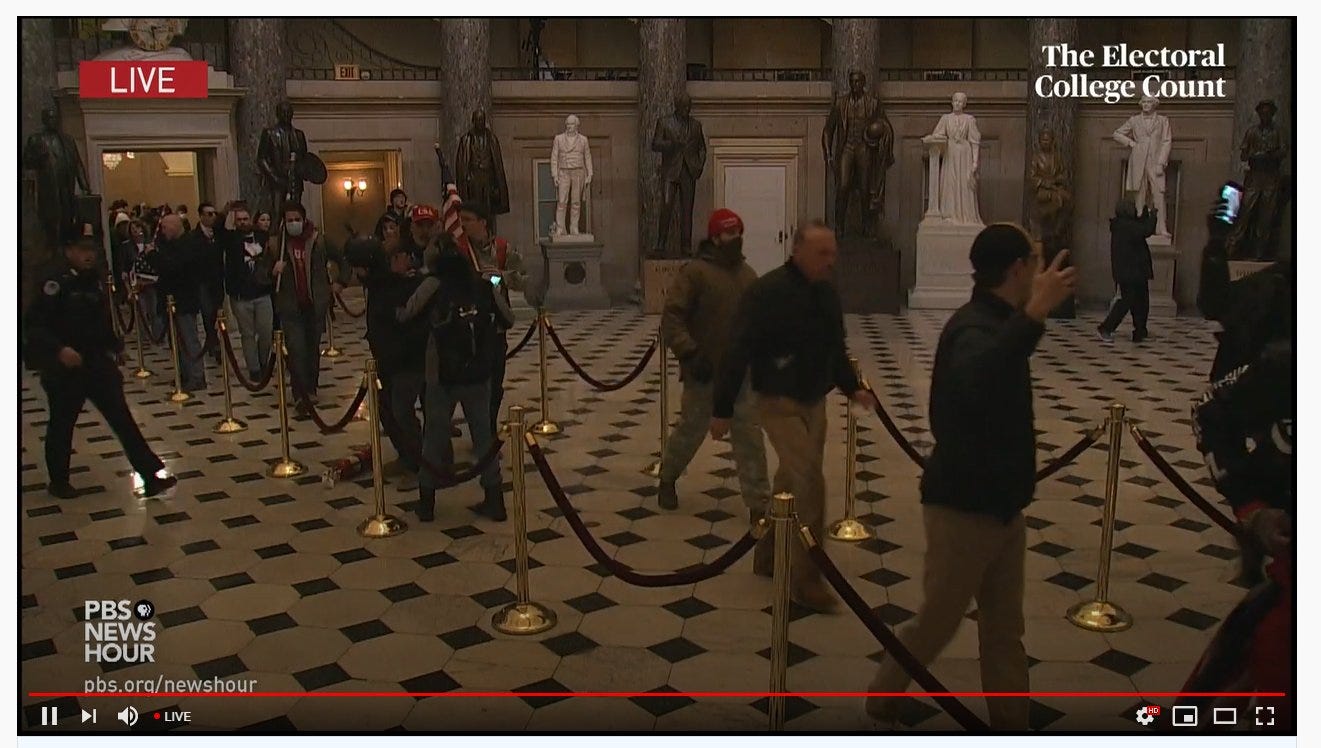
America is a country which has always taken the design of institutions seriously, as is demonstrated by the extensive discourse around how to structure the Constitution in the period of its founding. Yet its foundational population was entirely capable of political action outside of those institutions if they felt it necessary. The 1789 Constitution itself was enacted without reference to the rules of the Articles of Confederation, and similar examples of institutional irreverence continued to occur throughout the next several decades. America’s founding stock understood that ‘you can just do things’, and that institutional constraints on how politics should be conducted can simply be disregarded when they conflict with desired outcomes. That understanding no longer pertains. Today, to ‘act politically’ is by definition to act institutionally. A population which would not presume to walk outside the lines cannot unconstitutionally force the resignation of Congress, let alone overthrow the constitution itself.
The first test of the possibility of revolutionary violence — and, indeed, the true test of Francis Fukuyama’s thesis in The End of History and the Last Man — will be whether the official mechanisms of legitimacy and political activity within modern ‘liberal democratic’ capitalism are even contestable within the imaginations of Western populations themselves, or whether the domestication of our political instincts has progressed beyond recovery.
To begin to explain the problem introduced by modernity for revolutionary action, we can look to Frenchman Alexis de Tocqueville’s Democracy in America, in which he describes the way in which democratic society transforms the psychological character of the people and shrinks their political horizons:
‘I think then that the species of oppression by which democratic nations are menaced is unlike anything which ever before existed in the world: our contemporaries will find no prototype of it in their memories. I am trying myself to choose an expression which will accurately convey the whole of the idea I have formed of it, but in vain; the old words despotism and tyranny are inappropriate: the thing itself is new; and since I cannot name it, I must attempt to define it.
I seek to trace the novel features under which despotism may appear in the world. The first thing that strikes the observation is an innumerable multitude of men all equal and alike, incessantly endeavouring to procure the petty and paltry pleasures with which they glut their lives. Each of them, living apart, is as a stranger to the fate of all the rest—his children and his private friends constitute to him the whole of mankind; as for the rest of his fellow-citizens, he is close to them, but he sees them not;—he touches them, but he feels them not; he exists but in himself and for himself alone; and if his kindred still remain to him, he may be said at any rate to have lost his country.
Above this race of men stands an immense and tutelary power, which takes upon itself alone to secure their gratifications, and to watch over their fate. That power is absolute, minute, regular, provident, and mild. It would be like the authority of a parent, if, like that authority, its object was to prepare men for manhood; but it seeks on the contrary to keep them in perpetual childhood: it is well content that the people should rejoice, provided they think of nothing but rejoicing. For their happiness such a government willingly labours, but it chooses to be the sole agent and the only arbiter of that happiness: it provides for their security, foresees and supplies their necessities, facilitates their pleasures, manages their principal concerns, directs their industry, regulates the descent of property, and subdivides their inheritances—what remains, but to spare them all the care of thinking and all the trouble of living?
Thus it every day renders the exercise of the free agency of man less useful and less frequent; it circumscribes the will within a narrower range, and gradually robs a man of all the uses of himself. The principle of equality has prepared men for these things: it has predisposed men to endure them, and oftentimes to look on them as benefits.
After having thus successively taken each member of the community in its powerful grasp and fashioned him at will, the supreme power then extends its arm over the whole community. It covers the surface of society with a network of small, complicated rules, minute and uniform, through which the most original minds and the most energetic characters cannot penetrate, to rise above the crowd. The will of man is not shattered, but softened, bent, and guided; men are seldom forced by it to act, but they are constantly restrained from acting. Such a power does not destroy, but it prevents existence; it does not tyrannize, but it compresses, enervates, extinguishes, and stupefies a people, till each nation is reduced to nothing better than a flock of timid and industrious animals, of which the government is the shepherd.’
Tocqueville fits into a broader tradition of civilisational pessimism that emerged in response to the visible changes during the early stages of Europe’s journey into modernity: ‘liberalism’, capitalism, the rupture of ‘organic’ social bonds and the establishment of the centralised modern state evidently produced great economic, technological, military and intellectual dynamism; but in this new mode of human life something was clearly being lost.
For Tocqueville, it was the combination of the social baseline of modernity (characterised by materialism and the equality of conditions in abstracted social relations — more on which later) and democratic government (which could legitimise a kind of state even more ambitious in its management of everyday affairs than the administrative absolute monarchy of Ancien Régime France) which provided the structural explanation for the transformation in mores and enervation of political energies in America (and, in the aftermath of the French Revolution, eventually the West as a whole). His explanation renders these conditions rather contingent: liberalism competed against alternative visions of modernity, and had history played out differently it could have lost that struggle to fascism or communism, or indeed the persistence of various regimes in a more politically heterogeneous Western world. Nor is it obvious that the victory of liberalism alone would arrest the ability of the imagination to conjure alternatives, especially given that both of its most prominent alternatives in the twentieth century emerged out of the same intellectual genealogy that produced liberalism itself.
Others, of whom Nietzsche is perhaps most prominent, suggest that the particular conditions of our modernity have a more fundamental (and therefore perhaps more historically irrepressible) basis. Nietzsche believed that the prevailing intellectual instincts of his time — and indeed the psychological character of his contemporaries — were more full and honest expressions of Christian morality, and as a result saw it as a natural and logical end state of Christian civilisation. Nevertheless, he also recognised the proximal importance of these structural factors. Even more pessimistic than Tocqueville of the egalitarian impulse in liberalism, Nietzsche identified its levelling institutions and doctrine of individual (and later human) rights as a cancer on mankind’s thymos (lit. spiritedness) in much the same manner:
‘My conception of freedom. — The value of a thing sometimes does not lie in that which one attains by it, but in what one pays for it — what it costs us. I give an example. Liberal institutions cease to be liberal as soon as they are attained: later on, there are no worse and no more thorough injurers of freedom than liberal institutions. One knows, indeed, what their ways bring: they undermine the will to power; they level mountain and valley, and call that morality; they make men small, cowardly, and hedonistic [genüsslich] — every time it is the herd animal that triumphs with them. Liberalism: or in other words, herd-animalization.’
This fear would ultimately be echoed by Fukuyama, who did not share Nietzsche’s conviction that the victory of liberalism was necessarily caused by the triumph of these aspects of our nature and tendencies in our thinking, but shared his fear that its ultimate consequence might be to facilitate the rise of the Last Man.
The problem of specialisation
The debate over the effects of modernity on the human condition was already in full swing by the mid-eighteenth century. Whilst Tocqueville and Nietzsche primarily considered the political and philosophical transformations of their time, one particular eighteenth-century theorist was more concerned with developments in the economic sphere.
Adam Ferguson, responding to the ideas of his contemporary and more famous namesake, Adam Smith, did not challenge Smith’s core observations on the division of labour and the economic gains which result. He recognised that the individual pursuit of private gain and the ever-increasing specialisation of labour inarguably advanced the commercial wealth of society and the aggregate power of the state. As a result, these phenomena would facilitate exponential progress across every realm of human endeavour. Rather than disputing these premises, Ferguson sought to introduce sociological and anthropological concerns into Smithian analysis of economic progress.
Ferguson’s interests, much like Nietzsche’s, were in the character of the people and the nature of the lives they lived. Ferguson’s interest was in the possibilities of liberty in the face of the revolution of commercial society in Europe — and, like Nietzsche identified the psycho-physiological constitution of the population or citizen body as inextricable from an intensely political understanding of liberty which is synonymous with sovereignty — the power to see one’s will realised in the world, or at least within one’s own life. For Ferguson, this kind of freedom underpins man’s existence as a political agent, a central aspect of the human experience.
His concern, however, was that the ever-intensifying commercial specialisation that enabled this historically unprecedented generation of surplus entailed the narrowing of the capacities of the individual in all spheres of life in which they were unspecialised. The result is an individual with radically diminished independence, far greater reliance on others, and thereby significantly weakened sovereignty. One wonders if even Ferguson could have imagined the extent to which this process would develop by our time, in which most people below a certain age lack even the skills to perform basic home maintenance (and in many cases even outsource such things as cooking and cleaning).
Moreover, commercial society constructs for the first time a superstructure over which no individual or organisation exercises any agency whatsoever. Individual commercial decisions are made by consumers and producers in order to maximise the satisfaction of their desires (for goods and profit respectively). These decisions are not (and cannot be) made with any reference to the political preferences we might have with regard to the organisation of society, yet the economic superstructure which shapes so much of our lives and directs all of our productive efforts emerges from them. Nobody came to the conclusion that outsized social rewards for investment banking would produce a better society, nor did anyone choose to structure today’s British economy around financial services. Instead, they made billions of individual purchasing decisions with reference only to those economic desires with relevance to that discrete choice, and these facts of our society emerge as the entirely unchosen consequences of those petty decisions.
Life ‘in nature’ is necessarily mostly unspecialised; a hunter-gatherer must possess a great variety of skills and faculties: the capacity for violence, physical strength and endurance (both for hunting and for war), a range of productive and artisan skills (for toolmaking and maintaining living environments), a wealth of knowledge about the natural world, as well as social and proto-political skills for maintaining cohesion within the group and organising against external threats. It is easy to see how this diversely competent type of man would have a wholly different relationship to sovereignty, and therefore a far deeper capacity for independent political engagement.
Ferguson’s idealised classical republican model of politics accounted for this in the suggestion that the farmer-citizen-militiaman was the bedrock of political liberty (perhaps in our post-agrarian society we could generalise this notion to the producer-citizen-soldier). Only through such a collective model could individuals on the whole expect ‘non-domination’ — a circumstance in which no superior power exists which can impose itself on the citizen. This sensibility that a polity seeking to maintain a politicised citizenry must guard against the excesses of specialisation would later find a different expression in the work of Jacob Burckhardt in ‘The Greeks and Greek Civilisation’, where, speaking of the Greek republics, he says: ‘the polis… starts with the whole, which precedes its parts’. Like Ferguson, Burckhardt suggested that political agency depended upon the citizen retaining a breadth of capacities irreducible to any single social function.
Specialisation in general, then, reduces an individual’s range of competence and makes them weaker in all sorts of ways. It also changes the nature of their relationship to society, by binding them up in one small corner of a highly complicated web. The idea of imposing oneself upon society as a whole is far easier to entertain when one contains all of society within oneself and when one exists on equal terms with one’s compatriots; far harder from the constrained viewpoint of a specialised worker entangled in one small corner of a complex economic and social web. Specialised competence encourages staying in your lane, a psychological orientation which extends beyond the workplace and into one’s engagement with political society.
The problem of demilitarisation
There is one form of specialisation in particular which has an outsized impact on the prospects for revolutionary violence, and it is hinted at in the formulation of farmer-soldier-citizen found in Ferguson. Whilst generalised competence is required for non-domination, martial competence in particular is crucial for reasons that will be quite obvious. Physical force and the dispersed ability to exercise it is the ultimate backstop of the free state, and the fundamental basis of the citizen’s status as a political agent. This was, of course, recognised by the American founding fathers, who held it of sufficient importance that only the right to speak freely would be codified with higher precedence in the Constitution.
Needless to say, the ability to exercise force goes well beyond the mere right to bear arms (though that is not itself an insignificant factor). For the American millionaire enjoying his suburban life in ‘Liveable Austin’, his collection of AR-15s is little different to his socially challenged son’s collection of Funko Pops. No matter how much the firearm may have democratised warfare, it comes to nought if it is psychologically unfathomable for Austin Man to use the force of his arms as intended in Jefferson’s vision of the agrarian republic, which sought to institutionalise not the Constitution but its generative principle of popular sovereignty in the ability of American citizens to take extra-legal, violent action against the risk of subordination.
The full set of reasons for the diminished psychological and physiological constitution of populations in our aged (and quite literally fat) liberal democracies range from the obvious to requiring closer dissection beyond the scope of this essay. But one part of this puzzle is that the modern(ising) state and the progress of specialisation eventually resulted in the professionalisation of armies. This kind of specialisation, and the end of the militia which it brought, represented the gravest danger for Ferguson. Shorn of the necessary exposure to violence and the martial training to partake in it effectively, the overspecialised subject of a state in commercial society would, generationally, lose the faculty entirely (indeed, much of military training, after all, is simply the accustomisation of soldiers to regular violence).
The professional soldier, whose sole craft is the practice of violence, would become no different to the mercenary — separate from his fellow citizens, who are nonetheless entirely dependent on him. Ferguson constantly drew analogies to the Roman Republic-turned-Empire, describing the kind of state whose violent capacities were divorced from the broad base of its citizenry in this way as ‘Praetorian’ (divorced from the society it sits over, and in equal parts parasitic upon and the guardian of the people at large). Though military-praetorian states would only be a short-lived experiment in Western modernity, governments since the 19th century onwards assumed ever greater responsibilities, in which the condition of dependence of the ordinary person (and corporate entities like businesses, or capital as a force in itself) on the central authority not only for security, but in the provision of public goods, coordination of private interaction and exchange has increased exponentially. Under these conditions of dependence upon the state, it is not only the physical capacity to extra-legally resist or ‘Exit’ which diminishes, but also the directly antagonistic orientation towards it which would motivate such resistance (as opposed to working for change within the system), precisely because any extra-legal action becomes unimaginable.
This process was interrupted by the total ‘people’s wars’ of the twentieth century, in which conflict between European powers with roughly equivalent levels of economic and military sophistication (and bottlenecks in military technology) demanded mass conscript armies. The experience of these wars delayed the atrophying of the psychological constitution and the technical and organisational abilities necessary to engage in non/counter-institutional coordination of violence within the broader population. Conscription ensured the organisational memory which would later facilitate paramilitarism, most notably during the mid-century. Under various political conditions, from Germany in the 20s to Ulster and Italy in the 60s and 70s, these potentialities did indeed manifest to varying extents. The rupture from these conditions is easily visible in the latter half of the century — for example, in observing American civilian and conscript responses to the Vietnam War compared with earlier attitudes towards similar conflicts in Korea and elsewhere.
It is finally worth noting that exposure to violence is not solely the preserve of military involvement. For essentially all of human history, some level of interpersonal violence coloured the lives of men in a near-universal fashion. The extent of this transformation in the nature of life cannot be understated. In Britain, 79% of men have never been in a fight as an adult. Around half have never been in a fight at all. To most of our ancestors, the prospect of a 40-year-old man who had never experienced violence would presumably be about as laughable as a 40-year-old virgin was to the audience of the eponymous film, and would carry similar connotations of fundamental incompleteness. As an aside, it is interesting that we recognise the ways in which the suppression of sexuality can lead to perversions of character and distortions of our nature — yet we pay no attention to the total absence of this equally fundamental experience in our lives and the consequences thereof.
The problem of de-corporatisation
Ferguson was, however, unaware of a new vector for political action which would rise and fall following the period of high modernity. The highly specialised modern economy would introduce new vulnerabilities for states, which popular movements and non-state actors could exploit. Furthermore, the openness of democratic states to entry facilitated the rise of organised efforts to capture office within them. The two great institutions of democratic political action which arose in this context were trade unions and political parties, which at their foundation had a character very different to the hollow echoes of them which exist today.
Trade unions acutely understood their relationship to the economic processes (such as the provision of public goods in transportation or energy) which underpinned the state. At critical junctures over the century following the Second Industrial Revolution, unions were able to leverage labour power both in revolutionary moments (such as the Russian Revolution) and non-revolutionary ones (across the Western world and especially in Britain), where they were able to extract political concessions within the democratic framework chiefly by the shock use of labour ‘Exit’ in strikes. In their earliest period, unions were de facto extra-legal political organisations (at least in the relevant sense here, and sometimes straightforwardly according to the law) because of the threat of this kind of Exit.
The term ‘political party’ describes a range of institutional structures. In British political history, the term is first applied anachronistically to describe groupings in Parliament that tended to vote together, such as the Whigs or the Tories. Following the Representation of the People Act 1867, which doubled the franchise to include all male heads of household, both the Conservatives and the Liberals became true political parties in the modern sense, with memberships open to the public. But it was elsewhere that the form was taken to its maximal extent, in America, in two very different forms with the Republican party of Abraham Lincoln and the political machines of the Democratic party; and in Europe, with the revolutionary parties of fascism and communism. Sometimes more so even than the unions, these parties were able to organise every political effort of their membership, and in many cases even exercised a great deal of control over their everyday lives. Many of them even established semi-professionalised military means of their own in the form of party militias (readers will be familiar with the Blackshirts, the Red Front and the original Antifaschistische Aktion, but may not be aware that Lincoln had his own militia in the lead-up to his election). Even without formal party militias, the expectation in other countries that political affiliation included some level of ‘muscle’ and exercise of street power as part and parcel of political life made British ‘democracy’ a remarkably violent affair through the late 19th-mid 20th century by our standards.
What both of these forms of organisation shared was the capacity to formalise and institutionalise extra-legal political action, which could then feed back into the official, legitimate power contest. This greatly extended the scope for political action: organised in these forms, the economic and social conditions of modernity were transformed into an asset, as the same kind of domestication and reliance on broader social structures which reduced each citizen’s individual political agency encouraged them to corporatise and thereby recapture sovereignty by exploiting vulnerabilities in a hyper-specialised world.
Those who imagined revolutionary change from the mid-late nineteenth century onwards were therefore able to develop a far more institutionalised mode of delivering a rupture, through the total capture of the existing institutions of state and the use of state power to direct society. Germany, Italy, and the United States all saw transformative political movements succeed in the interwar period, yet all at least ostensibly continued to operate broadly within pre-existing constitutional frameworks of legitimacy, securing their desired change by replacing officeholders with party members throughout the state. Even the March on Rome was followed by Mussolini’s appointment as Prime Minister, and in most cases modern revolutionaries began or concluded their conquest of the state by winning an election.
Since the middle of the century, however, and especially in the last two decades thereof, these forces have diminished greatly. The unions were in many cases folded into the official decision-making procedures of the state, where their influence withered as the Western economy shifted towards types of labour less conducive to unionisation and the process of specialisation further divorced individuals from the productive process as a whole (making it harder to leverage the chokepoints that they had previously controlled). Political parties, too, saw a decline in membership and general salience as the scope of political contestation shrank and more and more decision-making rights were outsourced to permanent bureaucracies. In many countries, including most of Europe and de facto the United States, parties have become semi-official organs of the state, their activities regulated and controlled within a centrally determined framework. Whilst it may still be possible to construct an organisation on the same basis as these great organs of democratic power, which abrogates the problems of modernity by providing a legitimised framework through which individuals can act outside of the official structure, no such organisation truly exists today.
The problem of exit
Ultimately, any possibility on the civil war spectrum requires competing factions exercising leverage in order to coerce the state or the political body as a whole into concessions (or indeed total surrender). A breakdown into civil war proper requires an inability to resolve these conflicts resulting from bargaining friction — usually the consequence of incomplete or inaccurate information on one side or both. How might this pattern of escalation play out today?
In his book ‘Exit, Voice and Loyalty’, Albert O. Hirschman typed three ways in which dissatisfied members of firms, organisations and states may raise their objections. We have already referred to the use of Exit (the temporary withdrawal of participation in a system or the attempt to permanently detach oneself from it), and Voice (the raising of grievance or proposals for change through officially sanctioned mechanisms). Hirschman, a left-wing economist writing at the height of post-war corporatism, feared Exit as an anti-democratic capitalist discipline to overcome the power of labour, and narrowly defined it as a market-based mechanism operating primarily through the flight of Capital across national borders. Per Quinn Slobodian’s account in Globalists, Capital, F.A. Hayek, and the Austrians in Geneva, presented with the losing hand against the dominant position of labour (and national) power through the exercise of Voice after the Second World War, turned to an institutionalisation of Exit in what became known as neoliberalism. Yet a more expansive understanding of Exit may be warranted to provide a full account of its historical impact. Beyond the mass of physical bodies, is a strike meaningfully different from the temporary withdrawal of Capital, insofar as it is an attempt to extract concessions from the state through the threat of the withdrawal of labour? If not, then we can rightly describe unions, for most of their history, as operating under the exact same modus operandi that Hirschman feared Capital would deploy.
During a period in which conceptions of revolutionary change were defined in strictly economic terms, these modes of Exit were highly impactful. Yet, today, both Capital and especially Labour have become denuded of their political heft. Whilst the weakening of these strategies may have particular historical and policy roots, in broad terms it should not surprise us that neither tool seems a plausible route to political change today, since, at least in Western countries, we can no longer speak sensibly of Capital or Labour as coherent political interests. The divergence of Corporate America in 2024 provides obvious evidence for this, as does the swing of much of the working classes behind the right across the West despite the continued official support of most unions for the left. Fleeting glimpses of newly relevant exercises of Exit have been seen — most notably the strikes of truckers and farmers in Canada, the Netherlands, and elsewhere — but all so far have come from niche sections of society which lack the leverage to escalate conflict sufficiently.
In the absence of any obvious options here, and as a response to the tyrannical nature of democratic society upon individual freedom described by Tocqueville, a radicalised concept of Exit has captured the imaginations of highly divergent figures on the right sharing an elitist bent, from Ayn Rand to the Bronze Age Pervert and many in the American tech sphere. These ideas forego the possibility of domestic change, and instead seek complete separation from existing states and structures of governance. Proposals have ranged from the establishment of private cities or microstates, to Patri Friedman’s ‘Seasteading’, to the exploitation of growing global disorder to initiate a new golden age of piracy by Western PMCs which promises (at least for a lucky few) the negative liberty of Robinson Crusoe over the sovereigntist classical freedom of Cicero. Yet all these proposals rely on further breakdown of the global system, and with it the ability of states to assert authority. Even in the multipolar future that many expect, the balance of power between the world’s national and regional governments and these kinds of non-state actors will continue to be highly unequal. The experience of perhaps the only somewhat successful private city so far in Honduras, Prospera, which is in the process of being shut down by hostile courts and politicians, is instructive. Perhaps the most ambitious attempt at Exit in recent years has been Elon Musk’s mission to leave the planet entirely — a mission he no longer seems to believe in.
Regardless of whether any of these efforts may bear their own fruit — and it would be wrong to entirely deny the possibility, or indeed to denigrate the attempt — forms of Exit which abandon the attempt to leverage political change cannot contribute to the escalation of political conflict, and the tendency of those seeking Exit to look in that direction dampens the possibility that such conflicts will boil over.
A very similar dynamic can be seen in expressions of Voice. Hirschman’s description of Voice belies the fact that it too, to be effective, must have an assertive character. An argument’s power lies in the support that argument can muster, and it is the necessity of demonstrating this that has meant the protest has emerged as the dominant expression of Voice across the West over the past several centuries. The possibility of protests boiling over into civil conflict is deeply engraved in our political imaginations. Indeed, today’s understanding of regime change is intimately bound up in the symbolism of ‘the people’ marching on the corrupt dictatorship to wrest power for themselves. Yet for this to actually occur requires that same pattern of escalation to be met with bargaining friction which results in a breakdown. Typically, this involves a state meeting protests with force, miscalculating their level of support, and being overwhelmed by the response. Yet whilst protests once carried an implicit threat as a result of the violent capacities of the mob, today they have no such power. As a result, protest — and with it, the power of Voice itself — has become an entirely symbolic phenomenon. The past two summers saw as many as 100,000 protestors attend the ‘Unite the Kingdom’ rallies, yet neither the state nor the demonstrators themselves had any reason to fear that the marches could escalate towards revolutionary action (as, for example, protests in England following the Napoleonic Wars could have done). This mutual understanding therefore precludes the possibility of the escalation spiral which would lead Voice to produce a breakdown into conflict.
The problem of globalisation
There is one final condition of modernity which deserves brief consideration in this discussion: the historically novel condition of a genuinely global system. The often trite adage that, if one strikes at the king, one had better be sure not to miss, provides a warning against any attempt at political change — which can only meaningfully be pursued at the level of the state, which is broadly speaking to say at the level of the nation — when many important centres of power lay beyond its borders.
An obvious example of this situation is the imperial power of the United States — a hegemon which more than any before cares deeply about matters of internal governance regarding its ‘allies’, and will act to enforce those concerns. Equally, the structures of global governance which regulate international affairs impose various conditions upon each and every country.
It’s easy to wave away these concerns on the basis that a revolutionary party could withdraw from various international organisations if they presented a barrier to their ambitions. Yet it is by no means obvious that pressure from external states — and, perhaps more importantly, international opinion more broadly — can be so easily disregarded.
To take a relatively minor example, consider the currently contentious issue of the Office for Budgetary Responsibility in Britain, which many readers will have been disappointed to learn will not be abolished under a future Reform government. The relevant facts in this decision are entirely divorced from the political preferences and even the analytical opinions of those making it. Whether one believes it is desirable to depoliticise budgetary decisions politically or sensible to do so for fiscal reasons is not the point — the fact that international financial markets do creates the reality that abolishing this organisation would incur a cost paid through increased yields on government bonds. Whether or not that cost is sufficient to force a government into certain choices, it is certainly sufficient to influence any potential regime’s choices, constraining their freedom and thereby reducing the attractiveness of revolutionary action.
This again returns us to the difficulty of Exit. Much of that which imposes on us from outside in an international context is entirely depersonalised, much as is the economic superstructure which imposes on us as individuals (as previously discussed). There is a historic tendency to believe in the power of the state to overcome economic forces and external actors and enforce its will through physical might — a power which the state did indeed possess throughout most of history. Yet today, that power has never been weaker. The mobility of capital as well as international tax and regulatory competition have constrained the ability of states to effectively restructure economic life, whilst the spread of global media and communications has limited their ability to direct cultural life at a national level.
The experience of Viktor Orbán in Hungary is telling in this latter regard especially. Despite his strong grip over the Hungarian state and his commitment to promoting a cultural alternative to Western liberalism, he was ultimately unable to do so. That is in part a particular failing of his model, which contained little to attract or excite the kind of talented young people that invariably determine the direction of cultural trends. Yet the problem was perhaps insoluble regardless of this: the Hungarian state, which would once have held a commanding position within the psychological landscape of Hungarians from which it could exercise great cultural power, simply cannot do so in a world in which Hungarian youth have such a broad window on the world through the internet and other means. Individuals adopt cultural trends largely out of the conviction that doing so will elevate their own status. If internal status within a group and external status outside of it are in competition, internal status can only be preferred if the group is powerful enough that it is better to be a bigger fish in that smaller pond. Hungary is a small nation; any Hungarian cultural project will be small as a result — and the world is so much bigger. Yet, we have to ask, barring perhaps the two global powers of America and China (and even the latter has yet to truly make its mark in this regard), is any country big enough to offer its best citizens greater satisfaction of ambition through the rejection of everything outside its borders?
Conclusions
There is perhaps one argument in favour of the possibilities we have refuted which remains somewhat compelling: that civil conflict is a capacity which exists within our unchanging human nature, and that any circumstances which preclude it can therefore only ever be fleeting. Yet the arguments above make clear that, regardless of the extent to which we are the same animal that fought so many wars before, the social, economic, political, and psychological conditions of modernity are genuinely novel in ways which fundamentally reshape the scope of political possibilities.
Given the atrophied capacities of any one faction to develop leverage over the society as a whole – or in other words, real political power – and the gradual closure of physical horizons which has only become more acute since the victory of ‘liberal democracy’ and capitalism in the Cold War — it should be no surprise that the ability to imagine revolution, or the fundamentally different mode of life which might inspire it, has more or less disappeared in any mass sense. This should be the first question that presents itself to any party interested in ‘regime change from below’. This article has discussed the limitations of Western populations in regaining the muscle memory to confront state power. Ultimately, considering the constraints on mass action, those who hope for it will likely be disappointed — and those who fear it fear in vain.
Yet, whilst acute civil conflict which results in fundamental political change might well now be impossible, another kind of simmering unrest could still arise. It may be the case that Western populations’ realisation that increasing vulnerabilities can be exploited by organised actors continues to develop, as it did in the aftermath of incidents such as the Southport riots. Though none of this will come to the cataclysmic ends prophesied by some online, the question remains open as to whether this more limited exercise of real political power by non-state actors may eventually begin to reshape the ambitions of those who have learned to act. What exactly that initial exercise might look like, and how it can exist beneath the official mechanisms of democratic legitimacy, will be explored in the following part of this article.
This article was written by Francis Gaultier, Commissioning Editor, and Harry Jee, Managing Editor. Have a pitch? Send it to submissions@pimlicojournal.co.uk.
If you wish to support what we do, please consider subscribing. If you are already subscribed, why not upgrade to a paid subscription?