
A friend of mine recently said that ‘Birmingham is an otherwise healthy man with stage 3 leukaemia’. The city has wide, leafy boulevards in its suburbs, which are home to residents who are arguably some of the best of England. But despite boasting more parkland per capita than any other major European city, the fact is that large parts of Birmingham are a demographic sinkhole covered in levels of rubbish that you will not find anywhere else in Europe (and no, this is not the fault of the eternal bin strike — I remember how bad it was before).
When leftists — like Lewis Goodall (having interviewed Akhmed Yakoob) and Aaron Bastani, who did the rounds recently by calling Birmingham ‘vital’ — insinuate that Birmingham is fun, youthful, and dynamic, they know exactly what they are doing. This framing of the city is, of course, in bad faith, and you can imagine Bastani’s smug grin anticipating the reaction to such a ridiculous claim.
Outside of being a good Troll, the other interest of a journalist in presenting such a narrative is that it serves their self-image as bohemian scribblers, like Baudelaire, observing the beauty in decay. This was evidently the motivation in Will Lloyd’s foray into the Birmingham discourse:
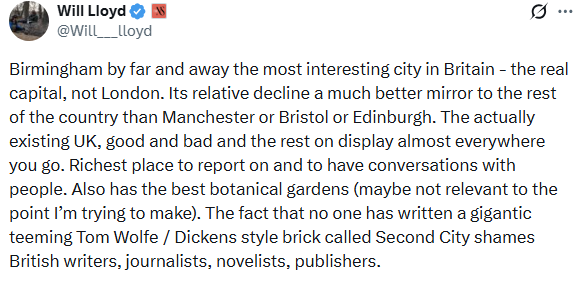
Birmingham’s decay does indeed make it interesting (although it would be very difficult to claim it is beautiful). But as with any attempt to ‘aurafarm’, the only way one can point out the absurdity of the effort is by making the implicit explicit. For those of us who are not full-time scribblers and are mainly interested in the business of making the country a better place to live, this type of curiosity in our national life offers little consolation.
Let’s begin with what was left unspoken: Birmingham is a place that was recorded as less than 50 per cent white British at the last census (42.9%), a number that will have declined further in the five years since. This is far removed from England’s overall figure of 73.5%. The idea that Birmingham can be more representative of Britain, or of a British future, than other cities when the people who live in Birmingham (and especially inner-city Birmingham) are so demographically different from the rest of the country, even by the standards of 2026, is farcical.
To return to Bastani’s claim that Birmingham is ‘vital’, this seems to be supported by the fact that Birmingham has, by some definitions (city-level statistics are always somewhat dubious due to the boundaries being basically artificial), Europe’s most youthful city population, with 40% of its population being 25 and under. The youth population is considerably less white British than the national average, but this is particularly true of Birmingham, where 35% of 16-24 year olds are Asian, and it is from this cohort — very alien to most of the rest of the country — that the phenomenon of Akhmed Yakoob spawned. This demographic repatterning, of course, took place against the express will of the general British public.
Akhmed Yakoob, interviewed for a pre-election documentary last week in a ‘dessert shop’ — a very much foreign institution that serves as a Pakistani halal alternative to the British pub, something which most English people would not be aware exists as a staple in inner-city Birmingham — began with a discussion about Yakoob rising to prominence as a ‘TikTok lawyer’. You could be generous and say that Bastani genuinely had no idea what this actually entailed. Years before Gaza became a contentious issue, Yakoob rose to fame amongst the youth of inner-city Birmingham as the lawyer in the city who could get people off drug charges, driving offences, ‘joint enterprise’ gang charges, and much more. From this, Yakoob has become a celebrity who, admittedly, has a certain charm — much like that of the protagonists of Four Lions — and carries an entourage with him everywhere he goes (which never extends beyond inner-city Birmingham and his house just outside Birmingham, near leafy Aldridge).
The fact that even someone as tuned in to the Birmingham scene as Bastani could not accurately tell you how, exactly, Akhmed Yakoob first came to prominence (or, worse still, actively chooses to hide it) is indicative of the true nature of the city. Other than political obsessives, Yakoob — the man who is objectively the face of the city’s ‘vitality’ — is also completely unknown outside of inner-city Birmingham. This means that the city is far from somewhere that can seriously be considered ‘the real capital’ of England. It should now be clear that an honest conversation about Birmingham first requires us to use language that is less euphemism-laden.
Yakoob building a profile from behaviour which most would see as pro-crime and pro-criminal, and then converting this into significant political capital, is something that the British people as a whole would find utterly reprehensible. The fact that Sadiq Khan is arguably the single most hated politician in all of England speaks to this: the mere perception that Khan does not do enough on crime is enough to make millions upon millions of people froth at the mouth at the mere mention of his name — yet Akhmed Yakoob is the representative of a culture so unknown that even Novara Media’s fans would not be able to explain how he came to be, despite them interviewing him only last week.
One of the things Bastani was most enamoured by was learning that Akhmed Yakoob is, in fact, opposed to the biraderi (i.e., clan-based) method of politics, which Labour used to capture the votes of first-generation Pakistani migrants in Britain. Biraderi (sometimes also spelt Baradari) is the Urdu word for ‘brotherhood’, which in a political context refers to bloc voting that is organised by community elders, who usually then direct people to lend their votes to councillors and MPs who were also selected via kinship ties. During the interview, Yakoob’s right-hand man, Shakeel Afsar, states that his first ancestor to step foot on English soil — his grandfather — could not speak English, but through the biraderi system still knew exactly who to vote for every election day.
Virtually all Britons would be baffled if you asked them what ‘biraderi’ means and what effect it has on politics in Birmingham. And yet, here we have Bastani taking Yakoob’s comments as a huge piece of evidence that the system’s supposed abolition — not for something that the rest of us would recognise, but instead for something which looks suspiciously like the next generation’s version of it, but to the advantage of Yakoob rather than the Labour Party — is proof that Birmingham is showing some kind of ‘vitality’, and is therefore ‘fascinating’. What, exactly, the abolition of tribalistic practices which have not existed in the rest of England for centuries, in favour of new tribalistic practices which also have not existed in the rest of England for centuries, has to do with England in general rather than Birmingham in particular, and how it makes Birmingham ‘vital’, is not explained. The vast majority of Brits would also opt for a far less polite word than ‘fascinating’ if the situation were explained plainly to them.
Bastani’s day out in Birmingham concludes with an interview with a Green council candidate for an area which includes Dudley Road, one of the most notoriously Pakistani-dominated areas of Birmingham. The Green candidate complains of the aggressive leafleting that the Yakoob-backed independents have been carrying out outside of his local mosque, and also complains that they have been homophobic throughout the campaign by ‘exposing’ Polanski’s behaviour and the company which he keeps. His response is to trot out tired (yet familiar) lines about how discrimination against one group means that discrimination against all groups will become inevitable, and so on and so forth.
This interview serves to show just how completely and utterly divorced from the reality of everyday British life the political conversation in Birmingham today truly is. In Birmingham, we have the Green candidate — that is, the same party that partly won in Gorton and Denton through brazenly appealing to Muslims with foreign-language campaign literature — complaining about the conduct of his political opponents near the local mosque, behaviour which all Britons know to be alien (even aside from the religious institution itself being alien). The Green candidate is also aware that the attack line which the Yakoob-backed independents were using is ‘not allowed’. He therefore decides to wave his hand, hoping that an umpire will come and adjudicate for him. Sadly, in twenty-first-century Birmingham, that umpire left the field many years ago and is simply not there.
And, in part, the umpire is also not there because no one really pays attention to what is actually happening in inner-city Birmingham, not least the journalists who have been breathlessly praising the city over the last few days. Because why would you bother? Inner-city Birmingham’s politics is simply foreign to the rest of us, both literally and figuratively. It tells us virtually nothing about the country as a whole — and as the nation discovers what the city has become, it has one resounding answer. Birmingham is not its future: it is the future that the British people are choosing to reject.
This article was written by Christopher Danby Lloyd, a Pimlico Journal contributor. Have a pitch? Send it to submissions@pimlicojournal.co.uk.
If you enjoyed this article, please consider subscribing. If you are already subscribed, why not upgrade to a paid subscription?
I think one of the best examples of the contrast in Birmingham is The Castle & Falcon. A pub and live music venue in what was originally an Irish area, it is now a little enclave of White "alternative" culture in a Pakistani dominated slum. I have heard from women who have been to gigs there how they feel unsafe around the "locals". That would be a more honest exploration of some of the problems with Birmingham than Bastani's interviews.
Good breakdown of the views of Bastani and co.
I don't think these phenomena are very unique to Birmingham though, plenty of other inner cities, suburbs and satellite towns.
Birmingham is interesting in that even more so than other cities it houses some of the most productive and most draining members of the population in very close proximity (although they don't mix much).
Despite all the ‘levelling up’ money that gets thrown at the north in general and Manchester in particular, Birmingham is still larger and richer than the latter; even with the large numbers of often foreign born who are either welfare dependent or work in the black market. An article that explores this dynamic and the other Birmingham - the mostly English, modern industrial, quietly confident, lacking the northern chip on the shoulder Birmingham would be good to see.