
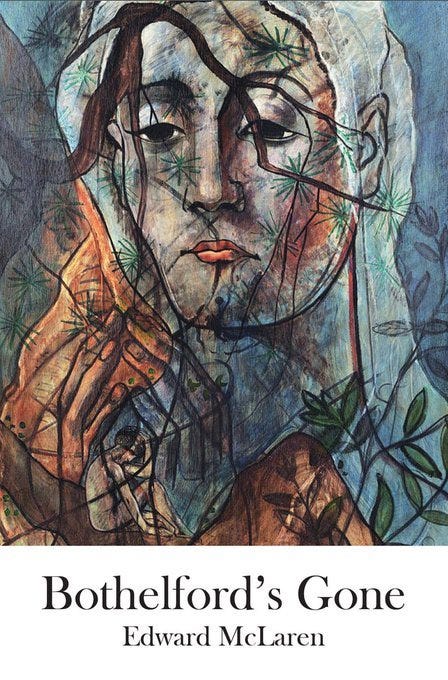
To write poetry after Rotherham is barbaric, Adorno might have said. The debut novel Bothelford’s Gone by Edward McLaren, published in January 2026, is the second, to my knowledge, attempt at fictionalising the grooming gangs, following Roger Scruton’s 2015 novel The Disappeared.
The protagonist is Jack, who grows up in the fictional deindustrialised and demoralised Northern town of Bothelford. At secondary school age, he discovers that his classmate Agatha has been repeatedly raped by a gang of Muslim men led by Mr Hussein, Agatha’s English teacher.
McLaren’s novel is explicitly contemporary, with much of the action taking place after lockdown. This is a commendable editorial decision: something would be lost if the novel had taken place a decade or two in the past, since there is still the persistent myth that the grooming gangs operated in a few towns like Rotherham and Telford in the 2000s, rather than occurring across several decades and in virtually every British town or city with a sizeable Pakistani population. Moreover, McLaren is able to imply that the gangs are an ongoing stain on the British nation: that they are likely still in operation or, at least, that their perpetrators have not properly been brought to justice.
Where Scruton attempts to locate the grooming gangs in the collapse of Britain’s Christian culture, McLaren takes a more oblique attitude to explanation, which ultimately falls between two inadequate positions. In places, he refuses explanation at all, treating the atrocities as belonging to a category beyond causation. In this sense, McLaren mirrors certain Jewish thinkers like Elie Wiesel who deny the explicability of the Holocaust. For Wiesel, we should approach the Holocaust like Job, not seeking explanation but bearing witness to an evil that exceeds human comprehension.
At other points, he quietly contradicts this, implying that the gangs are some kind of cosmic consequence of British imperialism. Instead of the gangs being inexplicable, they are considered to be beyond ordinary cause-and-effect. Tellingly, McLaren namedrops Spengler’s Decline of the West, which posits that civilisations have quasi-organic lifecycles, including senescence and death. In this light, the grooming gangs are the symptom of an inexorable historical process. The first chapter provides a quasi-Spenglerian history of the town, narrating that ‘Bothelford was punished for reaping the rewards of empire’ and that Britain is ‘occupied’. Later in the novel, he allows a gang member to tell Jack that ‘…your race conquered my race… Your white race humiliated India and Pakistan.’
The explanatory failure also manifests stylistically. The sentence ‘whatever cells remained in the British imperial lion, now nothing more than a tattered, barely sentient head, were absorbed into the body of the American eagle’ achieves bathos where it strained to be tragic. McLaren reaches for Spengler and lands somewhere near a sixth-form history essay. At times, McLaren’s voice can be shrill. Quotidian problems in Britain, like creeping Americanisms and TikTok-style short-form video, are treated with the same venom as industrialised child rape — as if they are somehow the same symptoms of wider civilisational decline.
Mr Hussein torments Agatha by making her read aloud in class the interracial rape scene in J.M. Coetzee’s Disgrace, where the white protagonist’s daughter is gang-raped by three black men in post-apartheid South Africa. ‘Drooling’, and with ‘hungry joy’, the teacher implicitly tells Agatha that she deserves what happens to her. The daughter, Lucy, refuses to report the rape, framing her suffering as a kind of historical debt that whites owe black South Africans, which Coetzee treats with studied neutrality, neither condemning nor endorsing Lucy’s decision. For McLaren, England, as personified through Agatha, is cast as Lucy, accepting her rape as a form of colonial reparation. By choosing to make Agatha’s English teacher her tormentor, McLaren captures how Pakistani men in positions of authority were also perpetrators in these crimes.
McLaren is right to point to the almost incomprehensible evil that these gangs have committed, and likely continue to commit. Reading the court transcripts of the Oxford grooming gang — which sexually enslaved and tortured at least 300 underage girls — has forever ruined the City of Aquatint, where I spent my unthinking undergraduate years. However, by making the grooming gangs either inexplicable or the inevitable consequence of civilisational decline, McLaren compounds the mystification surrounding them. Both positions place the gangs beyond human agency. Wiesel developed his views on the incomprehensibility of the Holocaust in response to Hannah Arendt’s controversial Eichmann in Jerusalem. By calling the evil of Eichmann ‘banal’, Arendt did not diminish its horror but reminded us of its human origin. The grooming gangs were not the result of an incomprehensible darkness but a set of real and tangible factors.
For the banal explanation that Arendt demands, we might look to the monograph A Pakistani Community in Britain. Written by the sociologist Alison Shaw, it describes the Pakistani community in East Oxford, which would gain notoriety for the Oxford grooming gang. Shaw identifies two features of Pakistani culture that together explain the gangs’ behaviour. Social life is structured by the baradari, a tightly knit clan network characterised by fierce internal loyalty and an almost complete lack of moral obligations to outsiders. She narrates that, for Pakistanis, ‘…survival lies in strengthening their baradaris, extending the network of people bound to each other and multiple obligations… the baradari network is trusted rather than the system of police or the law.’
Shaw also documents the widespread belief that Western women are ‘regarded as sexually promiscuous’ and that a ‘woman out alone is in effect asking for sexual relations with a man’. According to Pakistani men interviewed by Shaw, rape ‘…is always the woman’s fault, because it is the natural result of a woman dressing provocatively and being out alone.’ The baradari networks made coordinated abuse possible, whilst beliefs that Western women were ‘free game’ supplied the ideological licence. Such an explanation makes this evil intelligible, without ever being forgivable.
A work such as this hangs on its ability to reflect on society: like Upton Sinclair’s The Jungle, it earns its anger only if it is faithful to the reality it condemns. Indeed, in the preface, McLaren declares the work to be ‘a true story for the future’. However, as a novel that aims to provide ‘Caliban’s mirror’ to twenty-first-century Britain, it fails. McLaren’s Spenglerian fatalism elevates the grooming gangs to the realm of the mythic. Myths demand archetypes rather than particulars, and this preference for the mythic over the real corrupts the novel at the level of detail.
We are told that ‘Ferraris and Lamborghinis’ pick up students from the school gates, despite Bothelford being a supposedly normal Northern town. Oddly, McLaren makes one of Agatha’s tormentors an Alawite who shops at Harrods, using the wealthy culturally-assimilated Muslim as a rebuke against the myth of integration, despite the real-life gangs being overwhelmingly Sunni Pakistani. The Alawites, a Shia-adjacent religious group wholly distinct from the Sunni Ummah, lack the baradari system or the clan networks spanning multiple British cities that facilitated the gangs’ crimes. These details substitute an exotic and cinematic evil for the banal truth. More damaging still is his omission of the inter-city trafficking networks that Peter McLoughin describes in Easy Meat. As Shaw documents, baradari networks tend to span several cities in Britain. McLaren omits this crucial aspect, implying that the gang operated exclusively in Bothelford.
These infidelities to the truth have serious political consequences, not just aesthetic ones. The corollary to Arendt’s claim that all evil is intelligible is that it can be made accountable.
This article was written by an anonymous Pimlico Journal contributor. Have a pitch? Send it to submissions@pimlicojournal.co.uk.
If you enjoyed this article, please consider subscribing. If you are already subscribed, why not upgrade to a paid subscription?
I read the fatalism this reviewer criticises to be a fair reaction to the decades of denial, cover-ups, and institutional support for the rape gangs. Why shouldn't the evil be mythologised since it is hard to see it ever being confronted?
The notion that rape of a child is justified as racial reparations is probably the most disgusting thing I have heard so far this year.
Also during Bangladesh's independence war the Pakistani government had institutionalised rape camps and mullahs had issued a fatwa saying that Bengali women are property of the Pakistani state. So any Bangladeshi origin guys who are supporting the Pakistanis should be reminded of this fact.