
Who’s worse: the people who tried to break into Oriel College because they couldn’t bear Nathan Cofnas giving a talk on diversity — or the people who saw a Tory peer lay one hand on a wooden door and thought, Waterloo? On the night, the former, obviously. Ask Paul Bradford, Oriel’s head porter, who was injured protecting the college. But since nobody on the Right is proposing to hang a portrait of the protesters in Hall, let’s have a word about the latter.
In what is now referred to as an emblematic picture of ‘The Siege of Oriel’, two porters have their weight against the door. Behind them stands the smaller frame of Neil Mendoza, Provost, one palm delicately resting on the wood as though he’s been told the paint is nearly dry. ‘Lord Mendoza, provost of Oriel College, holds back the front door’, announced on Twitter the Oxon Universities' Reform Society (OURS), organisers of the conference with Cofnas. Online, AI slop began to drip, with touches of Caravaggio and other types of dramatic baroque lighting, Rembrandt’s clothes here and there, and a reconstitution of the closing of the gates at Hougoumont. I’m all for artistic licence, but when you have to rearrange the limbs of the participants to get the battle scene you ordered, perhaps — shock, horror — it wasn’t Waterloo. (And doesn’t removing the hands from the wooden door put the college at risk of invasion?)
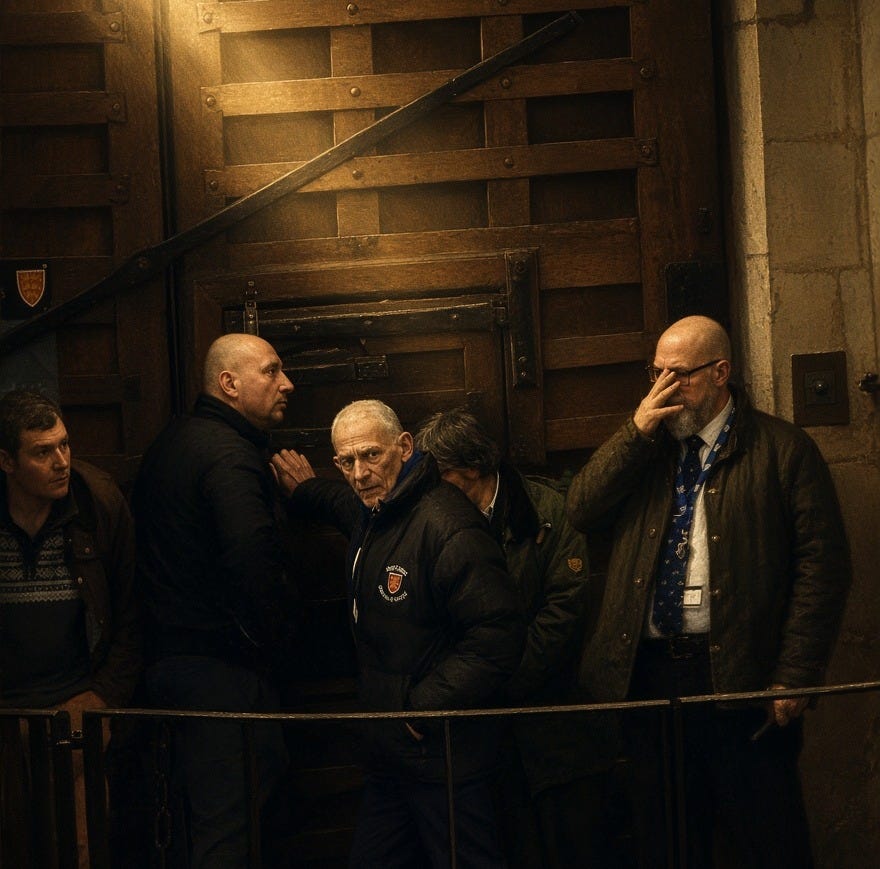
Mendoza let the talk go ahead. Good of him to observe the basic standards of freedom of speech one expects from a head of house. He also had the decency, the next day, to tell the students who’d actually been hurt: the head porter, Paul Bradford. Those who’ve spent time at Oxbridge know that the porters are usually the ones who keep the place standing, dutifully and without fuss. While they were busy holding the door, Mendoza’s admirers were a bit too much in a hurry, mythologising a fabricated hero.
Before Cofnas had even arrived, the Free Speech Union had a letter ready for anyone who wished to thank the Provost. Indeed, why should the people who wanted the talk cancelled have his inbox to themselves? But the thank-you note for Tuesday evening is too eager to turn the ordinary discharge of a Provost’s duties into an act of extraordinary courage; a character reference that doesn’t chime quite right with the rest of his tenure. Anyone who remembers the business with Rhodes would have held off signing.
You might vaguely recall Rhodes Must Fall, either the prologue or its sequel, but are you sure about who won the fight? The decolonialist protest campaign began in Cape Town in 2015, where the university (UCT) took down its statue of Rhodes. Oxford had one too: the mining magnate, imperialist and Oriel College benefactor stood high above the High Street on the front of the building his money had paid for. On 9 June 2020, two days after Edward Colston’s statue went into Bristol harbour, a crowd gathered beneath the little effigy of Cecil Rhodes in Oxford. There were police on the roof. Down below, people knelt and stood on cue. Nearby, the enormous Latin inscription advertising Rhodes’s generosity didn’t trigger many reactions; maybe there are advantages to the decline of classical education after all.
Eight days later, Oriel’s governing body announced that it would like Rhodes removed and appointed an independent commission to look into the matter. An Oriel historian, Robert Beddard, who’d been teaching there ten years before Mendoza turned up as a fresher, made the case for keeping the small statue. His point was a good deal less comfortable than the usual guff about learning from history: what entitled this generation of fellows to decide how much of Oriel’s past the next one should be allowed to inherit? Beddard put his name to that argument. A majority of the submissions to the commission favoured keeping the statue. Yet the governing body still wanted it down, and didn’t care much that the few students from the college who stood up to the crowd got horribly vilified by their peers, harassed and defamed. Quite a few got free lessons in critical race theory poured down their throats, and postcolonial buzz words thrown at them from the ‘cool kids’ on campus. In the midst of a lockdown that trapped everyone in a horrible emotional and psychological doom loop, when the victim of this bullying asked the Provost for support, they found his door firmly closed.
What saved Rhodes was his Grade II* listing. Getting permission would cost a packet, take years, and might not work — winning by bureaucratic KO, if you will. We have the white knights that we deserve. Lord Mendoza, on the other hand, had been swift to declare conflicts arising from his (quite numerous) public appointments, which conveniently recused him from voting on the relevant decisions. Gavin Williamson nevertheless welcomed the outcome as a victory for learning from our past. There is now a plaque beneath Rhodes explaining that the college wanted him gone but had taken legal advice against it. You do wonder what a Tory defeat would have looked like.
But what wasn’t celebrated, and definitely didn’t deserve a FSU-sponsored thank-you note, was all the fine print at the bottom of the contract. You see, for keeping the statue, Mendoza and his board agreed to sacrifice the culture of their College in the long run. The adversaries forced the creation of the office of Tutor for Equality, Diversity and Inclusion, complete with a fellowship and a seat among the trustees. They instituted an annual lecture on colonialism and established a fellowship in French tied to an associate professorship in Francophone post-colonial literatures.
For some of the measures it undertook after the commission reported, the college earmarked a sum equivalent to what remained of the Rhodes legacy — a nice touch. The old boy wasn’t fit to stand on the premises, but he could still pick up the bill. And while conservatives were outside congratulating themselves on the survival of a lump of stone, somebody on the other side had acquired a vote on the management of the College’s internal affairs. Which side would you rather have been on?
Three weeks before the Rhodes protest, Sir Oliver Dowden, as Tory Culture Secretary, had made Mendoza Commissioner for Cultural Recovery and Renewal, a board overseeing a £1.57 billion rescue fund. A CBE for ‘services to arts and culture’ swiftly followed. Keeping theatres alive was certainly worth doing. But the Government’s own evaluation estimated that between 60 and 70 per cent of organisations receiving funding would probably have survived without it, albeit some only by shedding staff. Not quite the resurrection of Lazarus, then. The Public Accounts Committee also discovered that some successful applicants were being asked to produce milestones for their diversity plans before receiving their money. Yet again, this time with Mendoza’s blessings, the Conservatives spent a fortune rescuing the cultural establishment that hates them, without troubling it to reconsider much of anything at all.
Labour subsequently found Mendoza a seat on its Soft Power Council. ‘We leave our soft power assets lying around’, he told Oriel, participating eagerly in that old Tory tradition of spewing meaningless platitudes rooted in vacuous concepts plucked from the pointless musings of 90s political science departments. The British ‘soft power’ Council doesn’t ‘lack oomph’, as its members recently whined; it simply should have never existed in the first place.
As with all ceremonial and empty things, it gets better with a bit of fizz. The Council spent £7,257.73 on its first meeting and £8,094 on a reception to mark its launch. Asked on 6 November when it would meet again, the Government said: ‘in the coming months’. Perhaps a gala, this time, to celebrate the miles run?
Mind you, Tories understand the importance of appointments perfectly well when the appointment matters to them. Simone Finn, Michael Gove’s ex-girlfriend, served with Francis Maude on his Cabinet Office board, imposing parity on new public appointments, and went on to be Boris Johnson’s deputy chief of staff. When Mendoza took his seat in the Lords, Finn walked him in. When Gove took his, there she was again, with Ed Vaizey on the other side. In between, the Conservatives had found Mendoza a job chairing Historic England. So the next time a Tory asks, rather plaintively, how it is that the Left got hold of all our cultural institutions, somebody might ask him who he thinks was making the appointments. The Left didn’t put Neil there.
It’s not just Tory Lords who found themselves gifted new relevance which outlived the fall of their government. Henry Newman, one of Gove’s and Boris’s key advisers, one of the last Boriswave deniers and staunch defender of keeping Priti Patel on the front bench to avoid internal race wars, went on to become Kemi Badenoch’s chief of staff. At dinners and soirées, the usual suspects, tailed by status-obsessed mean girls of the Sarah Vine type, continue to party with a delighted sense of duty — that of the inner group’s preservation. The Conservatives would like us to draw a line under their catastrophic 14 years of governance: a tad difficult to do whilst so many of them continue to amass honours and positions for their very participation in it.
But, not to worry, the Tories aren’t forgetting all their good traditions. Of course, class snobbery remains a particular delicacy for members of the old gang, to whom it matters enormously who’s brought through the gates and into the room - especially if they’re unwilling to pledge blind allegiance. The most revealing part of Mendoza’s letter after the talk wasn’t the lines about freedom of speech, but the reminder that Oriel itself hadn’t invited Cofnas: the students had. Quite so, my Lord. What an agreeable arrangement for someone to be, when convenient, the man who stood up for Nathan Cofnas’ right to speak and, the next minute, thank heavens, not the sort of man who’d actually ask him to do so.
Mendoza, once a reportedly louche member of the Piers Gaveston Society, knows all too well that the principal danger of an Oxford gathering, even more so when things are genuinely tough and require some spine, is being held responsible for the guest list. Among true friends at the peers’ table - where Cofnas is, of course, persona non grata - the scholarly name only appears through affected grins and polite denigration. Perhaps that’s where Lord Mendoza, true patriot, spent the rest of his evening. Hard to know — after his five-minute photoshoot at the Oriel gates, he wasn’t seen again all night.
This article was written by Alma Allen, a Pimlico Journal contributor. Have a pitch? Send it to submissions@pimlicojournal.co.uk.
If you enjoyed this article, please consider subscribing. If you are already subscribed, why not upgrade to a paid subscription?
Quite a garbled, rambling article. No one has ever really suggested that Lord Mendoza is some sort of right-wing firebrand. But by any relative standard, Oriel remains more institutionally conservative than almost any other Oxbridge college. The suggestion that, in exchange for keeping Rhodes, the college has undertaken a wholesale ideological renovation is just incorrect. Like many Pimlico articles, there is an undercurrent of needless bitterness and windmill-tilting in this piece.